CDD and KYC are closely related concepts, but they are not interchangeable. Both help businesses understand who their customers are and whether those customers present financial, compliance, or fraud risks. However, they operate at different levels of the customer risk management process.
In digital services, identity verification provides the technical foundation for both KYC and CDD. Technologies such as document verification, face matching, liveness detection, and ongoing identity monitoring help businesses establish identity remotely and respond when customer risk changes.
1. What Is KYC?
KYC stands for Know Your Customer. It refers to the processes a business uses to identify a customer and verify that the submitted identity belongs to a real person.
During digital onboarding, a typical KYC workflow may include:
- Collecting personal information
- Capturing an identity document
- Extracting document data through OCR
- Checking document validity and authenticity
- Comparing the document portrait with a live face
- Confirming genuine presence through liveness detection
- Screening the customer against relevant databases
The objective is to answer two fundamental questions: “Who is this customer?” and “Can the claimed identity be trusted?”
Face++ capabilities can support the biometric layer of digital KYC. Face comparison determines whether the current user matches the identity document portrait, while liveness detection helps identify printed photos, replay attacks, digital media, and other attempts to impersonate a genuine customer.
2. What Is CDD?
CDD stands for Customer Due Diligence. It is the broader process of understanding a customer, evaluating the risk associated with the relationship, and applying appropriate controls.
CDD generally includes identity verification, but it extends beyond confirming a name, document, and face. A business may also assess:
- Customer occupation or business activity
- Expected account use
- Source of funds
- Geographic exposure
- Ownership and control structures
- Transaction patterns
- Sanctions or politically exposed person status
- Device, behavioral, and account risk signals
CDD therefore asks a wider question: “What level of risk does this customer relationship represent?”
The answer determines whether the customer can proceed normally, requires additional checks, or should be declined. Higher-risk customers may be subject to Enhanced Due Diligence, commonly known as EDD.
3. The Main Difference Between CDD and KYC
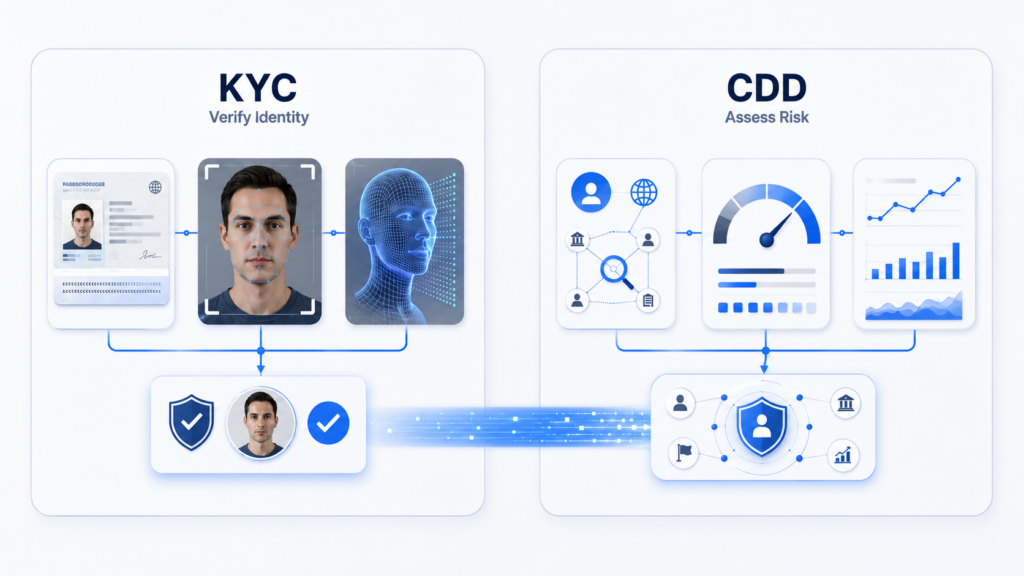
KYC primarily establishes and verifies customer identity. CDD uses identity information together with broader risk data to evaluate the customer relationship.
A practical comparison is:
- KYC focus: Identity
- CDD focus: Customer risk
- KYC question: Is this person who they claim to be?
- CDD question: Is it appropriate to establish or continue this relationship?
- KYC timing: Primarily onboarding and reverification
- CDD timing: Onboarding and throughout the customer lifecycle
In practice, terminology may vary across jurisdictions and organizations. Some businesses use “KYC” as an umbrella term covering identity verification, CDD, screening, and monitoring. In formal compliance frameworks, however, CDD is usually a core component of a broader KYC and anti-money laundering program.
4. How Digital Identity Verification Supports KYC
Digital identity verification converts traditional face-to-face checks into a remote workflow. A customer can submit an identity document and complete a face capture without visiting a physical branch.
A robust workflow should not depend on face similarity alone. A deepfake created from the customer’s portrait may still achieve a high matching score. The system should also determine whether the capture comes from a genuine live person and whether the media has been replayed or injected.
Face++ face verification and liveness capabilities can help businesses build this layered biometric control. Face matching establishes identity similarity, while liveness analysis evaluates facial texture, depth, lighting, motion, and other signals associated with genuine presence.
These results can be combined with document, device, screening, and behavioral information within the organization’s wider KYC and CDD architecture.
5. How CDD Continues After Onboarding
Passing an onboarding identity check does not mean customer risk will remain unchanged. Accounts may be transferred, devices may change, personal information may be updated, and transaction behavior may become inconsistent with the original customer profile.
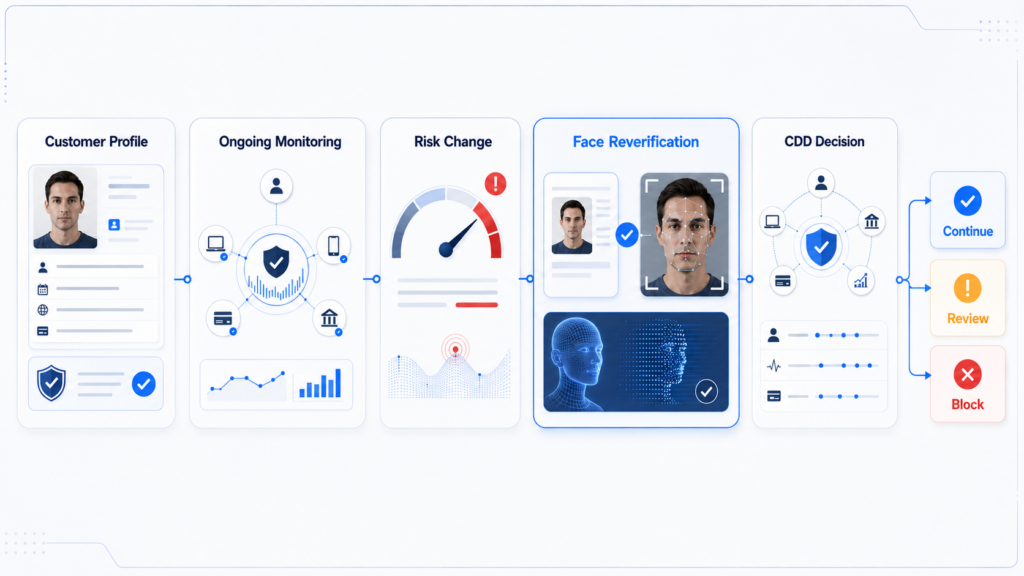
Ongoing CDD monitors these changes and triggers proportionate actions. For example:
- A low-risk customer may continue without interruption.
- A new device may trigger face reverification.
- A major profile change may require document resubmission.
- Unusual transaction behavior may require enhanced review.
- Evidence of account takeover may result in temporary blocking.
Face verification can provide an effective step-up control when risk changes. Instead of repeating the entire onboarding process for every event, businesses can use a live face and liveness check to confirm that the legitimate customer is still in control.
6. Why KYC and CDD Should Work Together
KYC without broader CDD may confirm an identity without adequately understanding its risk. CDD without reliable identity verification may build a risk profile around false, stolen, or synthetic information.
An effective digital identity strategy connects four layers:
- Identity document and data verification
- Face matching and liveness detection
- Customer, device, behavioral, and transaction risk analysis
- Ongoing monitoring and risk-based reverification
Face++ can support the facial identity layer across onboarding and higher-risk customer events. When integrated with document verification, screening, device intelligence, and policy decisioning, these capabilities help businesses create a more complete KYC and CDD workflow.
7. Frequently Asked Questions
Q1. Is CDD the same as identity verification?
No. Identity verification confirms who the customer is. CDD uses that verified identity together with additional information to assess customer risk.
Q2. Is KYC part of CDD, or is CDD part of KYC?
The answer depends on how an organization uses the terms. Operationally, identity-focused KYC checks are often treated as part of CDD. At the program level, KYC may also be used as the broader term covering CDD, screening, and monitoring.
Q3. How does Face++ support digital KYC and CDD?
Face++ supports biometric identity verification through facial analysis, face comparison, and liveness detection. These capabilities can help confirm customer identity during onboarding and provide step-up verification when ongoing CDD detects a higher-risk event.