Digital identity verification often begins with a familiar request: upload an identity document. However, the documents accepted—and the information that must be extracted and validated—vary by country, use case, and risk level.
A scalable verification process must do more than read text. It should identify the document type, extract structured data, assess authenticity, and confirm that the document belongs to the person presenting it. Face++ supports this layered approach by combining identity document OCR with face comparison and liveness detection.
1. Why Document Type Matters
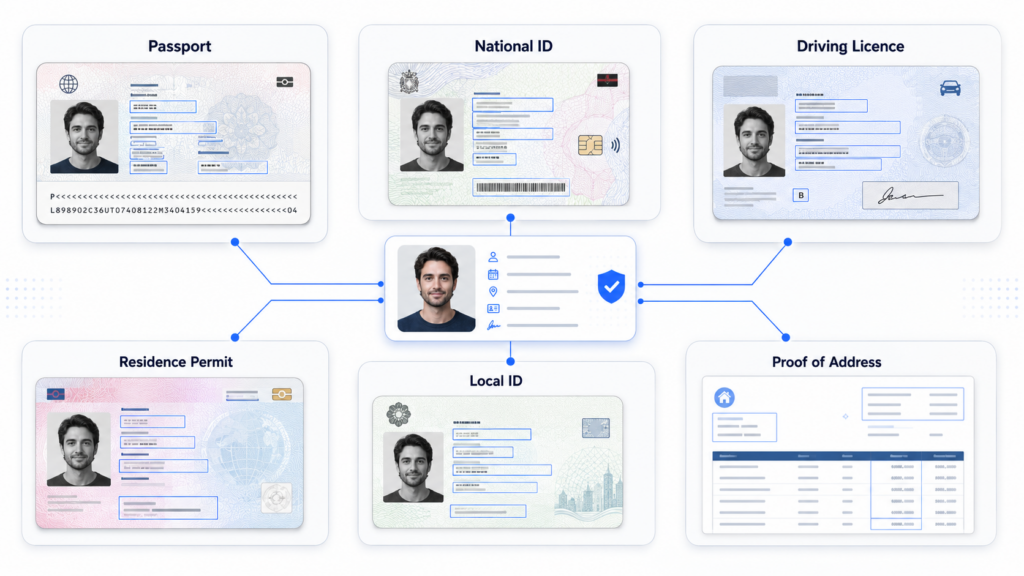
Different identity documents provide different levels of assurance. A passport may support international onboarding, while a driving licence may be useful for domestic identity or address checks. Some documents contain machine-readable zones, barcodes, embedded chips, or security patterns; others rely mainly on printed data and a portrait.
The document type determines:
- Which fields should be extracted
- Which format and consistency rules apply
- Which security features can be inspected
- Whether the document is suitable for the intended transaction
- Which additional identity checks may be required
An effective eKYC workflow should therefore classify the document before processing its contents.
2. Passports
Passports are among the most widely accepted identity documents for cross-border digital verification. They normally include a portrait, full name, nationality, date of birth, passport number, issue and expiry dates, and a machine-readable zone.
A passport verification workflow should compare visible data with the MRZ, check date and numbering formats, inspect document structure, and detect signs of editing, replacement, or recapture.
Face++ OCR can convert passport fields into structured data for onboarding systems. The extracted portrait can then be compared with a live face, while liveness detection helps determine whether a genuine person is present.
3. National Identity Cards
National identity cards are primary identification documents in many markets. Depending on the country, they may include an address, personal identification number, signature, barcode, QR code, or information printed on both sides.
Because national ID formats differ significantly, global businesses need document coverage that accounts for country, version, language, and layout. Validation should also connect the front and back of the same card, ensuring that visible fields, encoded data, and user-submitted information remain consistent.
Face++ helps businesses automate identity document OCR while integrating the resulting data with document, face, and liveness checks.
4. Driving Licences
Driving licences are frequently used for digital onboarding, age checks, account recovery, and domestic identity verification. Common fields include name, portrait, date of birth, licence number, address, vehicle categories, and expiry date.
However, a driving licence is not equally suitable for every market or compliance requirement. Businesses should confirm whether it is an accepted identity document for the relevant service.
Readable fields alone are not enough. The workflow should assess expiry status, layout consistency, barcode data, possible manipulation, and whether the portrait matches the current user.
5. Residence Permits and Immigration Documents
Residence permits help verify the identity and residency status of foreign nationals. They may contain a permit number, nationality, date of birth, validity period, immigration category, portrait, and machine-readable data.
These documents often require country-specific processing because their formats and legal functions differ. Platforms should distinguish between identity information and immigration status, applying the appropriate validation rules to each.
For higher-risk onboarding, residence permit checks can be combined with passport verification, Face++ face comparison, and liveness detection to strengthen identity confidence.
6. Voter IDs, Social Security Cards, and Other Local Documents
Some countries use voter cards, tax identifiers, social security cards, or other government-issued documents in identity workflows. Their value depends heavily on local regulation and document design.
Not every government-issued card is a strong photo identity document. Some lack a portrait, expiry date, or robust security features. These documents may work better as supporting evidence than as the sole basis for identity approval.
Digital platforms should define accepted document combinations according to jurisdiction, customer risk, and the action being performed.
7. Proof-of-Address Documents
Utility bills, bank statements, government letters, tax documents, and tenancy records are commonly used to verify an address. They are supporting documents rather than primary photo IDs.
A proof-of-address workflow should extract and normalize the customer’s name, street address, city, postal code, country, issuer, and document date. These fields should then be compared with the user’s profile and primary identity document.
Businesses should also check document freshness, visual manipulation, and inconsistencies between the claimed address and other risk signals.
8. From OCR Extraction to Identity Verification
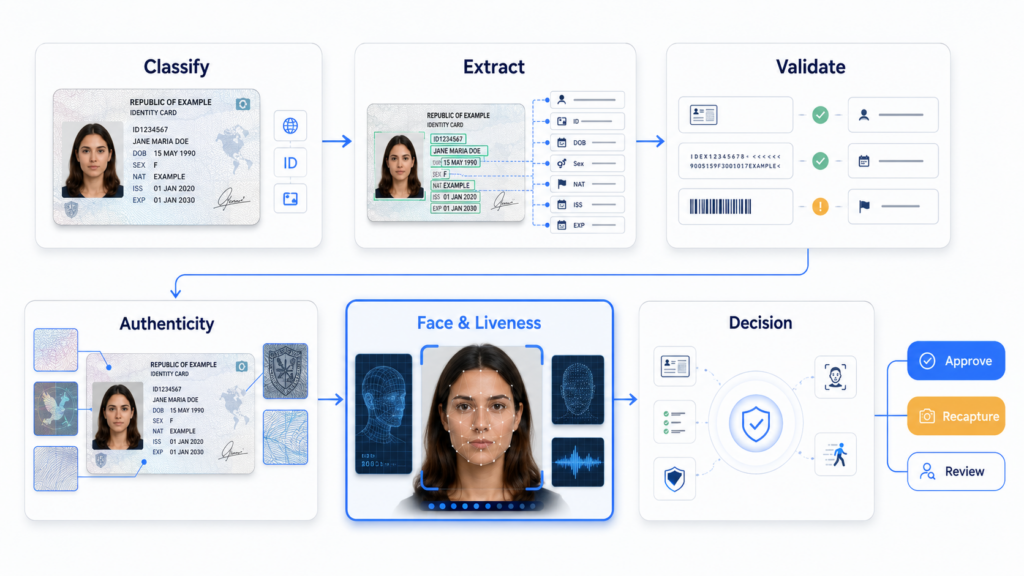
Document OCR answers: “What information appears on this document?” It does not independently answer: “Is the document genuine?” or “Does it belong to this user?”
A stronger workflow combines several layers:
- Document classification: Identify the country, type, and version.
- OCR extraction: Convert visible fields into structured data.
- Consistency validation: Compare fields across the document, MRZ, barcode, document back, and user input.
- Authenticity analysis: Inspect layout, security features, image replacement, editing, and recapture signals.
- Face verification: Compare the document portrait with the current user using a 1:1 face match.
- Liveness detection: Check that the biometric sample comes from a genuine live person rather than a photo, replay, mask, or injected media.
Face++ allows these capabilities to work as connected identity controls instead of isolated checks. Businesses can apply stronger verification when documents are unfamiliar, risk signals change, or transactions carry greater exposure.
9. Frequently Asked Questions
Q1. What are the most common identity documents used in digital verification?
Passports, national identity cards, driving licences, and residence permits are the most common primary documents. Proof-of-address documents and local government cards may provide supporting evidence.
Q2. Is identity document OCR enough for eKYC?
No. OCR extracts readable information, but readable data does not prove authenticity. Businesses should combine OCR with consistency checks, document fraud detection, face verification, and liveness detection.
Q3. How does Face++ support identity document verification?
Face++ can support structured document data extraction and connect the document portrait to face comparison and liveness detection. This helps businesses verify both the submitted identity evidence and the person presenting it.
Q4. Should every country accept the same document types?
No. Document availability, regulatory acceptance, formats, and fraud risks differ by market. Global platforms need country-specific document policies within a consistent verification architecture.
10. Building a Scalable Document Verification Strategy
A scalable identity verification system should not treat every document as interchangeable. It should recognize the document, understand its fields, apply the correct validation rules, and determine whether additional biometric or risk checks are needed.
By combining identity document OCR, face comparison, liveness detection, and configurable decisioning, Face++ helps digital platforms build more consistent onboarding workflows across document types and markets—without relying on document readability as the only measure of trust.