Device fingerprinting helps digital platforms recognize devices, connect repeated sessions, and identify suspicious changes during onboarding or account access. It can reveal signals such as browser configuration, operating system, network attributes, language, time zone, hardware characteristics, and application environment.
However, a device fingerprint is a risk signal—not proof of identity. Fraudsters may manipulate, rotate, or conceal device attributes to appear as new or trusted users. Effective digital identity verification should therefore combine device intelligence with Face++ face verification, liveness detection, behavioral analysis, and risk-based decisioning.
1. What Is Device Fingerprinting?
Device fingerprinting creates a probabilistic identifier from multiple technical attributes associated with a browser, application, or device. Unlike a login cookie, the fingerprint can help recognize a returning environment even when local storage has been cleared.
Common signals may include:
- Operating system and browser version
- Screen, language, and time-zone settings
- Hardware and graphics characteristics
- Network and IP information
- Installed fonts or browser capabilities
- Application integrity and device configuration
- Emulator, virtual machine, or automation indicators
No single attribute is sufficiently reliable. A fingerprint becomes useful when multiple relatively stable signals are evaluated together and compared across sessions.
2. Common Device Fingerprinting Bypass Risks
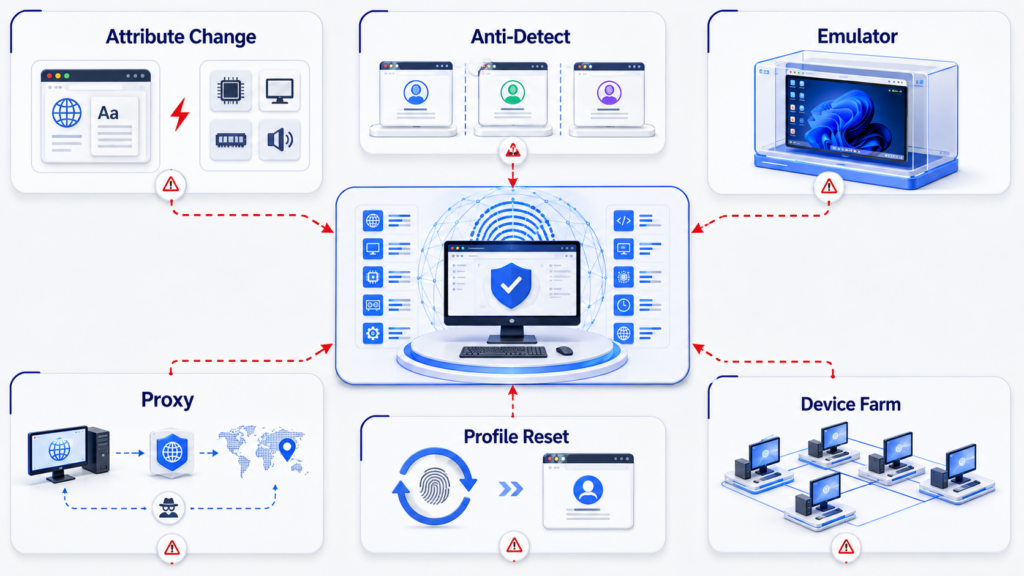
2.1 Attribute Manipulation
Fraud tools may modify browser or device attributes so that the same environment produces different fingerprints. A platform may then treat repeated activity as coming from unrelated devices.
The defensive concern is not one changed value, but an unusual combination of signals. For example, the claimed operating system may conflict with graphics, browser, language, or hardware characteristics.
2.2 Anti-Detect Browsers
Anti-detect browsers are designed to create multiple isolated profiles with different technical attributes. Fraudsters may use them to operate many accounts while making each session appear independent.
Detection should focus on cross-signal consistency, automation patterns, repeated infrastructure, and relationships between devices, identities, and behavior rather than relying only on a generated device ID.
2.3 Emulators and Virtual Machines
Emulators and virtual machines can allow attackers to create, reset, and operate many controlled environments. Some attempt to imitate ordinary consumer devices, while others conceal virtualization indicators.
A low-confidence emulator signal should not always trigger rejection. It should contribute to a broader risk score alongside identity, behavior, network, and account-linkage evidence.
2.4 Network and Location Obfuscation
Proxies, VPNs, and other routing services can change apparent IP addresses and locations. Fraudsters may use them to avoid regional controls or make repeated activity appear geographically distributed.
Platforms should compare IP location with time zone, language, device history, account information, and claimed address. Rapid or implausible changes may justify additional verification.
2.5 Device Reset and Profile Rotation
Clearing storage, reinstalling applications, changing browser profiles, or resetting environments may weaken identifiers that depend heavily on local data.
Resilient systems should use server-side linkage, historical signal comparison, and graph relationships rather than assuming that every newly generated identifier represents a genuinely new device.
2.6 Device Farms and Automation
Device farms use multiple physical or virtual environments to create accounts, collect promotions, test stolen credentials, or scale other abusive activity.
Even when each device appears technically valid, similarities in timing, navigation, identity data, network infrastructure, or facial submissions may reveal coordinated behavior.
3. Why Device Fingerprinting Alone Is Not Enough
Device fingerprints can change for legitimate reasons. Customers replace hardware, update browsers, travel, use privacy tools, or access services from work and home. Aggressive device rules can therefore create false positives and unnecessary onboarding friction.
At the same time, a stable fingerprint does not prove that the person using the device is the legitimate customer. A stolen or remotely controlled trusted device may still appear familiar.
Device intelligence is most effective when used to answer: “How risky is this environment?” It cannot independently answer: “Who is operating it?”
4. Building a Layered Identity Defense
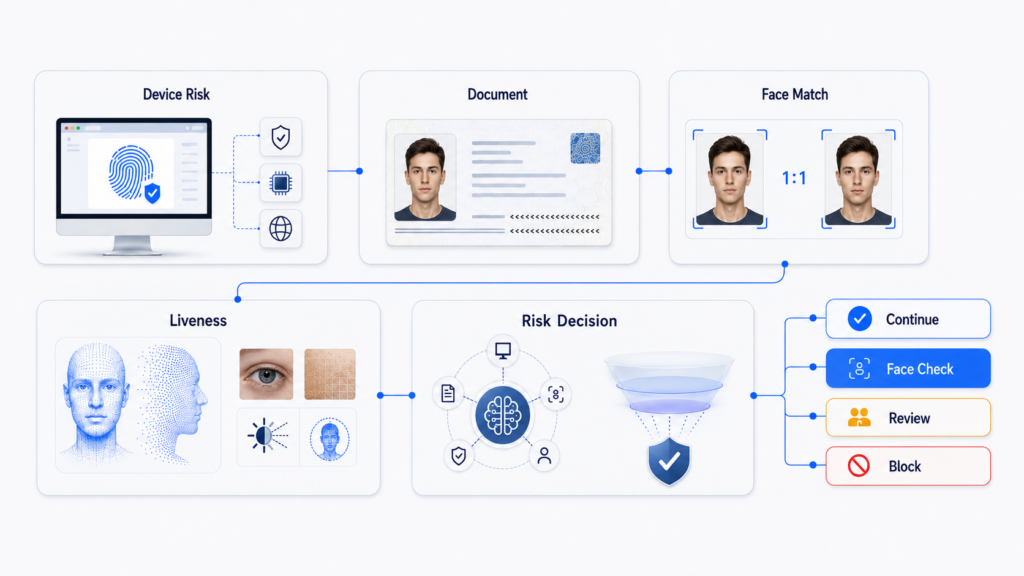
A stronger verification architecture combines several independent control layers.
4.1 Device and Session Integrity
Evaluate fingerprint stability, emulator signals, application integrity, proxy use, location consistency, automation, and relationships with previous sessions.
4.2 Document and Customer Data
Validate identity document information and compare it with the customer profile. Reused contact details, inconsistent addresses, or repeated document data can expose linked fraudulent applications.
4.3 Face Verification
Face++ face comparison can assess whether the current user matches a trusted reference portrait, such as the photograph extracted from a verified identity document.
This creates an identity-binding layer that remains useful even when attackers rotate devices or technical attributes.
4.4 Liveness Detection
A facial match alone cannot confirm genuine presence. Attackers may submit printed photographs, video replays, deepfakes, or injected media created from a real customer’s face.
Face++ liveness detection can help evaluate facial texture, depth, motion, lighting, and other signals associated with a genuine live capture. Combined with secure capture controls, it strengthens resistance to presentation and digital injection attacks.
4.5 Behavioral and Relationship Analysis
Navigation speed, input patterns, repeated workflows, shared infrastructure, and links between devices, faces, documents, and accounts can reveal coordinated fraud that appears normal at the individual session level.
5. Applying Risk-Based Decisions
Not every device anomaly should cause an immediate rejection. A risk engine can combine device, identity, biometric, network, and behavioral signals to select a proportionate response.
A low-risk session may continue without additional friction. A new but otherwise consistent device may trigger Face++ face verification and liveness detection. Multiple conflicting signals may require document reverification or manual review. Strong evidence of automation, identity reuse, or account linkage may justify blocking.
This approach allows trusted users to proceed efficiently while applying stronger identity controls when device confidence falls.
6. Frequently Asked Questions
Q1. Can device fingerprinting uniquely identify every device?
No. Device fingerprints are probabilistic and may change over time. Multiple devices can also produce similar attributes. They should be treated as risk and linkage signals rather than permanent identity credentials.
Q2. Does a new device always mean fraud?
No. Legitimate customers regularly change devices or browsers. A new device becomes more meaningful when combined with unusual location, behavior, account changes, or failed identity checks.
Q3. How does Face++ strengthen device-risk controls?
Face++ supports the biometric identity layer through face comparison and liveness detection. When device confidence is low, these capabilities can help determine whether the current user matches the trusted identity and is genuinely present.
Q4. What is the best defense against fingerprint bypass?
There is no single control. The strongest approach combines device intelligence, secure capture, Face++ facial verification, liveness detection, document checks, behavioral signals, relationship analysis, and risk-based decisions.
7. Conclusion
Fraudsters may attempt to bypass device fingerprinting by manipulating attributes, rotating environments, hiding location, or distributing activity across multiple devices. Because both legitimate and malicious environments can change, device data should never serve as the sole identity control.
By combining device intelligence with Face++ face verification and liveness detection, businesses can bind technical sessions to genuine users and apply stronger checks when risk signals become inconsistent.