Account takeover has become one of the most damaging fraud threats for digital platforms. Unlike fake account registration, account takeover happens after a legitimate account already exists. The attacker may have obtained the user’s password through phishing, credential stuffing, malware, SIM swap, or social engineering. From the platform’s perspective, the login may appear valid at first: the username is correct, the password is correct, and the session begins like a normal user journey.
This is what makes account takeover difficult to control. Traditional login security often relies on static credentials or one-time verification codes. These methods are useful, but they are no longer sufficient on their own. Attackers can reuse leaked passwords, intercept codes, manipulate devices, or trick users into approving a login. When the risk is high, platforms need a stronger way to confirm that the person attempting access is the real account owner.
Face verification provides that additional identity layer. By comparing a live selfie or video against a trusted facial reference, such as the image captured during onboarding or an existing verified profile photo, platforms can verify the user behind the login—not just the credential presented during the login attempt. This makes face verification especially valuable for high-risk login scenarios where fraud impact is high and user trust is critical.
Why High-Risk Logins Need Stronger Verification
Not every login attempt requires the same level of friction. A returning user logging in from a familiar device, location, and behavior pattern may only need a standard authentication flow. But when multiple risk signals appear together, the platform should escalate the verification requirement.
Common high-risk login indicators include a new device, an unusual IP address, a location change, repeated failed login attempts, suspicious session behavior, VPN or proxy usage, a device fingerprint mismatch, or an attempt to access sensitive functions immediately after login. In financial services, e-commerce, social platforms, ride-hailing, online gaming, and digital wallets, these events can quickly lead to unauthorized withdrawals, account abuse, data theft, or reputation damage.
The challenge is balancing security and user experience. Applying strict verification to every login may reduce conversion and frustrate legitimate users. But allowing suspicious logins to proceed with only a password or SMS code creates a major security gap. A risk-based identity verification approach solves this problem by applying stronger checks only when the risk level justifies it.
Face verification works well in this model because it is intuitive for legitimate users and difficult for attackers to bypass when combined with liveness detection and fraud risk controls.
How Face Verification Protects the Login Journey
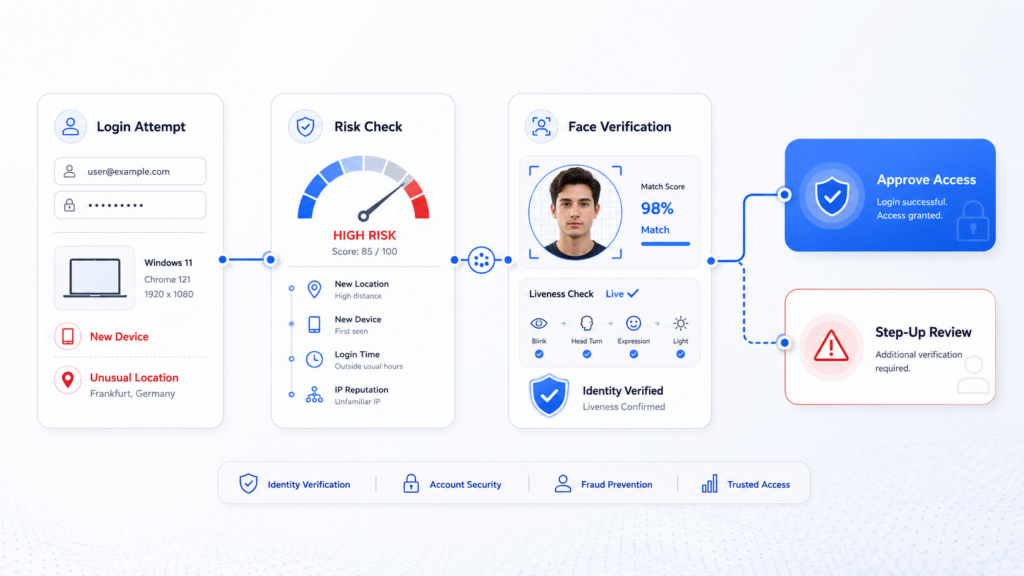
Face verification confirms whether the person attempting to access an account matches the enrolled or previously verified user. In a high-risk login flow, the platform may ask the user to complete a quick selfie or short video capture. The system then compares the live face image with a trusted reference image and returns a match score, confidence level, and verification result.
This process helps answer a critical question: is the person behind the session actually the account owner?
For legitimate users, the experience can be fast and familiar. They are not required to remember additional passwords or recovery questions. For attackers, however, the barrier becomes much higher. Possessing credentials is no longer enough. They must also pass a biometric identity check and prove that the presented face is live, genuine, and not a spoofed artifact.
This is especially important when attackers use stolen credentials to enter an account and then attempt high-value actions. A face verification step at login—or before sensitive actions after login—can interrupt the takeover before real damage occurs.
The Role of Liveness Detection
Face verification becomes significantly stronger when paired with liveness detection. Without liveness, an attacker might attempt to use a printed photo, replayed video, screen image, mask, or synthetic face to pass the verification step. Liveness detection helps determine whether the presented face belongs to a real person physically present during the session.
Modern liveness detection can support both active and passive approaches. Active liveness may ask the user to perform a simple action, while passive liveness can analyze facial, image, and session signals with less visible friction. For high-risk login protection, passive or low-friction liveness is often preferred because it helps maintain a smooth user experience while still improving security.
Liveness detection is also increasingly important as deepfake and injection attacks become more accessible. Fraudsters may attempt to bypass camera-based verification by feeding synthetic media directly into the session. A robust verification framework should therefore assess not only whether the face matches, but also whether the capture source, image consistency, and session environment appear trustworthy.
Where Face Verification Fits in Account Takeover Defense
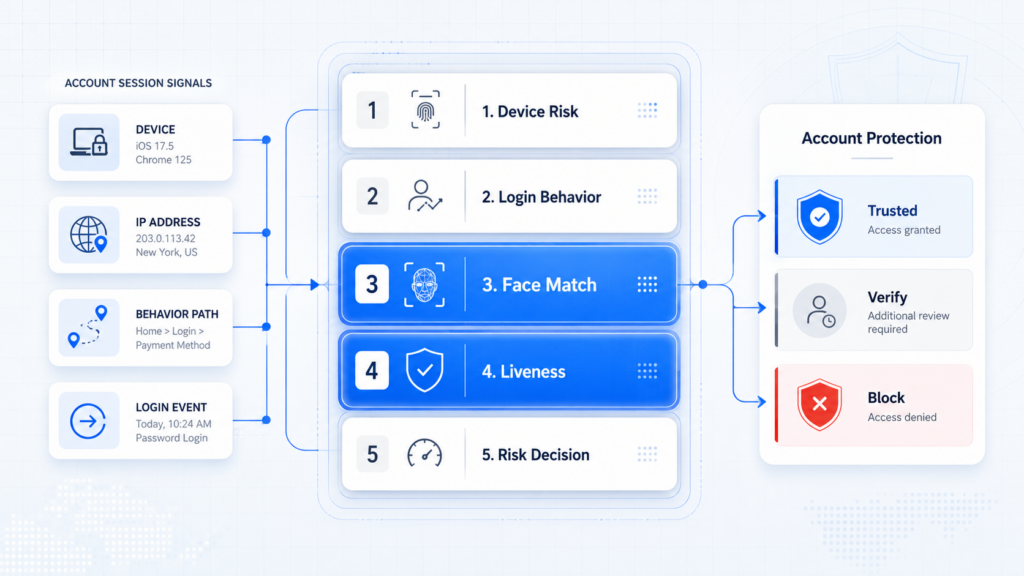
Face verification should not operate in isolation. It is most effective when integrated into a broader risk-based security architecture. Before triggering face verification, the platform can evaluate multiple signals, including device fingerprint, IP reputation, geolocation, behavioral patterns, login history, velocity rules, and account activity.
When the risk score is low, the user can proceed without additional friction. When the risk score is medium, the platform may use step-up authentication such as OTP, device confirmation, or additional checks. When the risk score is high, face verification can provide a stronger assurance that the user is legitimate. When the risk is extreme, the platform may block the session, freeze sensitive actions, or route the case to manual review.
This layered approach allows platforms to protect accounts while avoiding unnecessary verification for normal users. It also creates a more adaptive fraud defense model. Instead of treating all logins the same, the platform makes security decisions based on context.
High-Value Use Cases for Face Verification
Face verification is particularly useful in login scenarios where the cost of compromise is high. For digital banking and wallets, it can protect account access, password resets, new device binding, beneficiary changes, and large withdrawals. For e-commerce and marketplace platforms, it can help secure seller accounts, payout settings, and suspicious order behavior. For social and community platforms, it can protect creator accounts, verified profiles, and accounts with high influence or monetization value.
It is also useful for account recovery. Account recovery is often a weak point in security because attackers may try to bypass normal login controls by claiming they lost access. Face verification can help confirm the original user before allowing password reset, phone number change, or email replacement.
Another important use case is continuous identity assurance. A user may pass login verification but later attempt a sensitive action from the same session. If the session behavior changes or new risk signals appear, the platform can request face verification before allowing the action to continue. This helps prevent post-login abuse, not just suspicious login attempts.
Reducing Fraud Without Increasing Unnecessary Friction
A common concern with biometric verification is user friction. However, the right implementation can make face verification both secure and user-friendly. The key is selective triggering. Platforms should avoid requiring face verification for every login unless their business model demands very high assurance. Instead, they should use risk signals to determine when the additional step is necessary.
Clear user communication also matters. When users understand that face verification is protecting their account from suspicious access, they are more likely to complete the process. The capture flow should be simple, mobile-friendly, and tolerant of normal lighting or device variation. At the same time, the backend system should maintain strict standards for match accuracy, liveness, spoof prevention, and auditability.
For businesses, this creates a practical balance: lower fraud exposure, fewer unauthorized account changes, stronger protection for sensitive transactions, and a smoother experience for trusted users.
Compliance and Trust Considerations
Because face verification involves biometric data, platforms must handle it carefully. Strong privacy controls, data minimization, encryption, access control, and retention policies are essential. Users should know why verification is required and how their data is protected. Businesses should also ensure that their biometric verification process aligns with applicable data protection and industry compliance requirements.
From an operational perspective, audit logs are also important. When a suspicious login is challenged, the platform should be able to record the risk signals, verification result, decision path, and follow-up action. This supports internal investigation, compliance review, dispute handling, and continuous model improvement.
Building a Stronger Defense Against Account Takeover
Account takeover is not just a credential problem. It is an identity assurance problem. Passwords, OTPs, and device checks can help detect suspicious access, but they may not fully confirm who is behind the session. Face verification adds a human identity layer to the login journey, making it much harder for attackers to use stolen credentials or compromised sessions to take over accounts.
For digital platforms, the best approach is not to replace existing authentication methods, but to combine them intelligently. Device intelligence, behavioral risk, login history, liveness detection, and face verification can work together to create a layered defense. When the login is normal, the user experience remains fast. When risk increases, the platform can step up verification before the attacker reaches sensitive actions.
In a digital environment where credentials are frequently exposed and fraud tactics continue to evolve, high-risk logins require more than a password check. Face verification helps platforms protect real users, reduce account takeover losses, and maintain trust across the full account lifecycle.