Verifying a customer during onboarding does not establish whether every subsequent payment is legitimate. A genuine account holder may conduct suspicious activity, while a compromised account may behave differently from its verified owner.
AML transaction monitoring helps financial institutions identify activity that warrants investigation. It evaluates transactions alongside customer information, account history, and relevant relationships—not simply whether a payment exceeds a fixed amount.
Face++ face comparison and liveness capabilities can support identity assurance when account ownership needs to be reconfirmed. They complement transaction monitoring rather than replacing financial-crime analysis.
1. What Is AML Transaction Monitoring?
Anti-money laundering transaction monitoring is the ongoing assessment of financial activity to identify potentially suspicious patterns associated with money laundering, terrorist financing, or related financial crime.
Monitoring may consider individual transactions, activity over time, and relationships across accounts.
The central question is: Is this activity consistent with what the institution knows about the customer and the intended relationship?
An alert identifies activity requiring assessment. It is not proof that money laundering occurred.
Monitoring can involve automated systems, manual controls, or both, depending on the institution’s scale, products, and risk exposure.
2. Transaction Monitoring vs Screening and KYC
These controls serve different purposes:
- Identity verification: Establishes whether the applicant is the claimed person.
- Customer due diligence: Builds an understanding of identity, ownership, relationship purpose, and risk.
- Sanctions screening: Checks relevant parties against applicable restrictions and associated records.
- Transaction monitoring: Assesses financial behavior and patterns throughout the relationship.
Transaction screening may examine payment parties before processing. Transaction monitoring often examines broader activity across time, although the systems can exchange information.
Passing KYC or clearing a screening alert does not make subsequent transactions automatically trustworthy.
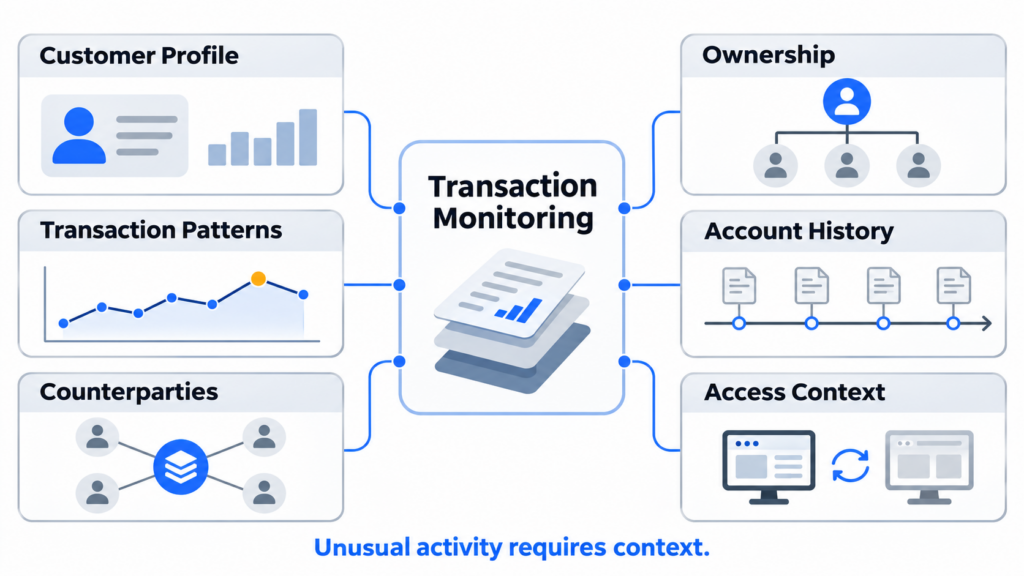
3. What Information Does Monitoring Use?
Useful inputs may include:
- Transaction amounts, frequency, timing, and direction
- Originators, beneficiaries, and payment channels
- Customer occupation or business activity
- Expected account use and source-of-funds information
- Beneficial ownership and related entities
- Account age and historical behavior
- Relevant geographic exposure
- Device, session, and account-access events
Reliable data linkage matters. Duplicate customer records, missing counterparties, inconsistent currencies, and incorrect timestamps can distort analysis.
A monitoring system should understand which records belong together without assuming that every shared attribute indicates wrongdoing.
4. Which Patterns Can Generate Alerts?
Potential indicators include:
- Activity materially inconsistent with the customer’s profile
- Rapid movement of funds without an apparent economic explanation
- Unexpected increases in transaction volume
- Repeated transfers involving connected accounts or common beneficiaries
- Unusual activity following a period of dormancy
- Transactions whose purpose is unclear or inconsistent with the business
- Patterns suggesting attempts to avoid applicable reporting controls
Each indicator requires context. Seasonal revenue, asset sales, family support, or business expansion may explain unusual activity.
Institutions should assess the combined pattern rather than treating one transaction size, location, or account relationship as conclusive.
5. How Detection Systems Work
Institutions may combine several analytical approaches:
Rules and scenarios identify defined patterns based on the institution’s risk assessment.
Behavioral analysis compares current activity with the customer’s history and relevant peer groups.
Network analysis examines relationships among accounts, counterparties, and entities.
Statistical or machine-learning models can prioritize unusual combinations or support alert triage.
No approach eliminates the need for governance. Rules require calibration, models require validation, and investigators need understandable evidence.
Monitoring may run during processing, near real time, or retrospectively. An AML alert does not automatically mean that a payment has been blocked.
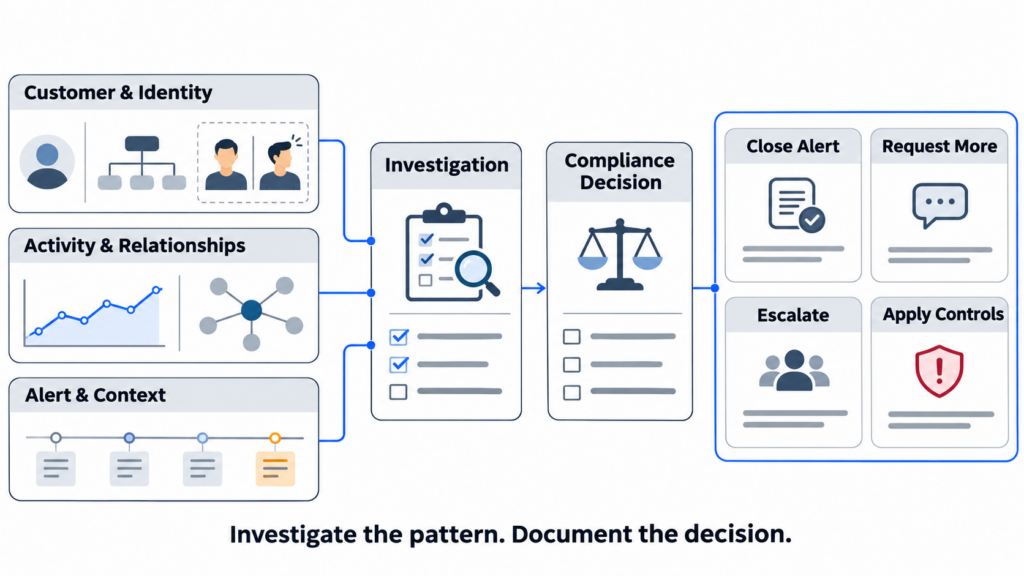
6. From Alert to Compliance Decision
A practical workflow includes:
- Validate the underlying transaction and customer data.
- Consolidate related alerts and relevant account activity.
- Compare the pattern with the customer’s expected behavior.
- Examine counterparties, ownership, and available explanations.
- Obtain additional evidence where appropriate and legally permissible.
- Document the assessment and escalate unresolved suspicion.
- Apply monitoring, account, or reporting actions under applicable requirements.
A suspicious activity report or suspicious transaction report is not a criminal conviction. Reporting terminology, triggers, deadlines, and confidentiality rules vary by jurisdiction.
Customer contact must also account for tipping-off restrictions. Identity reverification or requests for explanations should not be triggered mechanically when they could compromise an investigation.
7. Where Face++ Supports the Workflow
Some alerts raise a separate question: Is the verified customer still controlling the account?
For example, unusual payments may coincide with account recovery, contact-detail changes, or unfamiliar access behavior.
Face++ Face Comparing can compare a fresh facial capture with a trusted reference and provide confidence information for identity assessment. Liveness detection adds evidence of genuine presence, while capture-integrity controls address the acquisition path.
These checks can support risk-based reverification when appropriate. However:
- A facial match does not explain the source or purpose of funds.
- A liveness result does not establish that a transaction is legitimate.
- Successful reverification should not automatically close an AML alert.
Face++ contributes biometric evidence; dedicated monitoring, investigation, and compliance processes determine its relevance.
8. Improving Effectiveness Without Ignoring Risk
High alert volume is not the same as effective detection.
Institutions should review data completeness, scenario coverage, investigation quality, alert aging, repeat activity, and missed-risk findings.
Threshold changes should be evidence-based and tested against relevant risks—not made solely to reduce workload. Quality assurance, independent review, and documented change control help maintain oversight.
Investigation outcomes can improve customer profiles and detection logic, but historical decisions should not be treated as infallible training labels.
9. Frequently Asked Questions
Q1. Does every unusual transaction require a report?
No. Unusual activity requires assessment. Reporting depends on the applicable suspicion standard and legal obligations.
Q2. Is transaction monitoring always real time?
No. Institutions may combine real-time, near-real-time, and retrospective monitoring.
Q3. Can verified customers still generate AML alerts?
Yes. Identity authenticity and financial behavior are different risk dimensions.
Q4. Can face verification replace transaction monitoring?
No. It helps assess identity ownership, not the economic legitimacy of financial activity.
10. Detect Patterns. Investigate Context.
AML transaction monitoring connects financial activity with customer knowledge to identify patterns requiring attention.
Combining reliable transaction data, ongoing due diligence, contextual investigation, and appropriate identity reverification helps institutions make defensible decisions without treating every anomaly as confirmed wrongdoing.