Standard Know Your Customer checks help businesses identify customers, verify identity evidence, understand the relationship, and perform required screening. However, some customers, transactions, ownership structures, and geographic connections create risks that cannot be addressed through routine checks alone.
Enhanced Due Diligence, or EDD, applies additional investigation, approval, and monitoring measures when assessed money-laundering, terrorist-financing, fraud, or compliance risk is higher.
1. What Is Enhanced Due Diligence?
EDD is a risk-based extension of standard Customer Due Diligence. It provides a deeper understanding of:
- Who the customer and beneficial owners are
- Why the relationship or transaction is being established
- How funds and wealth were obtained
- Whether ownership or control is being concealed
- Whether the expected activity is reasonable
- Whether additional monitoring or approval is required
EDD does not mean every higher-risk customer is involved in wrongdoing. It means the business needs stronger evidence and closer oversight before accepting or continuing the relationship.
FATF’s risk-based framework distinguishes simplified measures for lower risk, standard CDD for moderate risk, and EDD where risk is higher.
2. When Can EDD Be Required?
EDD requirements depend on applicable law, regulatory guidance, sector, customer profile, and the organization’s risk policy.
Common triggers include:
- A customer or beneficial owner identified as a PEP
- Connections with higher-risk jurisdictions
- Complex or opaque ownership structures
- Unusual transaction size, frequency, or purpose
- Inconsistent source-of-funds information
- High-risk products, services, or delivery channels
- Adverse media or serious compliance alerts
- Sanctions or watchlist matches requiring resolution
- Non-face-to-face onboarding with elevated fraud indicators
- Material changes during an existing relationship
FATF states that financial institutions should apply enhanced measures where money-laundering or terrorist-financing risks are higher.
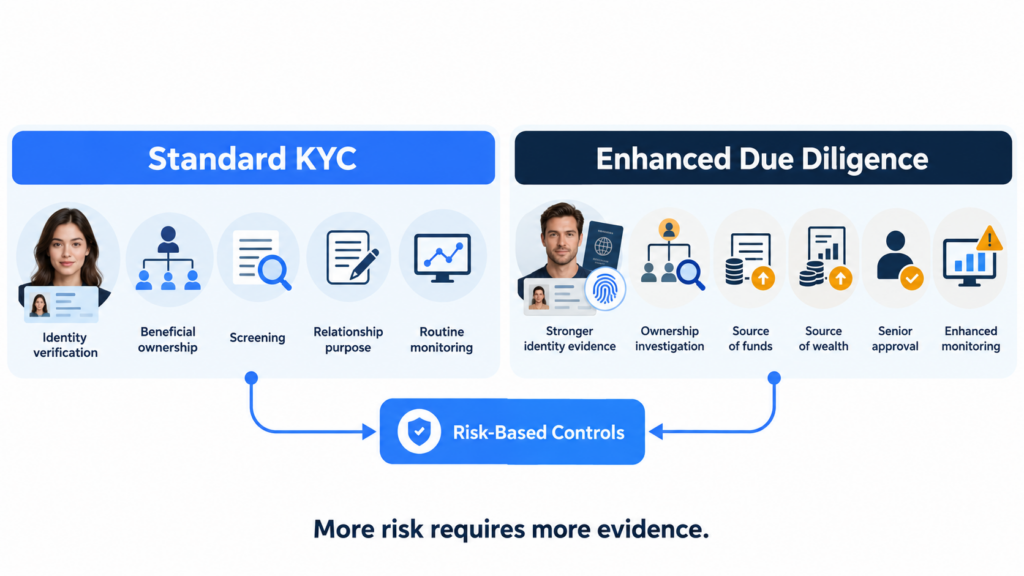
3. Standard KYC vs Enhanced Due Diligence
Standard KYC generally establishes the customer’s identity and initial risk profile. EDD examines higher-risk relationships in greater depth.
| Standard KYC | Enhanced Due Diligence |
|---|---|
| Verify identity | Strengthen identity assurance |
| Identify beneficial owners | Investigate ownership and control |
| Perform routine screening | Resolve alerts using additional attributes |
| Understand relationship purpose | Document economic rationale |
| Assign initial risk | Investigate specific higher-risk factors |
| Apply routine monitoring | Increase monitoring scope or frequency |
EDD should be proportionate to the identified risk. It is not simply a request for more documents without a clear purpose.
4. What Information Can EDD Collect?
Depending on the risk, EDD may examine:
- Additional identity or address evidence
- Occupation, business activity, and expected account use
- Corporate registration and operating records
- Directors, shareholders, and ultimate beneficial owners
- Source of funds
- Source of wealth
- Transaction purpose and counterparties
- Geographic exposure
- PEP, sanctions, and adverse-media results
- Related accounts, devices, or beneficiaries
Source of funds concerns the origin of money used in a particular transaction or relationship. Source of wealth considers how the customer accumulated their overall assets.
For certain higher-risk relationships, FATF measures include establishing source of wealth and source of funds, obtaining appropriate senior-management approval, and conducting enhanced ongoing monitoring.
5. Strengthening Identity Assurance During EDD
Additional compliance information is useful only when it is connected to the correct person or business.
An EDD identity workflow may include:
- Capturing additional identity evidence
- Extracting and normalizing data with OCR
- Validating document authenticity and consistency
- Comparing the current user with a trusted portrait
- Performing liveness and capture-integrity checks
- Checking beneficial owners and representatives
- Connecting identity results with screening and risk evidence
Face++ OCR can support structured data extraction. Face comparison can provide 1:1 biometric verification against a trusted identity portrait, while liveness detection helps assess whether the current sample comes from a genuinely present person.
For investigations into duplicate or linked identities, Face++ 1:N face search may provide additional evidence where legally permitted and appropriately governed.
These capabilities support the identity-assurance component of EDD. Complete EDD also requires screening, beneficial-ownership analysis, source-of-funds checks, compliance decisions, approvals, and monitoring.
6. Resolving PEP, Sanctions, and Adverse-Media Alerts
A screening alert is not automatically a confirmed match.
A reviewer may compare:
- Full name and aliases
- Date and place of birth
- Nationality and residence
- Current or former role
- Corporate relationships
- Beneficial ownership
- Known associates
- Event date and source credibility
EDD should first establish whether the customer is the person described by the record. The business can then evaluate the relevance, severity, timing, and legal implications.
PEP status, adverse reporting, or a similar name should not be treated as proof of criminal conduct. For foreign PEPs, FATF guidance calls for enhanced measures while recognizing the need for investigation and risk-based treatment.
7. EDD Is an Ongoing Process
Risk may change after onboarding. A customer may become a PEP, enter a higher-risk market, change beneficial ownership, alter transaction behavior, or trigger new screening results.
Ongoing EDD can include:
- More frequent customer reviews
- Event-triggered rescreening
- Updated identity and ownership evidence
- Transaction-pattern analysis
- Source-of-funds checks for significant activity
- Face reverification for sensitive events
- Enhanced approval and case documentation
Face++ face verification and liveness detection can support identity reverification when ownership, access, or customer identity becomes uncertain. AML and transaction-monitoring systems must separately evaluate financial and compliance risk.
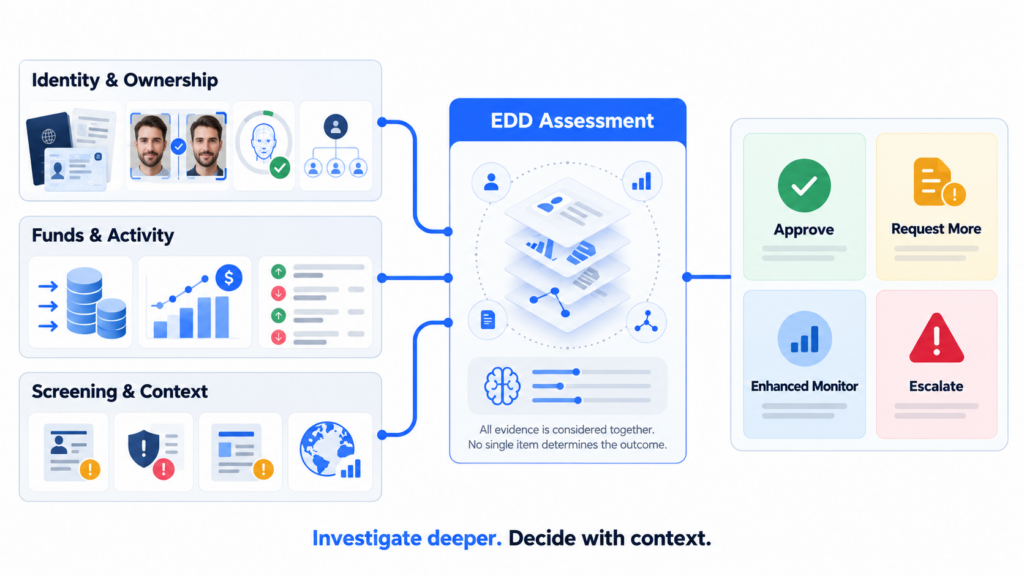
8. Making an EDD Decision
An EDD outcome should reflect the combined evidence rather than one alert or score.
Possible outcomes include:
- Approve with standard monitoring
- Approve with enhanced monitoring
- Request additional evidence
- Escalate for specialist or senior approval
- Restrict particular products or transactions
- Decline or terminate the relationship where required
- Consider regulatory reporting obligations
The business should record the identified risks, evidence reviewed, unresolved concerns, approvals, monitoring plan, and decision rationale.
If relevant CDD requirements cannot be completed, FATF methodology provides that institutions may need to avoid opening or continuing the relationship and consider whether a suspicious transaction report is appropriate.
9. Frequently Asked Questions
Q1. Is EDD required for every customer?
No. Enhanced Due Diligence is generally applied when the assessed risk or applicable regulation requires measures beyond standard KYC.
Q2. Does a PEP match mean the customer must be rejected?
Not automatically. The organization should resolve the match, evaluate the customer’s risk, and apply the controls required by law and policy.
Q3. Can Face++ perform the complete EDD process?
No. Face++ supports biometric identity assurance through OCR, face comparison, liveness detection, and face search. Screening, source-of-funds analysis, beneficial-ownership checks, and compliance decisions require additional systems and processes.
Q4. Why use liveness detection during EDD?
A facial match measures similarity but does not independently prove genuine presence. Liveness detection helps identify photos, replays, masks, deepfakes, and manipulated capture streams.
10. Apply More Assurance Where Risk Is Higher
EDD provides a structured response when standard KYC leaves material questions unanswered. Effective workflows combine stronger identity assurance, ownership transparency, screening resolution, financial investigation, approvals, and ongoing monitoring.
By integrating Face++ OCR, face comparison, liveness detection, and face search with broader AML and risk systems, businesses can investigate higher-risk relationships more efficiently while avoiding decisions based on a single document, alert, or biometric score.