Account takeover (ATO) occurs when an attacker gains control of a legitimate user’s digital account. Unlike new-account fraud, the attacker does not need to create a fake identity. They exploit an account that has already passed registration, identity verification, and possibly KYC checks.
This makes account takeover particularly dangerous. Once inside, an attacker may change security settings, steal funds, access personal data, abuse stored payment methods, or use the trusted account to target other users.
Passwords and one-time codes remain important, but they are no longer sufficient on their own. Digital platforms need layered controls that combine login security, device and behavioral signals, face verification, liveness detection, and risk-based decisioning.
1. What Is Account Takeover?
Account takeover is unauthorized access to an existing account followed by activity performed as if the attacker were the legitimate owner.
The compromise may begin with stolen credentials, but successful takeover usually involves several stages:
- Obtain or bypass login credentials
- Defeat or redirect authentication controls
- Establish a trusted session
- Change recovery or profile information
- Perform high-value actions before detection
ATO can affect banking, payment, lending, e-commerce, gaming, social media, mobility, and other digital services. Any platform that stores value, identity data, payment credentials, or trusted relationships can become a target.
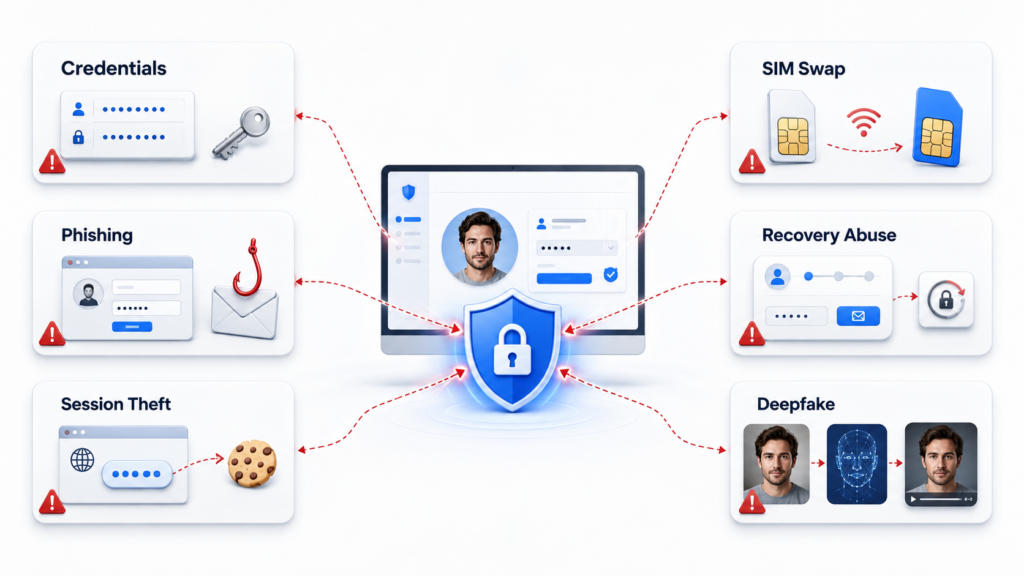
2. Common Account Takeover Methods
2.1 Credential Stuffing
Attackers test username and password combinations exposed in previous data breaches. Because many people reuse passwords across services, credentials stolen from one platform may unlock another.
Rate limits and password policies help, but platforms should also monitor new devices, unusual locations, automated login patterns, and activity that differs from the account’s normal behavior.
2.2 Phishing and Social Engineering
Fraudsters may impersonate a bank, platform, employer, or customer-support agent to persuade users to disclose passwords, one-time codes, or recovery information.
More advanced attacks can direct victims to realistic fake login pages or convince support teams to reset an account. The submitted information may be correct because it came directly from the legitimate user.
2.3 Malware and Session Theft
Malware can capture credentials, intercept authentication data, or steal an active session token. If an attacker obtains a valid session, they may bypass the normal login process entirely.
Platforms should therefore evaluate risk throughout the session, not only when the user signs in.
2.4 SIM Swap and Communication-Channel Compromise
If an attacker gains control of a victim’s phone number or email account, they may receive password-reset links and one-time codes.
Phone or email possession should not automatically be treated as proof of identity for sensitive recovery requests. Face verification can provide an additional identity-binding control.
2.5 Account Recovery Abuse
Recovery flows are often less protected than standard login flows. Attackers may claim that they lost access to a password, device, email address, or authenticator and then manipulate the platform into granting access.
Face++ face comparison can help determine whether the person requesting recovery matches a trusted enrollment portrait. Liveness detection can help verify that the recovery attempt involves a genuine live person rather than a photo, replay, deepfake, or manipulated video.
2.6 MFA Fatigue and Approval Manipulation
Some attackers repeatedly trigger authentication requests until the user approves one accidentally or simply to stop the notifications. Fraudsters may also contact the victim and provide a false explanation for the request.
Unexpected approval patterns, repeated prompts, and immediate high-risk activity should increase the session’s risk level.
2.7 Deepfake and Biometric Spoofing
Where facial verification is used, attackers may present printed photos, replayed videos, face swaps, AI-generated media, or digitally injected camera streams.
Face matching alone measures similarity; it does not prove genuine presence. Face++ liveness detection should therefore be deployed alongside face comparison, particularly during account recovery and sensitive account changes.
3. Warning Signs of Account Takeover
A single unusual event may be harmless. Risk becomes more meaningful when several signals appear together.
Common ATO indicators include:
- Login from an unfamiliar device or location
- Proxy, emulator, or automation signals
- Multiple failed login or recovery attempts
- Password, email, and phone changes in one session
- New beneficiary or payment-method registration
- Sudden withdrawal or transfer activity
- Unusual navigation or transaction speed
- Face mismatch or failed liveness detection
- One device linked to multiple unrelated accounts
These signals should feed a risk engine capable of evaluating their relationships. A new device alone may be low risk, but a new device followed by account recovery, profile modification, and a large withdrawal should trigger stronger controls.
4. How Face Verification Strengthens ATO Defense
Passwords, devices, and behavioral patterns establish whether a session looks familiar. Face verification answers a different question: is the current person the trusted account owner?
Face++ can be integrated as a step-up layer at high-risk moments such as:
- Account recovery
- Password or MFA reset
- New-device activation
- Phone number or email change
- New beneficiary creation
- Large withdrawal
- Suspicious session escalation
A fresh facial capture can be compared with a trusted portrait collected during onboarding or an earlier verified interaction. Face++ liveness detection adds genuine-presence analysis to help identify presentation and digital injection attacks.
Biometric verification should not replace every security control. Its value comes from combining identity evidence with device, network, behavior, transaction, and session context.
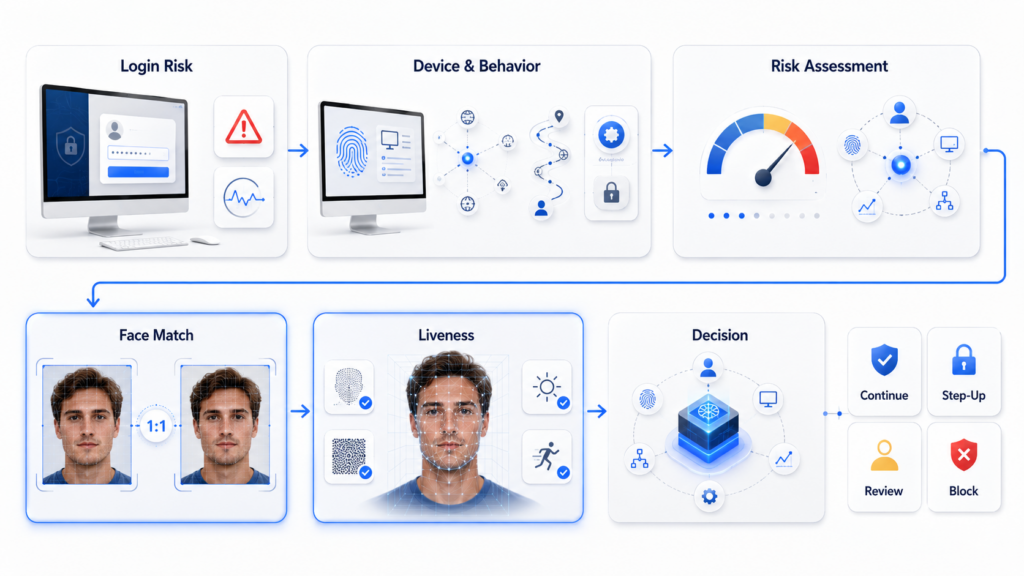
5. Building a Risk-Based Response
Forcing every user through facial verification at every login would create unnecessary friction. A better approach is to match the response to the observed risk.
- Low risk: Continue with standard authentication
- Moderate risk: Request an additional authentication factor
- Elevated risk: Trigger Face++ face verification and liveness
- High risk: Hold the action for review or block the session
Platforms should also protect the period after verification. A successful face check should not authorize every subsequent activity indefinitely. Major changes or transactions may require a new decision based on current session risk.
6. Frequently Asked Questions
Q: Is account takeover the same as identity theft?
No. Identity theft involves misuse of someone’s personal information. Account takeover specifically involves gaining unauthorized control of an existing account. The two often overlap.
Q: Can MFA completely prevent account takeover?
No. MFA reduces risk, but attackers may exploit phishing, SIM swaps, session theft, recovery workflows, or approval fatigue. Layered monitoring remains necessary.
Q: How does Face++ help prevent account takeover?
Face++ face comparison helps confirm that the current user matches a trusted identity, while liveness detection helps verify genuine presence. These capabilities can strengthen recovery and high-risk transaction workflows.
Q: When should a platform trigger face verification?
Face verification is most effective when triggered by meaningful risk changes, such as account recovery, a new device combined with abnormal behavior, sensitive profile changes, or a high-value transaction.
7. Conclusion
Account takeover rarely depends on one weakness. Attackers combine stolen credentials, compromised communication channels, session abuse, social engineering, and weaknesses in recovery workflows.
Digital platforms need equally layered protection. By combining continuous risk monitoring with Face++ face verification and liveness detection, businesses can bind high-risk actions to the legitimate account owner while keeping routine sessions convenient.