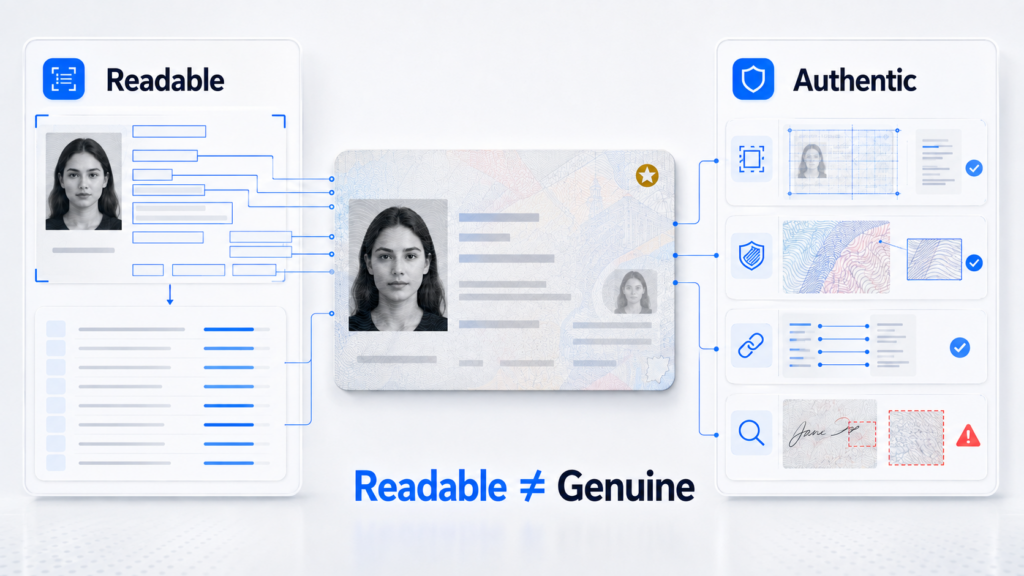
A clear identity document image can create a false sense of security. The name is readable, the portrait is sharp, the document number follows the expected pattern, and OCR extracts every field successfully. Yet none of this proves that the document is genuine.
Modern document fraud is increasingly designed to pass basic capture and OCR checks. Fraudsters can reproduce document templates, replace portraits, edit personal data, generate synthetic documents, or recapture manipulated files from another screen. The result may look clean and machine-readable while containing a completely fabricated identity.
For digital platforms, the key principle is simple: readability confirms data quality; authenticity confirms trust.
1. Readability and Authenticity Measure Different Things
Document OCR determines whether visible information can be extracted from an image. It commonly reads fields such as:
- Full name
- Date of birth
- Document number
- Nationality
- Address
- Issue and expiry dates
- MRZ or barcode data
High OCR confidence usually means the characters are clear and recognizable. It does not mean those characters were issued by a legitimate authority or have not been modified.
Document authenticity analysis asks different questions:
- Does the document follow the correct official template?
- Are fonts, spacing, colors, and field positions consistent?
- Are security features present and plausible?
- Has the portrait or personal information been replaced?
- Do the visible fields match the MRZ, barcode, or document back?
- Was the image captured from a physical document or recaptured from a screen?
A readable fake can therefore receive excellent OCR results while failing authenticity and consistency checks.
2. How Fraudsters Create Readable Fake Documents
2.1 Template Reconstruction
Fraudsters can recreate the visual structure of an identity document using design software or generative AI. They may reproduce the background, portrait area, text fields, and machine-readable zone with enough accuracy to appear convincing in a standard image.
Because the text is deliberately rendered clearly, OCR may extract it more easily than information from a worn or poorly photographed genuine document.
2.2 Field and Portrait Replacement
A genuine document image can be altered by replacing the name, document number, date of birth, address, or portrait. If the editing is clean, every new field remains readable.
Detection therefore requires more than text recognition. Systems should examine font consistency, alignment, compression patterns, image boundaries, and relationships between the portrait and surrounding document structure.
2.3 AI-Generated Identity Documents
Generative AI can produce realistic-looking document layouts, portraits, signatures, stamps, and background textures. Some synthetic documents may contain valid-looking dates and numbers even though no corresponding identity exists.
These documents may not contain obvious spelling errors or blurry fields. Their weakness is more likely to appear in structural inconsistencies, missing security features, repeated patterns, or conflicts between visible and encoded data.
2.4 Screenshot, Printout, and Recapture Attacks
Instead of submitting a manipulated digital file directly, a fraudster may display it on another screen or print it before capturing it again. This recapture process can conceal editing traces and make the submission appear more like a camera image.
Detection should inspect reflections, screen patterns, unusual lighting, paper edges, color reproduction, and other capture-context signals.
2.5 Genuine Document Misuse
Sometimes the document itself is real but belongs to another person. OCR and document authenticity checks may both pass because the document is legitimate.
This is why document verification must be connected to biometric identity verification. A current facial capture should be compared with the document portrait, and liveness detection should confirm that a genuine person—not a photo, replay, deepfake, or injected video—is present.
3. What Businesses Should Validate Beyond OCR
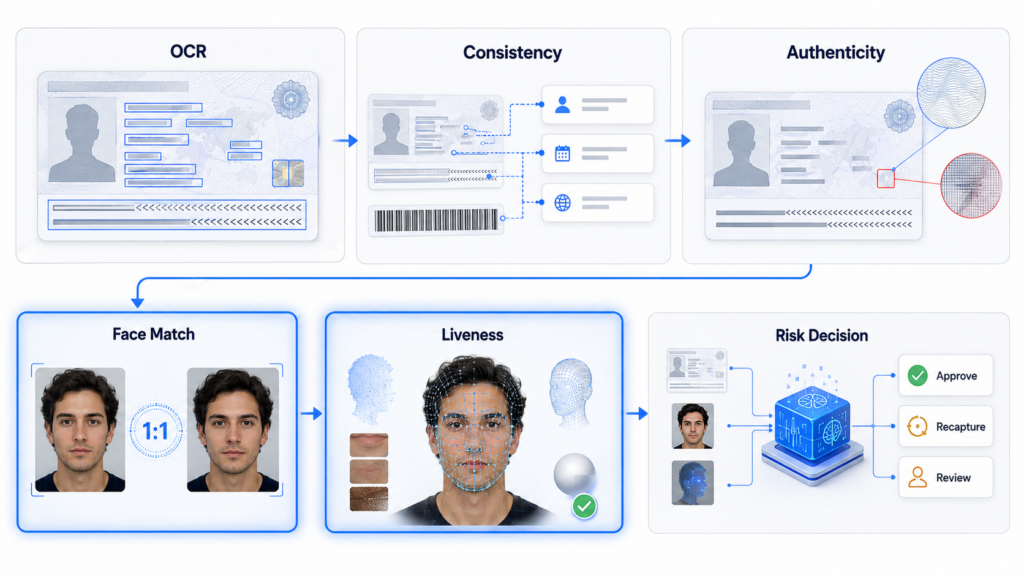
A strong eKYC workflow should apply several validation layers.
3.1 Capture Integrity
The system should first assess whether the submission came through an expected capture channel. Screenshots, virtual cameras, manipulated uploads, repeated images, and recaptured media may require rejection or additional checks.
3.2 Document Structure
The submitted document should be compared with the expected design for its country, type, and version. Field positions, fonts, colors, proportions, portrait zones, and machine-readable areas should follow known rules.
3.3 Cross-Field Consistency
Extracted information should be checked across all available sources:
- Visible front-side fields
- Document back
- MRZ
- Barcode or QR code
- User-entered information
- Existing customer profile
A document may be readable but still contain conflicting dates, names, document numbers, or encoded values.
3.4 Document Authenticity
The system should analyze signs of editing, image splicing, portrait replacement, synthetic generation, missing security features, and other manipulation traces.
No single signal should determine the result. Multiple weak inconsistencies may collectively indicate a high-risk document.
3.5 Face Match and Liveness
Face++ face comparison can help establish whether the current user matches the portrait on the identity document. Face++ liveness detection adds another layer by checking whether the facial capture represents a genuine live presence.
These biometric controls are especially important because document authenticity alone cannot prove that the person presenting the document is its legitimate owner.
4. Why Layered Verification Produces Better Decisions
Document verification should not operate as a collection of isolated pass-or-fail checks. OCR, authenticity analysis, face matching, liveness, device intelligence, and session signals should contribute to a unified risk decision.
For example:
- A readable document with consistent fields and a successful face-and-liveness check may be approved.
- A blurred but potentially genuine document may be routed to recapture.
- A readable document with an MRZ mismatch may require review.
- A valid document presented by a different person should be rejected.
- A document submitted through a suspicious digital injection channel may require stronger verification even if its visual content appears authentic.
This risk-based approach improves fraud detection without rejecting every imperfect document or forcing every customer through unnecessary friction.
5. Frequently Asked Questions
Q: Does successful OCR mean an identity document is valid?
No. OCR confirms that information can be extracted. It does not confirm that the document was officially issued, remains unaltered, or belongs to the current user.
Q: Can a fake document have valid-looking MRZ data?
Yes. Fraudsters can generate correctly formatted MRZ strings. The system must compare encoded data with visible fields and evaluate checksums, document structure, and authenticity signals.
Q: Why use Face++ after document verification?
Face++ face comparison connects the document portrait to the current user, while liveness detection helps confirm genuine presence. Together, they address identity ownership risks that OCR and document analysis cannot resolve alone.
Q: Should every suspicious document be rejected immediately?
Not always. Poor lighting, camera quality, or document wear can create false warning signals. A risk-based workflow can request recapture, trigger biometric step-up verification, or route uncertain cases to manual review.
6. Conclusion
A readable identity document is not necessarily an authentic one. OCR is essential for data extraction, but it must be combined with capture integrity, structural analysis, cross-field validation, document authenticity checks, and biometric identity binding.
By integrating document verification with Face++ face comparison and liveness detection, digital platforms can determine not only whether identity data is readable, but whether the document is trustworthy and belongs to the person presenting it.