Proof of address helps a business determine whether a customer is connected to the residential or business address they have declared. It may support customer due diligence, account opening, fraud prevention, eligibility checks, and regulatory compliance.
However, receiving a utility bill or bank statement is not enough. Businesses must also evaluate whether the document is acceptable, recent, authentic, internally consistent, and connected to the verified customer.
1. What Is a Proof of Address Document?
A proof of address document is evidence issued by a recognized organization that connects a named person or business with a specific location.
Depending on the jurisdiction and use case, businesses may need to verify:
- Full name
- Residential or business address
- Document issuer
- Issue or statement date
- Account or reference information
- Document completeness and authenticity
The applicable requirements vary by country, industry, customer type, and risk level. FATF establishes risk-based customer due diligence principles, while individual jurisdictions determine the detailed evidence and verification rules.
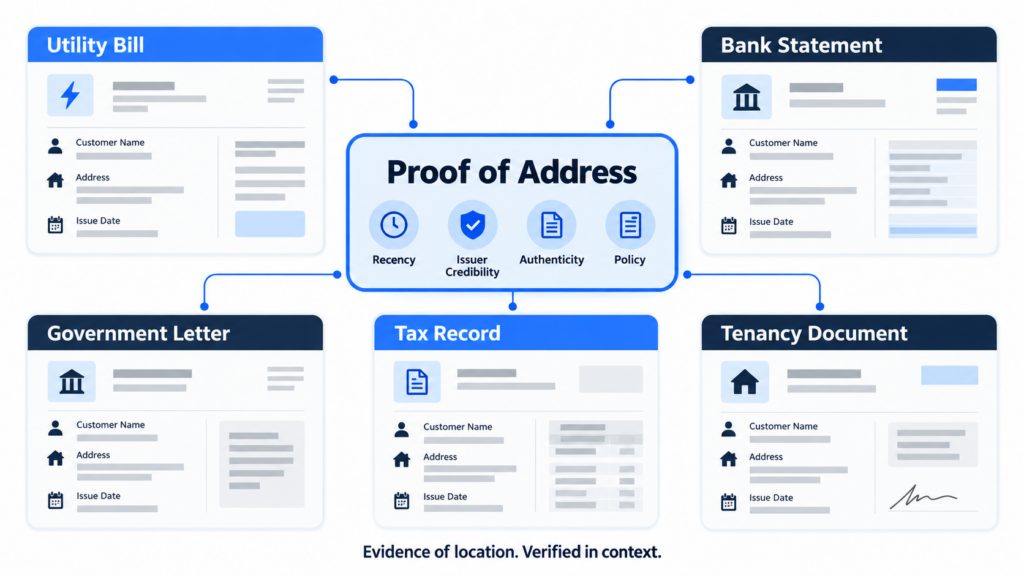
2. Utility Bills
Common utility documents include:
- Electricity bills
- Gas bills
- Water bills
- Fixed-line telephone bills
- Internet or broadband bills
A utility bill should normally show the customer’s name, service address, issuer, billing period, and recent issue date.
Businesses should check whether the document type is permitted under their policy. Mobile-phone bills, prepaid-service records, or bills generated entirely by the applicant may not provide the same level of assurance as established utility accounts.
Warning signs can include altered names, inconsistent fonts, missing pages, implausible account details, or an address that differs from the application.
3. Bank and Financial Statements
Bank, credit-card, mortgage, and certain regulated financial-account statements are widely used because they connect the customer with an independently maintained account.
Useful fields include:
- Customer or account-holder name
- Residential address
- Financial institution
- Statement date
- Partially displayed account reference
- Consistent page and statement formatting
Businesses should not collect more financial information than necessary. Transaction details may be masked when the remaining document still provides sufficient address evidence. UK supervisory guidance, for example, recognizes that redacted transactions may be acceptable when the statement continues to verify the customer’s address.
Downloaded statements should not automatically be rejected merely because they are digital. The business should instead determine whether electronic statements are permitted and how their integrity will be evaluated.
4. Government and Tax Documents
Potential government-issued address evidence includes:
- Local tax bills
- Tax assessments
- Government-benefit correspondence
- Voter-registration records
- Residence certificates
- Official licensing documents
- Municipal or public-authority letters
These documents can provide strong evidence when the issuer is authoritative and the information is current. Nevertheless, acceptance rules differ substantially between markets.
A document containing an address may also be used as primary identity evidence in some jurisdictions. Businesses should prevent inappropriate reuse when their policy requires separate identity and address sources.
5. Tenancy, Housing, and Insurance Records
Businesses may also accept:
- Tenancy or lease agreements
- Mortgage statements
- Property-tax records
- Home or rental insurance documents
- Housing-association correspondence
These documents can be useful when conventional utility accounts are held by another household member. The verification process should assess the named parties, property address, effective dates, signatures where relevant, and credibility of the issuing organization.
Privately created agreements may require additional evidence because they can be easier to fabricate than records independently maintained by a regulated institution or public authority.
6. What Makes Address Evidence Acceptable?
A strong validation process evaluates more than the document category.
Recency
The issue date should fall within the period allowed by the business’s policy. Different document types may have different validity windows.
Name Consistency
The name should correspond with the verified identity after accounting for reasonable abbreviations, transliteration, marriage-related changes, or formatting differences.
Address Completeness
The document should contain enough information to identify a physical residential or business location. A post-office box alone may not establish where the customer resides or operates.
Issuer Credibility
The document should come from a recognized authority, regulated institution, utility, employer, landlord, or another source permitted by policy.
Authenticity and Integrity
Businesses should check for modification, compositing, inconsistent typography, unusual metadata, missing pages, template anomalies, or disagreement between visible and encoded information.
HMRC guidance lists bank statements, utility bills, council-tax records, and comparable official correspondence as possible evidence, while stressing recency and forgery risk.
7. Why OCR Alone Is Not Sufficient
OCR extracts visible information. It does not independently prove that the information is authentic.
A manipulated statement may still produce accurate OCR results. A layered workflow should therefore include:
- Image-quality assessment
- Document-type recognition
- OCR and field normalization
- Template and tampering analysis
- Name and address matching
- Issuer or trusted-source validation where available
- Device and session-risk analysis
- Escalation for uncertain evidence
Face++ OCR can support structured data extraction, but document validation and the final acceptance policy require additional controls. Face++ distinguishes OCR from broader document verification, which evaluates authenticity, validity, quality, and consistency.
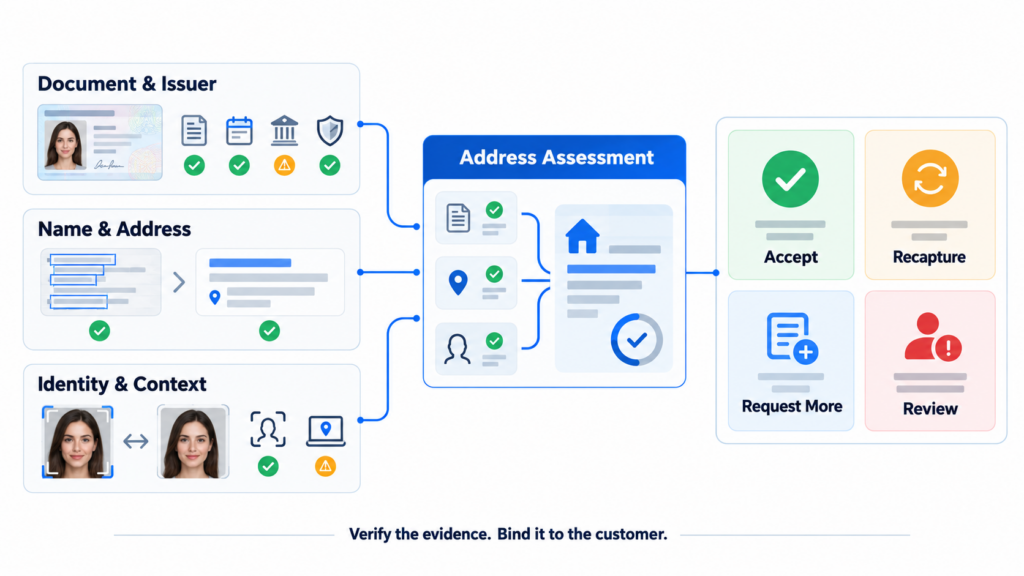
8. Connecting Address Evidence to the Customer
Proof of address verifies an asserted location; it does not necessarily prove who uploaded the document.
A stronger onboarding process can combine:
- Identity-document verification
- Face comparison with the document portrait
- Liveness detection
- Proof-of-address validation
- Device and behavioral signals
- AML and sanctions screening
Face++ face comparison can help establish whether the applicant matches the trusted identity portrait. Liveness detection helps determine whether the facial capture comes from a genuinely present person rather than a photograph, replay, or mask.
These biometric controls strengthen identity binding, but they do not independently confirm that the declared address is accurate. Face++ supports the biometric identity layer rather than validating the address itself.
9. Handling Customers Without Standard Documents
Some legitimate customers may lack conventional address evidence, including recent movers, students, dependants, displaced persons, or people with limited access to financial services.
A risk-based process may allow:
- Alternative government correspondence
- A regulated electronic data check
- A residence certificate
- Verified delivery to the declared address
- Supporting evidence from multiple independent sources
- Manual review with documented justification
Alternative methods should be defined in policy and applied consistently. Lower-risk or limited-function accounts may also use proportionate controls where permitted by applicable law.
10. Frequently Asked Questions
Q1. Which documents are commonly accepted as proof of address?
Utility bills, bank statements, government correspondence, tax records, mortgage statements, and tenancy documents are common examples. Acceptance depends on local rules and business policy.
Q2. How recent should a proof of address document be?
There is no universal period. Many organizations establish document-specific windows, such as several months for statements and longer periods for annual tax records.
Q3. Can an electronic statement be accepted?
Potentially. Businesses should evaluate the issuer, document integrity, delivery method, and applicable regulatory requirements rather than assuming every downloaded document is invalid.
Q4. How does Face++ support proof-of-address verification?
Face++ OCR can extract relevant fields, while face comparison and liveness detection can help bind the submission to the verified customer. Address validation still requires document, issuer, policy, and contextual checks.
11. Build a Layered Address-Verification Process
Reliable proof-of-address verification requires more than locating a name and address on a readable document.
Businesses should assess document eligibility, recency, issuer credibility, authenticity, field consistency, and customer identity together. Face++ OCR, face comparison, and liveness detection can support the extraction and identity-binding layers, while a risk engine combines address evidence with document, device, compliance, and session context.