Face verification and face recognition are often used interchangeably, but they usually describe different biometric tasks. Both technologies analyze facial features, yet they answer different questions and support different business scenarios.
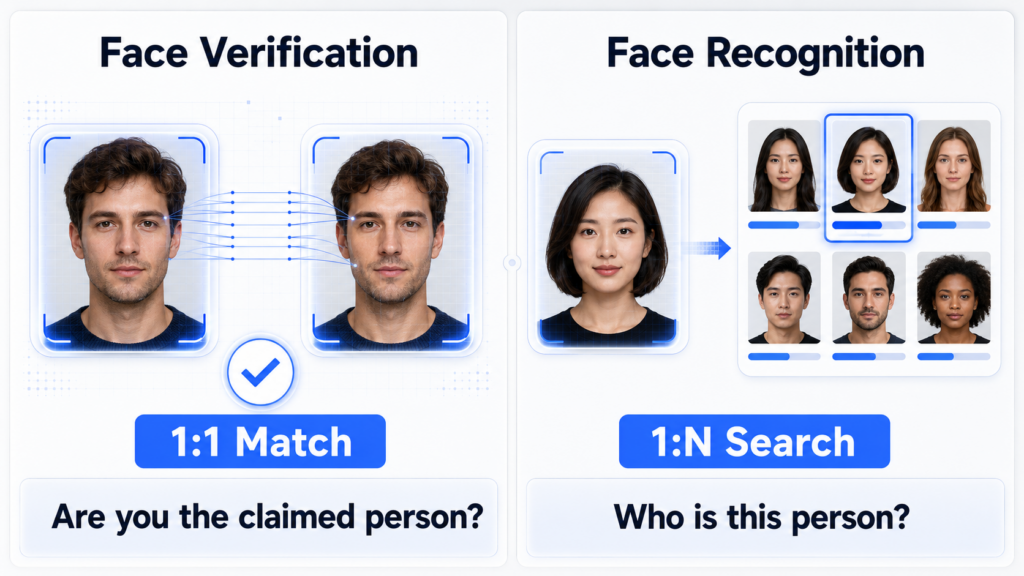
Face verification typically compares one face with one known identity. Face recognition, when used to describe facial identification or face search, compares one face against many enrolled faces.
Understanding this distinction is important when designing digital onboarding, authentication, access control, fraud prevention, or large-scale identity search systems.
Face Recognition as a Broader Category
Technically, face recognition is an umbrella term for technologies that detect, analyze, compare, or identify faces. It can include both face verification and facial identification.
However, in commercial and operational discussions, “face recognition” often refers specifically to one-to-many identification. This article uses that common distinction:
- Face verification: One-to-one comparison
- Face recognition: One-to-many search
The key difference is not simply the facial algorithm. It is the question the system is trying to answer.
What Is Face Verification?
Face verification determines whether two facial images belong to the same person.
The system compares a newly captured face with a specific reference image. That reference may come from an identity document, an account enrollment record, or a previously verified customer profile.
The process answers:
“Is this person who they claim to be?”
A typical verification workflow includes:
- The user claims an identity
- The system retrieves the corresponding reference portrait
- A current selfie or facial video is captured
- Facial features are extracted and compared
- The system returns a similarity score or verification result
Because only two faces are compared, face verification is commonly described as a 1:1 match.
Common Face Verification Use Cases
Face verification is suitable when the user’s claimed identity is already known. Typical applications include:
- Remote customer onboarding
- Identity document verification
- Account login
- Account recovery
- Password reset
- High-value transaction approval
- Sensitive profile changes
- Workforce or customer authentication
During eKYC, for example, the system compares the customer’s current face with the portrait extracted from an identity document. A successful match helps establish that the applicant is connected to the submitted credential.
What Is Face Recognition?
Face recognition, in the narrower identification sense, searches for a captured face within a database of enrolled faces.
The system answers:
“Who is this person?”
Instead of starting with one claimed identity, it compares the probe face against multiple candidates and returns the most similar matches. This is known as a 1:N search, where “N” represents the number of faces in the database.
A typical recognition workflow includes:
- A face is detected in an image or video
- The system extracts a facial template
- The template is searched against an enrolled database
- Candidate matches are ranked
- The system returns one or more possible identities
Recognition does not always produce a definitive identity. Depending on image quality, database size, thresholds, and similarity between candidates, human or secondary-system review may still be required.
Common Face Recognition Use Cases
One-to-many recognition is used when the person’s identity is unknown or when the system needs to find duplicates across a population. Applications include:
- Duplicate-account detection
- Watchlist matching
- Customer lookup
- Access management
- Missing-person search
- Photo organization
- Attendance management
- Investigation support
In digital onboarding, face search can help identify whether one person is attempting to register multiple accounts using different identity documents.
1:1 Comparison vs 1:N Search
The operational differences between verification and recognition extend beyond the number of faces compared.
Search Scope
Face verification compares the submitted face with one specific reference. Face recognition searches across many enrolled identities.
As the recognition database grows, search efficiency and candidate-ranking accuracy become increasingly important.
Decision Output
Verification usually produces a similarity score and a pass-or-fail result based on a configured threshold.
Recognition typically returns a ranked candidate list, similarity scores, or a “no match” result. The business system must then determine whether the leading candidate is reliable enough for the intended action.
Accuracy Considerations
A threshold that works for a 1:1 comparison may not be suitable for a large 1:N database. Searching more faces increases the possibility of unrelated people producing similar scores.
Recognition systems therefore need to be evaluated using realistic database sizes, image conditions, demographic diversity, and operational thresholds.
Enrollment Requirements
Verification requires a trusted reference image linked to a known identity. Recognition requires an enrolled database with appropriately collected, organized, and protected facial templates.
The quality of enrollment data directly affects both systems.
Why Liveness Detection Is Separate
Face matching determines whether facial characteristics are similar. It does not automatically determine whether the submitted face comes from a real person who is physically present.
An attacker may present a printed photograph, replayed video, mask, deepfake, or digitally injected stream that closely resembles the genuine user. The face match may be strong even though the session is fraudulent.
Liveness detection addresses this separate question:
“Is the facial input coming from a genuine live person?”
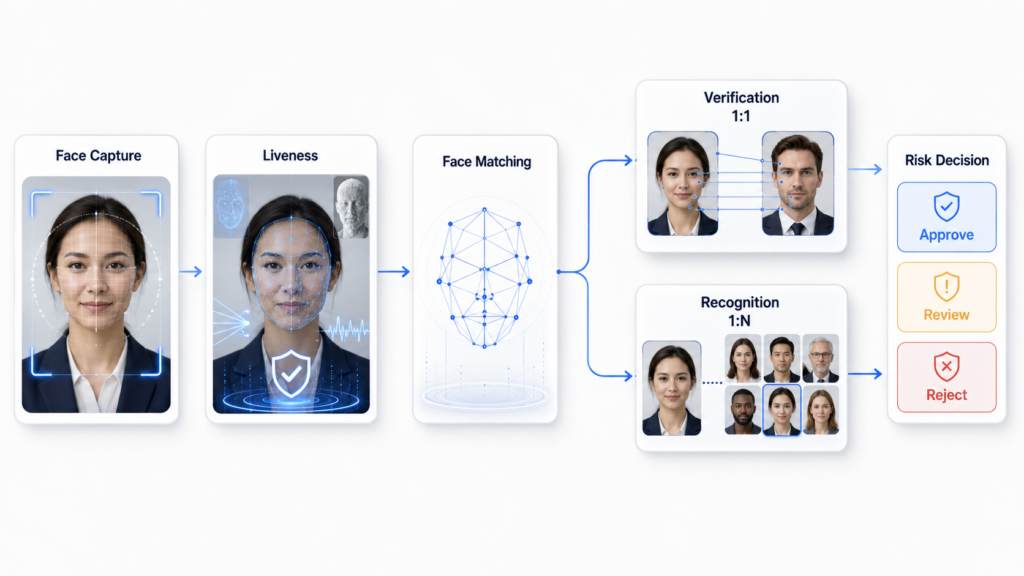
For remote verification, face matching and liveness detection should usually operate together. The system can first confirm that a real person is present and then determine whether that person matches the claimed identity.
Security and Privacy Considerations
Facial biometric data requires strong governance regardless of whether it is used for verification or recognition.
Businesses should define:
- A clear and legitimate purpose
- Appropriate user notice or consent
- Data minimization requirements
- Encryption and access controls
- Retention and deletion policies
- Audit and accountability procedures
- Processes for handling false matches and appeals
One-to-many recognition generally requires additional consideration because it involves searching across a broader population. Organizations should control who can access the database, which use cases are permitted, and what evidence is required before acting on a possible match.
Facial templates should not be treated like ordinary account data. If compromised, biometric characteristics cannot be reset in the same way as a password.
Choosing the Right Technology
The correct choice depends on the business question.
Use face verification when:
- The person claims a specific identity
- A trusted reference portrait is available
- The goal is authentication or identity confirmation
- The desired result is a controlled pass-or-fail decision
Use face recognition when:
- The person’s identity is unknown
- The system must search a database
- Duplicate or related accounts must be identified
- A ranked candidate list is operationally useful
Some platforms may need both. An onboarding flow can use face verification to compare the applicant with an identity document and face recognition to detect whether the same person already exists under another account.
Building a Complete Facial Identity Workflow
Face comparison should be integrated with broader risk controls. A complete workflow may include:
- Secure facial capture
- Image-quality assessment
- Liveness and injection detection
- Face verification or recognition
- Device and session intelligence
- Behavioral risk signals
- Configurable decision rules
- Manual review for uncertain cases
This layered approach reduces reliance on a single similarity score and helps the system respond proportionately to different levels of risk.
Conclusion
Face verification and face recognition use similar biometric foundations but solve different problems. Verification performs a 1:1 comparison to confirm a claimed identity, while recognition performs a 1:N search to identify a person or find related records.
Businesses should select the method according to the operational question, risk level, database structure, and privacy requirements. When combined with liveness detection, secure capture, and risk-based decisioning, both technologies can support more reliable digital identity and account-security workflows.