Digital onboarding used to have a relatively clear security model: collect an ID document, ask for a selfie, compare the face, and approve or reject the user based on the result. For many businesses, this was enough to meet baseline KYC requirements and move customers into the product quickly.
That model is now under pressure.
In 2026, the core challenge is no longer whether a user can upload a document or appear in front of a camera. The challenge is whether the person, video stream, device environment, and identity history can be trusted together. AI-generated faces, deepfake videos, and injection attacks have changed the economics of identity fraud. According to the World Economic Forum, AI can now help criminals automate, personalize, and scale deception globally, while AI-enhanced fraud has become significantly more profitable than traditional cybercrime methods.
For banks, fintech platforms, digital wallets, gaming platforms, crypto services, and online marketplaces, this creates a new onboarding risk: a fraudster may no longer need to steal a person’s face physically. They can generate, manipulate, replay, or inject synthetic facial content into a digital verification flow. Sumsub’s 2026 fraud trend analysis states that deepfakes now account for 11% of global fraudulent activity, while Entrust’s 2026 identity fraud report highlights deepfakes and injection attacks as major biometric fraud risks during onboarding.
This is where face recognition becomes more than a convenience feature. When designed correctly, it becomes a risk signal layer for digital trust.
Deepfake fraud is not just a better fake face
A deepfake attack in digital onboarding usually does not happen in isolation. It is often part of a broader fraud chain.
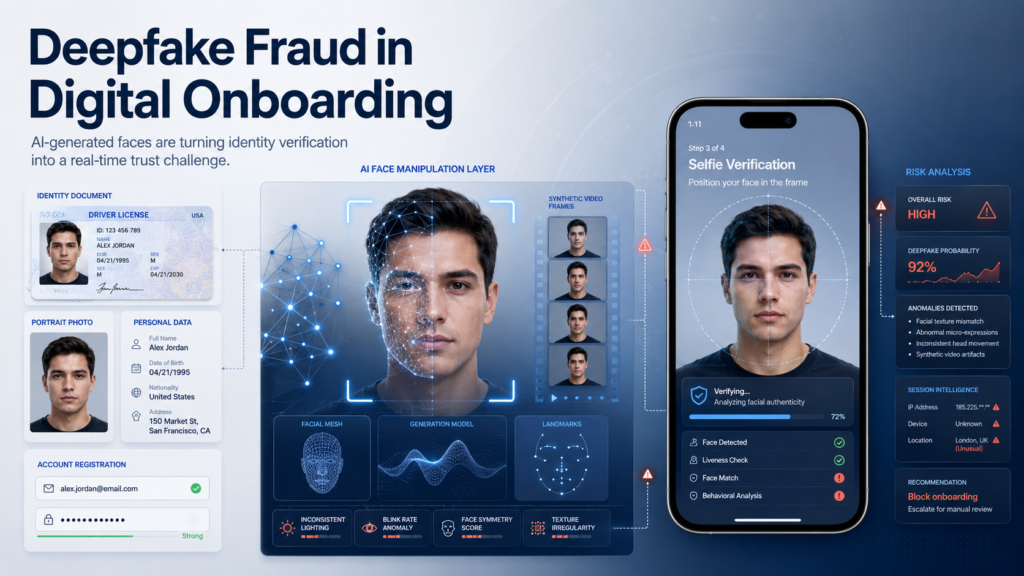
A typical attack may start with stolen identity data: a real name, a government ID image, a portrait photo, or leaked personal information. The fraudster then uses AI face manipulation tools to generate a selfie image or video that appears to match the victim. In more advanced cases, the attacker may inject a synthetic video stream directly into the onboarding session, bypassing the physical camera entirely.
This distinction matters. Traditional spoofing attacks often involved printed photos, screen replays, or masks. Deepfake-enabled attacks are more dynamic. They can simulate facial motion, adjust expressions, and imitate the visual cues that older verification systems expected to see.
Entrust notes that fraudsters often combine deepfakes with injection attacks to simulate legitimate users, making them hard to detect without multi-layered fraud prevention. This means digital onboarding systems need to answer several questions at once:
Is this face the same person as the ID photo?
Is this a real live person, not a synthetic or replayed face?
Has this face appeared across suspicious accounts before?
Does the device, session, and behavioral context match a normal user journey?
Face recognition is not the whole answer. But it is one of the most important inputs.
Where face recognition fits in the onboarding risk stack
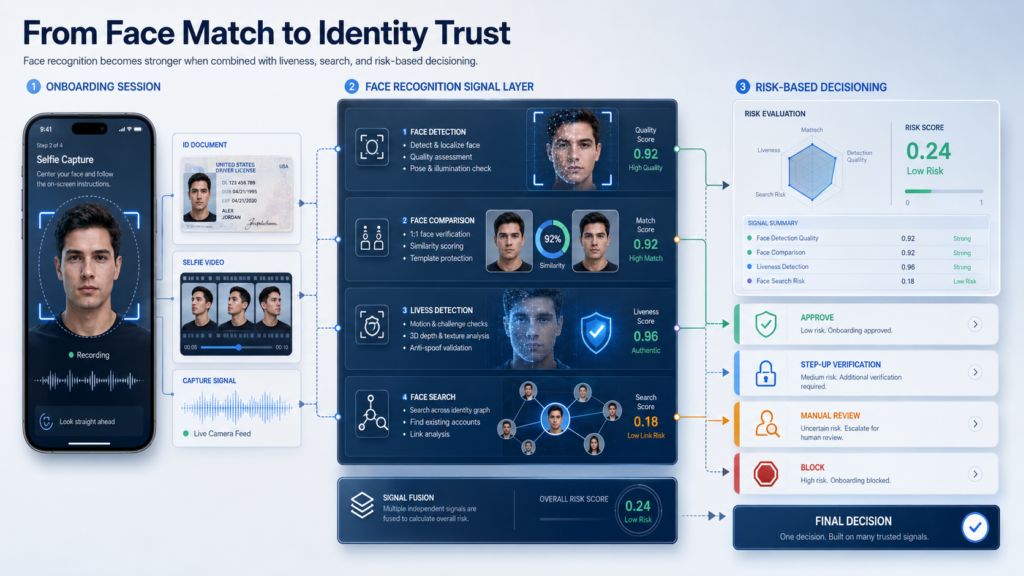
Face recognition helps digital onboarding teams create a structured identity decision from multiple visual signals. It does not simply say “match” or “no match.” A mature system uses face recognition to support risk-based decisioning.
The first layer is face detection. Before any identity decision is made, the system needs to locate the face accurately, assess whether the image is usable, and extract relevant facial features. Poor image quality, extreme blur, unusual angles, occlusion, or inconsistent lighting can all affect verification reliability. This is why image quality assessment should not be treated as a secondary UX detail. It is part of fraud control.
The second layer is face comparison. In a standard KYC flow, the user’s live selfie or video frame is compared with the portrait on the submitted ID document. Face++ Compare API, for example, checks the likelihood that two faces belong to the same person and returns confidence scores and thresholds to evaluate similarity.
The third layer is liveness detection. A face match alone cannot prove that the user is physically present. A fraudster may use a high-quality printed photo, a screen replay, a mask, or an AI-generated video. Face++ describes liveness detection as a way to detect whether a face is “live” rather than a photo, video, or mask, helping prevent spoofing attacks.
The fourth layer is face search. In higher-risk businesses, one user may create multiple accounts with different documents, emails, phone numbers, or devices. Face search helps identify whether the same or highly similar face has appeared in a known collection. Face++ Face Searching returns similar-looking faces from a given collection with confidence scores and thresholds, and uses FaceSet to store facial metadata for search and comparison workflows.
Together, these layers shift onboarding from a single verification check to a multi-signal identity risk decision.
Why face match alone is not enough in 2026
A common mistake is treating facial similarity as a final decision. In real-world onboarding, a high match score should not automatically mean the user is safe. It only means the submitted face appears similar to the reference face under the model’s comparison logic.
This is especially important in the deepfake era.
A synthetic face may be designed to match the ID photo. A replayed video may contain the correct person. A camera injection attack may deliver realistic facial motion without a real camera session. A mule account may pass the first check but later participate in payment fraud, bonus abuse, or account takeover.
That is why face recognition should be connected with liveness, device intelligence, session integrity, document checks, behavioral signals, and post-onboarding monitoring. The World Economic Forum argues that AI-driven fraud has become an ecosystem-level threat and requires more coordinated defenses across cybersecurity and anti-fraud functions.
For onboarding teams, the operational takeaway is clear: identity verification should not be optimized only for first-pass approval. It should be optimized for trusted conversion.
A low-friction onboarding journey is still important. But low friction should not mean weak security. The better approach is risk-based orchestration: approve low-risk users quickly, route uncertain cases to additional checks, and escalate high-risk signals before fraud enters the business.
A practical way to structure deepfake-resistant onboarding
A stronger onboarding architecture starts by separating three questions that are often mixed together.
First: is the face detectable and usable?
This is the quality layer. The system checks whether the face is visible, properly positioned, and suitable for analysis.
Second: does the face match the claimed identity?
This is the verification layer. The system compares the selfie or video frame against the ID portrait or trusted reference image.
Third: is the face presented by a real person in a trusted capture environment?
This is the liveness and anti-spoofing layer. The system looks for signals that the face is not a printed image, replayed video, mask, or manipulated content.
In 2026, a fourth question is becoming just as important: has this face appeared in suspicious identity patterns before?
This is where face search becomes valuable. Fraud teams can use facial similarity as a relationship signal across accounts. The goal is not to reject every repeated face automatically. There are legitimate cases where the same person may appear in multiple contexts. The goal is to detect abnormal patterns: one face linked to many accounts, one face connected to multiple documents, or one identity cluster showing repeated failed onboarding attempts.
This approach turns face recognition into identity intelligence.
From binary verification to risk-based decisions
A deepfake-resistant onboarding workflow should not rely on one model, one score, or one vendor response. It should convert multiple signals into a decision framework.
For example, a user with a strong face match, clean liveness result, consistent document data, normal device behavior, and no suspicious face-search history can move through the journey with minimal friction.
A user with a strong face match but weak liveness confidence should not be treated the same way. The system may ask for step-up verification, a new capture, or manual review.
A user with acceptable liveness but suspicious face-search links across multiple accounts may need fraud team review before account activation.
A user with clear injection or synthetic media indicators should be blocked or escalated immediately.
This matters because deepfake fraud is not only a model accuracy problem. It is an operational decisioning problem. ISO/IEC 30107-1:2023 provides a framework for defining and evaluating biometric presentation attack detection methods, while NIST’s Face Recognition Technology Evaluation continues to measure face verification performance using metrics such as false match rate and false non-match rate. These benchmarks reinforce an important point: biometric systems must be evaluated, tuned, and governed with measurable performance criteria, not vague confidence in “AI.”
Example: detecting a synthetic onboarding attempt
Consider a digital wallet platform that offers instant account opening and promotional rewards for new users.
A fraud group collects leaked ID images and uses AI tools to generate selfie videos that resemble the real ID holders. They submit these videos through automated onboarding flows and attempt to create hundreds of accounts. Each individual submission may look plausible. The ID image is real. The selfie appears human. The face may even match the document portrait.
A basic onboarding system may approve many of these accounts.
A face-recognition-driven risk workflow can introduce stronger controls at several points. Face comparison checks whether the selfie and ID portrait are visually consistent. Liveness detection checks whether the presented face is likely coming from a live person rather than a replay or manipulated source. Face search checks whether similar faces have been used repeatedly across many accounts. Risk scoring combines these signals with device, IP, phone number, email, and behavioral patterns.
The final decision is no longer based on a single selfie. It is based on the consistency of the entire identity event.
That is the real value of face recognition in 2026: not simply recognizing a face, but helping determine whether the identity claim is trustworthy.
How Face++ supports face recognition workflows
Face++ provides face recognition APIs and SDKs designed for developers and enterprises building identity, security, and verification workflows. Its face comparison capability can evaluate whether two faces are likely to belong to the same person, returning confidence scores and thresholds for similarity assessment.
For onboarding scenarios, this can support selfie-to-ID verification, face-based user verification, and person identification with ID photos. Face++ also provides liveness detection to help determine whether a face is live rather than a photo, video, or mask, and Face Searching to find similar faces within a collection for broader identity analysis.
For product and fraud teams, the benefit is not only technical accuracy. It is workflow flexibility. Face comparison, liveness detection, and face search can be combined into different onboarding strategies depending on risk level, geography, product type, and compliance requirements.
A low-risk consumer app may use face comparison and liveness as a fast verification layer. A fintech or digital wallet may add face search to detect multi-account abuse. A high-risk financial institution may combine these capabilities with manual review, device intelligence, AML screening, and post-onboarding re-authentication.
The right architecture depends on the business risk model. But the direction is consistent: digital onboarding needs to move from static identity checks to adaptive identity trust.
FAQ
Can face recognition detect deepfakes by itself?
Not completely. Face recognition helps compare and identify faces, but deepfake fraud detection usually requires multiple layers, including liveness detection, presentation attack detection, injection awareness, device intelligence, and behavioral risk analysis. A face match tells you whether two faces are similar. It does not automatically prove that the user is live, present, and trustworthy.
What is the difference between face comparison and liveness detection?
Face comparison checks whether two faces are likely to belong to the same person. Liveness detection checks whether the face being presented is from a live person rather than a spoofing medium such as a photo, video, or mask. In digital onboarding, both are needed because a fraudster may present a face that matches the ID but is not actually live.
Why is face search useful for fraud prevention?
Face search helps detect relationships across accounts. If the same or highly similar face appears across many accounts, documents, or onboarding attempts, it may indicate mule activity, synthetic identity abuse, bonus abuse, or organized account creation. The result should be treated as a risk signal, not an automatic rejection.
How should businesses reduce deepfake fraud without hurting conversion?
The best approach is risk-based onboarding. Low-risk users should pass quickly with minimal friction. Medium-risk users can receive step-up checks. High-risk users should be blocked or routed to review. This allows businesses to improve fraud detection while protecting legitimate user experience.
Why does deepfake fraud matter more in 2026?
Deepfake tools are becoming easier to access, more realistic, and more scalable. Fraudsters can now combine stolen identity data, synthetic facial content, and injection techniques to attack onboarding systems at scale. For digital businesses, this means identity verification must evolve from a compliance checkpoint into a real-time trust infrastructure.