Sanctions screening helps businesses determine whether a customer, company, beneficial owner, beneficiary, or transaction party may be subject to applicable legal restrictions.
The process is more complex than searching for an exact name. Watchlist records may contain aliases, alternative spellings, non-Latin scripts, incomplete identifiers, and information that changes over time. Screening systems must therefore identify potential matches and then resolve them using additional evidence.
Identity verification and sanctions screening perform complementary functions: identity verification establishes who the customer is, while sanctions screening evaluates whether that verified identity may correspond to a restricted party.
1. What Is Sanctions Screening?
Sanctions screening compares customer and transaction data against lists of designated individuals, entities, organizations, vessels, and other restricted parties.
Relevant sources may include:
- United Nations Security Council sanctions lists
- National and regional sanctions authorities
- Sector-specific or activity-based restrictions
- Internal restricted-party lists
- Ownership and control information
- Applicable geographic or program-based restrictions
The UN Security Council Consolidated List includes individuals and entities subject to measures imposed under different sanctions regimes. Its records may include names, aliases, original-script names, addresses, listing dates, reference numbers, and supplementary identifying information.
Businesses must select lists and screening policies according to the jurisdictions, products, customers, and transactions relevant to their operations.
2. Preparing Customer Data for Screening
Reliable screening begins with accurate identity data.
For an individual, the platform may collect and normalize:
- Full name
- Previous names and aliases
- Date and place of birth
- Nationality
- Residential address
- Passport or identity-document number
- Names in original and transliterated scripts
For a business, relevant data may include:
- Legal and trading names
- Registration number
- Registered address
- Directors and authorized representatives
- Shareholders and beneficial owners
- Parent companies and controlled entities
OCR can extract identity fields from submitted documents, but extracted data should be validated before screening. Misspelled names, incorrect dates, and poor transliteration can create missed matches or unnecessary alerts.
Face++ OCR and identity-verification capabilities can support accurate data capture, while face comparison and liveness detection help bind that identity information to the person completing the process.
3. Exact, Fuzzy, and Phonetic Matching
Exact matching identifies identical text strings. However, it may miss:
- Alternative transliterations
- Reordered names
- Typographical differences
- Abbreviations
- Former names
- Spacing and punctuation variations
- Phonetically similar spellings
Screening systems therefore commonly use fuzzy and phonetic matching to identify records that are similar but not identical.
OFAC’s search tool uses fuzzy logic for name searches, combining character similarity and phonetic matching. OFAC also states that a name-search score represents similarity rather than confirmation of a valid sanctions match.
Reducing the matching threshold can identify more possible variations, but it also increases false positives. Thresholds should reflect the organization’s risk assessment, customer population, language coverage, and compliance obligations.
4. Why a Name Match Is Not Enough
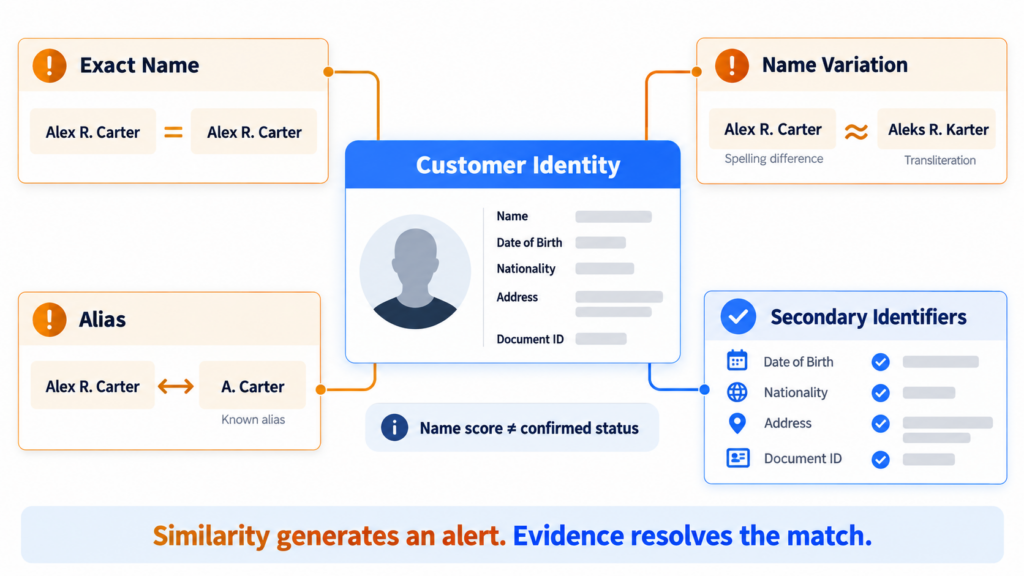
Many customers share names with listed individuals. A screening alert should therefore initiate match resolution rather than automatically determine the outcome.
Relevant secondary identifiers include:
- Date of birth
- Nationality
- Place of birth
- Address
- Identity-document number
- Company registration details
- Occupation or organizational role
- Known associates
- Beneficial ownership
OFAC recommends comparing the complete list entry with all available customer or transaction information. A shared first or last name may be insufficient, while a close name match combined with the same date of birth and location may require further investigation.
The quality and quantity of matching attributes matter more than the name score alone.<div style=”height:10px;”></div>
5. Resolving Potential Matches
A match-resolution workflow may include:
- Confirming which list and sanctions program generated the alert
- Reviewing the complete watchlist record
- Comparing names, aliases, scripts, and secondary identifiers
- Checking whether the customer is an individual, entity, or another listed target type
- Requesting additional identity or corporate evidence
- Reviewing ownership and control relationships
- Determining whether the match can be reasonably cleared
- Escalating unresolved or likely matches to compliance specialists
Face++ face comparison can support identity resolution when trusted reference imagery is legally available. It provides a confidence score and thresholds for assessing whether two face images likely belong to the same person. However, facial similarity cannot independently establish sanctions status or replace a compliance investigation.
6. Screening Beneficial Owners and Related Parties
Screening only the named customer may leave important exposure undiscovered.
Depending on applicable requirements and internal policy, businesses may also need to evaluate:
- Ultimate beneficial owners
- Directors and controlling persons
- Authorized representatives
- Transaction counterparties
- Beneficiaries
- Intermediaries
- Entities owned or controlled by designated parties
A company may not appear by name on a watchlist but may still be affected by ownership or control restrictions. Entity-resolution and corporate-relationship analysis are therefore important complements to conventional name screening.
7. Why Ongoing Screening Matters
Sanctions data and customer circumstances change over time. Authorities add, amend, and remove records, while customers may change names, ownership structures, addresses, or transaction relationships.
OFAC provides current sanctions-list data through its Sanctions List Service, while the UN publishes updates when entries are added, amended, or removed.
Platforms may screen:
- During onboarding
- Before or during relevant transactions
- When customer information changes
- When beneficial ownership changes
- After watchlist updates
- During periodic customer reviews
- When new risk evidence appears
Where account ownership is uncertain, Face++ face reverification and liveness detection can support a step-up identity check before the compliance decision continues.
8. Building a Risk-Based Decision Process
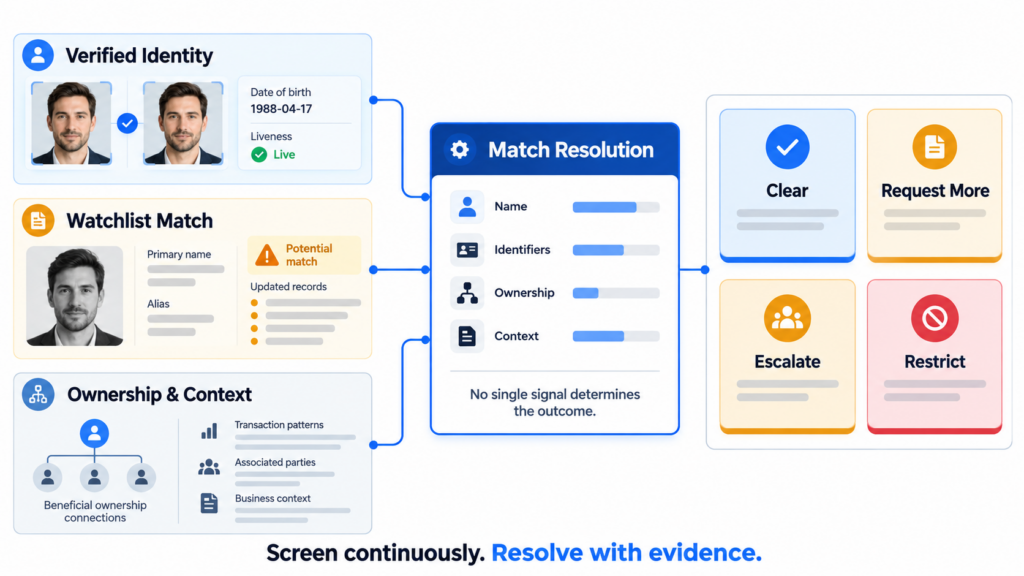
A sanctions alert is one input into a broader decision process. Relevant evidence may include:
- Name-match quality
- Secondary-identifier consistency
- List and sanctions-program context
- Customer and beneficial-ownership information
- Verified identity evidence
- Transaction purpose and counterparties
- Geographic context
- Previous screening decisions
- Face reverification and liveness results
Possible outcomes include clearing an obvious false positive, requesting more evidence, escalating the case, or applying restrictions required by applicable law and policy.
Organizations should preserve the watchlist version, matching fields, evidence reviewed, reviewer actions, and final rationale. OFAC specifically emphasizes maintaining complete and accurate records of the investigation and information used to determine whether a potential match was valid.