Global digital onboarding requires businesses to process identity documents issued in different countries, languages, scripts, and layouts. A customer’s document may contain Arabic, Cyrillic, Chinese, Thai, or Latin characters, while its machine-readable data represents the same information differently.
Multilingual OCR converts this content into structured identity fields. However, reliable onboarding requires more than reading visible text. Businesses must also identify the document layout, interpret field meaning, normalize language variations, validate extracted data, and connect the document to the person presenting it.
Face++ combines multilingual document processing with document analysis, face comparison, and liveness detection to support scalable identity workflows across markets.
1. What Is Multilingual Identity-Document OCR?
Multilingual OCR recognizes text written in multiple languages and scripts and converts it into machine-readable information.
For identity documents, the system must extract fields such as:
- Full name
- Date of birth
- Nationality
- Address
- Document number
- Issue and expiry dates
- Issuing authority
- Document type
- Machine-readable information
Identity-document OCR must also understand layout. The same date could represent birth, issuance, or expiry depending on its position and field label.
Face++ document processing can recognize multilingual text while interpreting document layouts, reading order, tables, and key fields. It can then return standardized fields, confidence scores, and issue indicators through APIs.
2. Why Global Documents Are Difficult to Process
Document formats vary substantially across markets. Differences may include:
- Left-to-right and right-to-left writing
- Native and Latin scripts on the same document
- Different name orders
- Multiple calendar systems
- Regional date formats
- Diacritics and special characters
- Vertical or non-linear text
- Different address structures
- Abbreviated issuing authorities
- Handwritten or stamped information
Image quality creates additional challenges. Blur, glare, perspective distortion, low resolution, compression, and partial obstruction can reduce recognition accuracy regardless of language.
A global onboarding workflow must therefore identify both what is written and how the issuing authority structures that information.
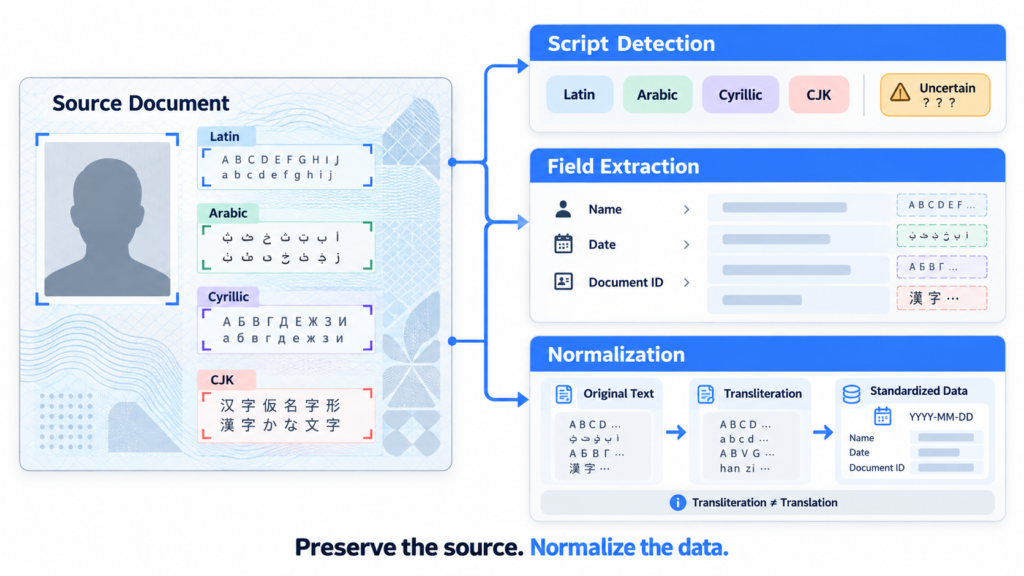
3. Script Recognition and Transliteration
Language recognition determines the language of text, while script recognition identifies the writing system. Several languages may use the same script, and one document may contain multiple scripts.
Transliteration converts text from one script into another without necessarily translating its meaning. For example, a name written in Cyrillic or Arabic may also appear in Latin characters.
ICAO Doc 9303 specifies common requirements for machine-readable travel documents. Where mandatory information uses a non-Latin script, a transcription or transliteration may also be provided. Machine-readable-zone names can differ from visually printed names because the MRZ uses a limited character set and may remove diacritics, punctuation, or parts of long names.
A reliable system should preserve:
- The original extracted text
- The detected language and script
- The document-provided transliteration
- A normalized representation for matching
- The relationship between visible and encoded values
Normalization should not silently overwrite the original evidence.
4. Normalizing Names Across Languages
Names are especially difficult because their structure varies across cultures and document types.
Potential differences include:
- Family name appearing before or after given names
- One name represented by several words
- Optional patronymics or prefixes
- Characters with multiple valid transliterations
- Removed accents or punctuation
- Truncated MRZ representations
- Married, previous, or alternative names
A business should avoid assuming that every name follows a Western given-name and surname structure.
The OCR workflow can return both raw and normalized name fields. Matching systems can then compare the document’s visible name, MRZ representation, application data, sanctions records, and other identity sources without treating every formatting difference as a contradiction.
5. Dates, Numbers, and Address Formats
Dates and numbers may appear familiar while carrying different meanings.
A value such as 04/07/2000 may be interpreted differently depending on the issuing country. Some documents use local-era calendars, native numerals, or abbreviated month names.
Validation should evaluate:
- Expected date order
- Calendar system
- Logical age range
- Issue date before expiry date
- Document-specific number format
- Native and normalized numeral consistency
- Visible and machine-readable values
Addresses require market-specific handling because the order of building, street, district, city, and postal information varies. Address normalization should preserve the source text while creating standardized components for comparison and downstream systems.
6. Extracting Data from Visual and Encoded Sources
Passports and some identity cards contain both a visual inspection zone and machine-readable data, such as:
- MRZ
- PDF417 barcode
- QR code
- Embedded chip
- Repeated data on the reverse side
These sources may represent the same information using different character rules.
A strong workflow compares:
- Visible name against encoded name
- Native-script name against transliteration
- Document number across sources
- Birth and expiry dates
- Nationality and issuing-country codes
- Front and back fields
- Visible portrait against trusted or chip imagery
Differences may result from legitimate transliteration, OCR error, document damage, or manipulation. The system should apply document-specific comparison rules before escalating the case.
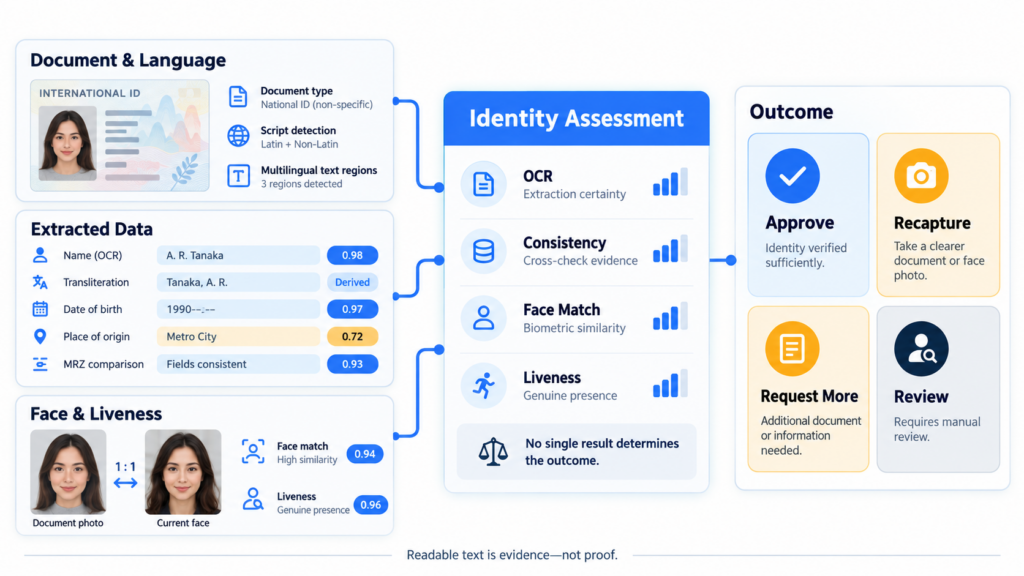
7. OCR Confidence Is Not Identity Confidence
A high OCR confidence score indicates that text was read clearly. It does not prove that:
- The document is authentic
- The data belongs to the applicant
- The document remains valid
- The image was captured securely
- The fields have not been altered
- The same identity is not being reused
Face++ distinguishes extraction from broader document and identity validation. Its document-processing workflow can normalize and cross-check related fields, flag uncertain values, and analyze suspicious document indicators.
Face comparison can then evaluate whether the applicant matches the document portrait, while liveness detection helps assess genuine presence. For higher-risk scenarios, 1:N face search can help identify possible biometric reuse across enrolled accounts.
8. Designing a Global OCR Workflow
A scalable onboarding workflow can include:
- Guided document capture and image-quality checks
- Country and document-type classification
- Language and script detection
- Layout-aware field extraction
- Raw-text preservation
- Transliteration and field normalization
- Visual and encoded-data comparison
- Document-validity and authenticity analysis
- Face comparison and liveness detection
- Risk-based approval, recapture, or review
Face++ supports global document recognition across large document libraries and can integrate OCR, document analysis, AML screening, face verification, liveness detection, and fraud controls within broader KYC workflows.
Field-level confidence should influence the response. Poor image quality may justify recapture, while unexplained identity inconsistencies may require additional evidence or manual review.
9. Frequently Asked Questions
Q1. Is multilingual OCR the same as translation?
No. OCR recognizes written characters. Translation converts meaning between languages, while transliteration represents text from one script in another.
Q2. Why can the visible name differ from the MRZ name?
MRZ fields use restricted characters and length limits. Diacritics, punctuation, and some name components may be transliterated, removed, or truncated.
Q3. Can Face++ OCR verify that a document is genuine?
OCR extracts data. Document authenticity requires additional analysis of structure, consistency, quality, tampering indicators, and available trusted sources.
Q4. How does Face++ connect extracted data to the applicant?
Face++ face comparison can compare the applicant with the document portrait, while liveness detection helps determine whether the current facial input comes from a genuinely present person.
10. Turn Multilingual Documents into Trusted Identity Data
Global onboarding requires more than support for multiple alphabets. Businesses must preserve original text, interpret document layouts, normalize scripts carefully, compare visual and encoded sources, and manage uncertainty according to risk.
By combining Face++ multilingual OCR with document analysis, face comparison, liveness detection, and contextual risk controls, platforms can convert diverse identity documents into structured onboarding data without treating readable text as sufficient proof of identity.