Digital identity verification establishes who a customer is. However, confirming a genuine identity does not show whether that person is associated with sanctions, political exposure, financial crime, or other compliance risks. That is the role of anti-money laundering screening, commonly known as AML screening.
By combining AML screening with Face++ face verification and liveness detection, digital platforms can evaluate both identity authenticity and customer risk during onboarding and throughout the account lifecycle.
1. What Is AML Screening?
AML screening compares customers, businesses, beneficial owners, and related parties against relevant compliance and risk data.
Common screening categories include:
- Sanctions lists
- Politically exposed persons, or PEPs
- Relatives and close associates of PEPs
- Regulatory and law-enforcement watchlists
- Credible adverse information
- Internal fraud or restricted-customer lists
The FATF Recommendations provide an international framework for combating money laundering, terrorist financing, and proliferation financing. However, exact screening requirements vary by jurisdiction, industry, customer type, and risk level.
A screening alert is not automatically proof of criminal activity. FATF notes that PEP requirements are preventive and should not imply that every PEP is involved in wrongdoing. Instead, a possible match may require additional investigation or enhanced due diligence. FATF PEP Guidance
2. AML Screening vs Identity Verification
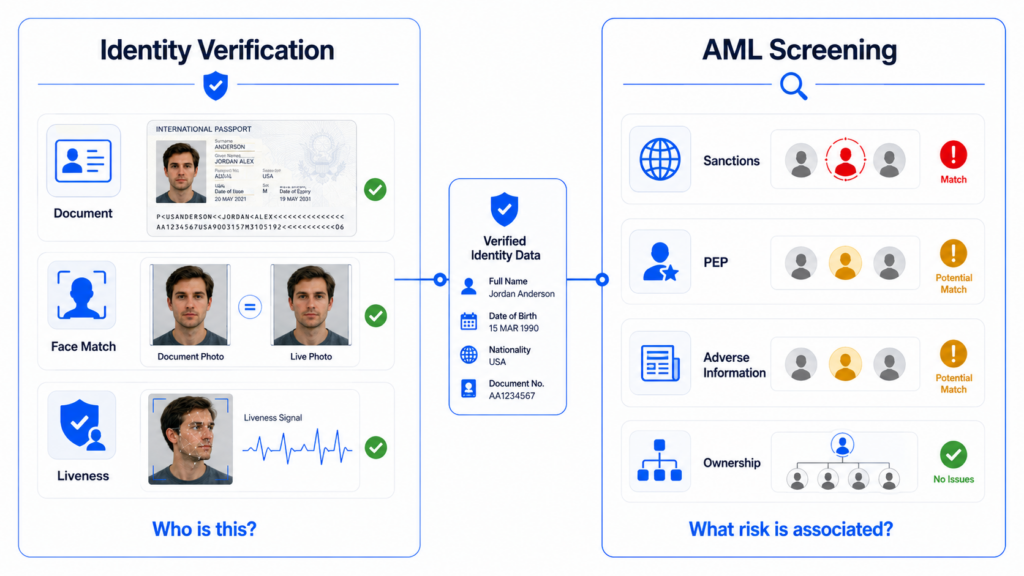
AML screening and identity verification answer different questions:
- Identity verification: Is this person genuinely the claimed identity?
- AML screening: Is this identity associated with relevant compliance risk?
A customer can pass identity verification but still trigger an AML alert. Conversely, a screening system can find a similar name without confirming that the applicant is actually the listed person.
Face++ strengthens the identity layer of this workflow. Businesses can compare the customer’s current face with a trusted reference portrait using 1:1 face verification. Liveness detection can then assess whether the session involves a genuine person rather than a photograph, replay, deepfake, or injected video stream.
The verified identity data can subsequently be screened by an appropriate AML solution.
3. What Customer Information Should Be Screened?
Screening only a customer’s name can generate too many false positives. A more reliable process may compare:
- Full name and known aliases
- Date of birth
- Nationality
- Country of residence
- Address
- Identity document number
- Company registration information
- Beneficial owners and controlling persons
For business customers, the organization may need to screen directors, authorized representatives, shareholders, or ultimate beneficial owners according to applicable regulations and internal policies.
Accurate identity data is therefore essential. OCR can extract information from identity documents, while normalization can standardize names, dates, addresses, and transliterations before screening. Face++ face verification can then help bind this structured identity information to the person completing the onboarding session.
4. Why AML Screening Produces False Positives
A screening system may return an uncertain match for several reasons:
- The customer has a common name.
- Different databases use different transliterations.
- A record contains incomplete identity information.
- The listed person uses several aliases.
- Dates of birth or nationalities are missing.
- Customer or ownership information is outdated.
These cases should not always result in automatic rejection. A risk-based workflow can compare secondary identifiers, calculate match confidence, request additional evidence, or send the case to a trained compliance reviewer.
Biometrics can help when the uncertainty involves identity ownership. For example, Face++ face verification and liveness detection can confirm that the current user matches the identity evidence. However, a facial match cannot determine whether a sanctions or PEP alert is valid; that requires separate AML analysis.
5. How AML Screening Supports Safer Digital Onboarding
A layered onboarding workflow can include:
- Capture identity documents and customer information.
- Extract and normalize relevant identity fields.
- Validate document and data consistency.
- Compare the customer’s face with the document portrait.
- Perform liveness detection to assess genuine presence.
- Screen the verified identity against relevant AML data.
- Resolve possible matches using additional attributes.
- Approve, escalate, review, or reject the application.
This structure addresses two distinct risks. Identity verification helps detect impersonation, stolen documents, presentation attacks, and synthetic media. AML screening helps identify customers who may require enhanced due diligence or other compliance controls.
Face++ can operate as the biometric identity-assurance layer within this architecture, helping businesses ensure that the identity being screened belongs to the person participating in the session.
6. Why Ongoing AML Screening Matters
Customer risk can change after onboarding. Someone may later appear on a sanctions list, become a PEP, change company ownership, or trigger new internal risk indicators.
Digital platforms may therefore combine periodic rescreening with event-based screening. Common triggers include:
- Customer profile changes
- Beneficial ownership changes
- Sanctions-list updates
- High-risk transactions
- Account recovery attempts
- New geographic or device risk
- Unusual account behavior
When a risk event also creates uncertainty about account ownership, Face++ face reverification and liveness detection can provide a step-up identity check before the user performs sensitive activity.
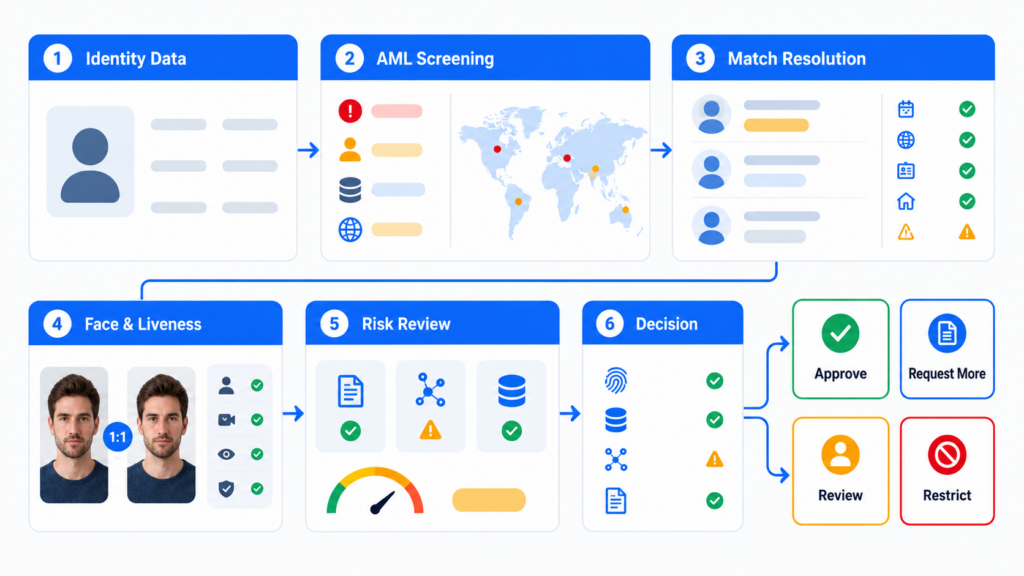
7. Building a Risk-Based AML Decision Process
AML screening should be one input within a broader decision process. Relevant signals may include:
- Screening result and match confidence
- Verified identity attributes
- Customer and ownership risk
- Face verification and liveness results
- Device and session intelligence
- Transaction context
- Previous account activity
A low-confidence name match may be resolved automatically using additional identifiers. An uncertain identity may require Face++ reverification. A higher-risk case may be escalated to compliance review, while a confirmed prohibited match may require restrictions under applicable policies.
No individual name match, biometric score, or device signal should determine the entire decision without appropriate context.
8. Frequently Asked Questions
Q1. Is AML screening the same as KYC?
No. KYC is the broader process of identifying, verifying, and understanding a customer. AML screening is one control within KYC and customer due diligence.
Q2. Can a verified customer still trigger an AML alert?
Yes. A customer may present genuine identity evidence but match a sanctions, PEP, or other relevant risk record.
Q3. Does Face++ provide complete AML screening?
Face++ focuses on biometric identity assurance, including face comparison and liveness detection. These capabilities can be integrated with dedicated AML screening, transaction monitoring, and compliance systems.
Q4. Is screening only needed during onboarding?
Not necessarily. Depending on regulatory obligations and customer risk, organizations may need periodic or event-triggered rescreening throughout the relationship.
9. Conclusion
AML screening and digital identity verification are complementary controls. AML screening identifies potential compliance risk, while identity verification determines who is actually interacting with the platform.
Combining suitable AML data sources with Face++ face verification, liveness detection, and risk-based reverification helps digital businesses build safer onboarding and account-management workflows without treating every possible match as a confirmed threat.