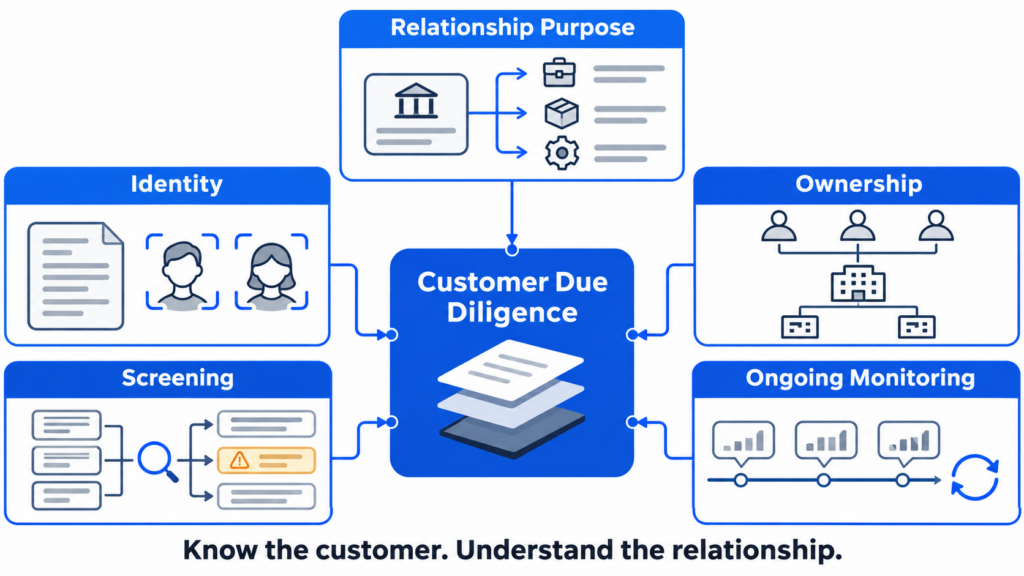
Customer Due Diligence, or CDD, is the process of identifying customers, verifying their identities, understanding the customer relationship, and assessing relevant financial-crime risk.
In digital onboarding, CDD extends beyond collecting an identity document or completing a facial comparison. A genuine person can still present compliance concerns, while a similar-name screening alert may concern someone else entirely.
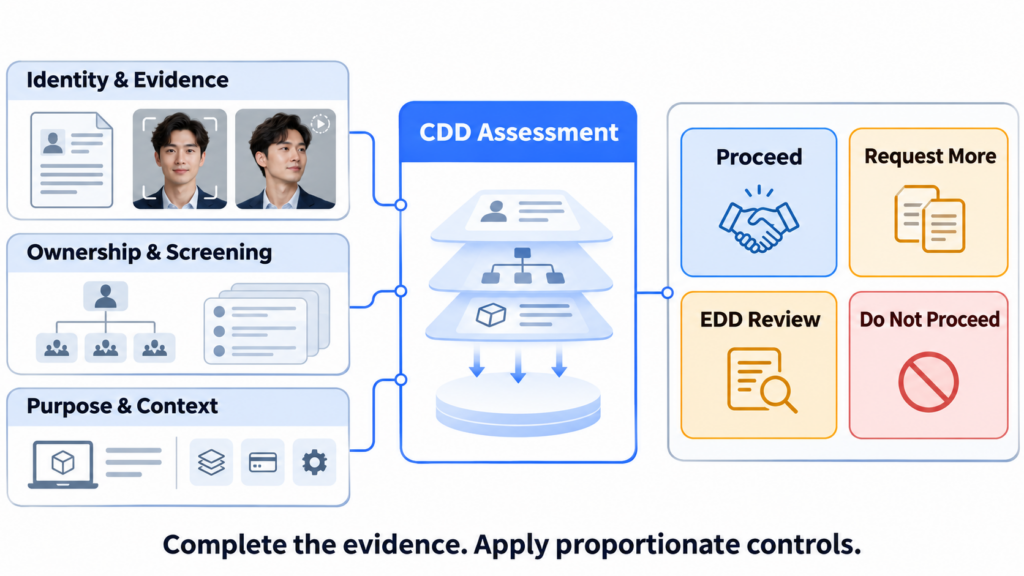
An effective workflow combines reliable identity evidence, ownership information, screening, and customer context to support a documented decision.
1. What Does Customer Due Diligence Cover?
The FATF framework identifies four core elements of CDD:
- Identifying the customer and verifying their identity
- Identifying the beneficial owner and taking reasonable verification measures
- Understanding the purpose and intended nature of the relationship
- Conducting ongoing due diligence and scrutinizing transactions
For organizations, this includes understanding ownership and control. Where someone acts on a customer’s behalf, the business also needs appropriate checks on their identity and authority.
The specific obligations depend on applicable law, regulated activity, and customer circumstances. CDD should not be reduced to one universal document checklist.
2. How CDD Differs From Identity Verification
Identity verification answers a narrower question:
Does the available evidence support the customer’s claimed identity?
CDD also asks:
Who owns or controls the relationship, why is it being established, and what risks require management?
OCR can extract document fields. Document checks can assess authenticity and consistency. Face comparison can evaluate whether the applicant resembles a trusted portrait, while liveness detection helps assess genuine presence.
These controls strengthen identity assurance, but they do not establish the legitimacy of a customer’s funds, explain company ownership, or resolve an AML screening alert.
Face++ can support the identity-verification layer within the broader CDD process rather than replacing compliance assessment.
3. Collect Relevant Customer Information
The information required should reflect the customer type, service, market, and applicable obligations.
For individuals, relevant information may include:
- Full name and date of birth
- Nationality and residential address
- Identity evidence
- Occupation or business activity
- Intended account use
For business customers, the workflow may additionally examine registration information, ownership and control, authorized representatives, and beneficial owners.
Collecting more information is not automatically better. Each field should serve a defined verification, compliance, or risk-management purpose.
Explain required evidence before capture, support local formats, and avoid requesting the same information repeatedly.
4. Verify the Evidence and the Applicant
A practical digital identity workflow may combine:
- Guided document capture and quality checks
- OCR extraction and field confirmation
- Document authenticity and validity checks
- Cross-field or source validation where supported
- Face comparison against a trusted portrait
- Liveness and capture-integrity controls
Face++ Face Comparing supports 1:1 comparison and returns confidence information for threshold-based assessment. Its onboarding solution also describes document checks, face matching, liveness, and application-risk controls.
Keep their meanings separate. Readable text does not prove document authenticity, a strong facial match does not prove liveness, and successful identity verification does not complete CDD.
5. Screen the Verified Identity and Relevant Parties
Depending on the applicable framework, screening may cover sanctions, politically exposed persons, and relevant adverse information.
For companies, relevant parties can include beneficial owners and authorized representatives, according to the organization’s obligations and policy.
Resolve possible matches using secondary identifiers and credible records. A similar name is not a confirmed match.
Likewise, PEP status signals potential exposure requiring appropriate controls; it does not establish wrongdoing. Adverse reporting requires source and context assessment rather than automatic acceptance as fact.
Face++ biometric verification can help establish who is participating in the session. Separate screening data and compliance analysis determine what an external record means.
6. Build a Customer Risk Profile
A customer risk profile brings the evidence together. Relevant factors may include:
- Identity and ownership confidence
- Product and service exposure
- Geography
- Purpose and expected activity
- Screening findings
- Distribution and onboarding channel
- Unresolved inconsistencies
Higher risk may justify enhanced due diligence, such as deeper ownership investigation, additional source-of-funds or source-of-wealth evidence, or appropriate approval and monitoring.
Simplified measures may be available in qualifying lower-risk circumstances where permitted. They are not permission to ignore mandatory checks.
The workflow should apply proportionate controls while respecting legal requirements that cannot be overridden by a favorable risk score.
7. Route Cases to an Appropriate Outcome
CDD decisions should distinguish missing evidence, technical failures, and substantive risk.
| Finding | Possible response |
|---|---|
| Poor capture quality | Guide the applicant and request recapture |
| Missing material information | Request specific additional evidence |
| Unresolved ownership or screening concern | Compliance review or enhanced due diligence |
| Sufficient evidence and completed required checks | Establish the relationship under applicable policy |
| Unmet legal requirements or prohibited activity | Do not proceed; apply required procedures |
A review outcome should identify what remains unresolved. Repeating the entire onboarding process may add friction without answering the actual question.
8. Continue CDD After Onboarding
CDD does not end with account approval.
Changes in ownership, customer information, screening records, or account activity can require reassessment. Transaction monitoring helps identify activity inconsistent with the understood relationship.
Where account ownership becomes uncertain, Face++ face comparison and liveness can support targeted reverification. This does not replace investigating transaction concerns or updating beneficial-ownership information.
Maintain a decision trail showing evidence sources, unresolved issues, review rationale, and relevant changes. Apply appropriate access, retention, and privacy controls.
Review frequency and triggers should follow applicable obligations and risk—not an assumed universal timetable.
9. Frequently Asked Questions
Q1. Is CDD the same as KYC?
The terms overlap in practice. CDD commonly describes the identification, verification, relationship-understanding, and ongoing risk-management measures within a broader KYC program.
Q2. Does passing face verification complete CDD?
No. It supports identity assurance but does not address all ownership, screening, relationship, or monitoring requirements.
Q3. Does every customer need enhanced due diligence?
No. Additional measures depend on applicable requirements and identified risk.
Q4. Can CDD be fully automated?
Many checks can be automated. Uncertain evidence, complex ownership, and material compliance concerns still need appropriate escalation and accountable decision-making.
10. Build CDD Around Evidence, Not Checkboxes
Effective CDD connects a verified identity with an understood customer relationship.
Face++ document and biometric capabilities can strengthen digital onboarding, while ownership checks, screening, and ongoing monitoring address the wider compliance picture.
The objective is sufficient, reliable evidence for the relationship—not simply a completed form or a passing biometric score.