An individual account may look legitimate while forming part of a coordinated fraud operation. Different accounts can share identity evidence, devices, payment relationships, or operating patterns—even when their names and contact details differ.
Fraud-network detection examines these relationships. Instead of asking only whether one application looks suspicious, it asks whether connected accounts reveal a broader pattern of abuse.
For digital platforms, combining identity verification with relationship analysis can help expose risks that account-by-account checks miss.
1. What Is a Fraud Network?
A fraud network is a connected group of actors, accounts, identities, or resources involved in fraudulent activity.
The network may include:
- Accounts controlled by the same operator
- Stolen or fabricated identities
- Compromised legitimate accounts
- Shared devices and contact details
- Common payment instruments or beneficiaries
- Intermediaries receiving or moving funds
- Services supplying fraudulent identity material
Not every participant has the same role or level of awareness. Some account holders may be victims or recruited intermediaries rather than organizers.
A network is therefore more than a list of suspicious accounts. Its significance comes from the relationships, activity, and evidence connecting them.
2. Why Single-Account Checks Can Miss Coordinated Abuse
Traditional onboarding checks evaluate one applicant and one session. They may confirm that fields are complete, a face resembles a document portrait, and the capture passes quality checks.
Those results do not establish that the applicant operates independently.
Several accounts may individually appear plausible while showing:
- Reused portraits under different identities
- Repeated document attributes
- Common devices or recovery channels
- Closely synchronized account activity
- Shared payout destinations
- Similar changes immediately before losses
Network analysis adds context to these individual results. It does not replace document verification, face comparison, or liveness detection.
3. Common Forms of Coordinated Account Fraud
Multi-Account and Promotion Abuse
Connected accounts may exploit incentives, referral programs, platform limits, or repeated access to restricted services. Multiple accounts alone are not necessarily fraudulent; the platform must establish the relevant policy violation or deception.
Coordinated Credit Abuse
Applications may share identity inconsistencies or operating infrastructure. Activity across accounts can become more informative than any single application.
Marketplace Abuse
Buyer and seller accounts may coordinate misleading transactions, reviews, refunds, or payouts.
Money-Mule Networks
Accounts may receive and transfer criminal proceeds. Some account holders knowingly participate, while others are deceived or exploited.
Account-Takeover Networks
Compromised accounts can become linked through common devices, recovery changes, beneficiaries, or subsequent activity.
These categories can overlap. An account created through identity fraud may later support payment abuse or illicit fund movement.
4. Which Relationships Help Reveal a Network?
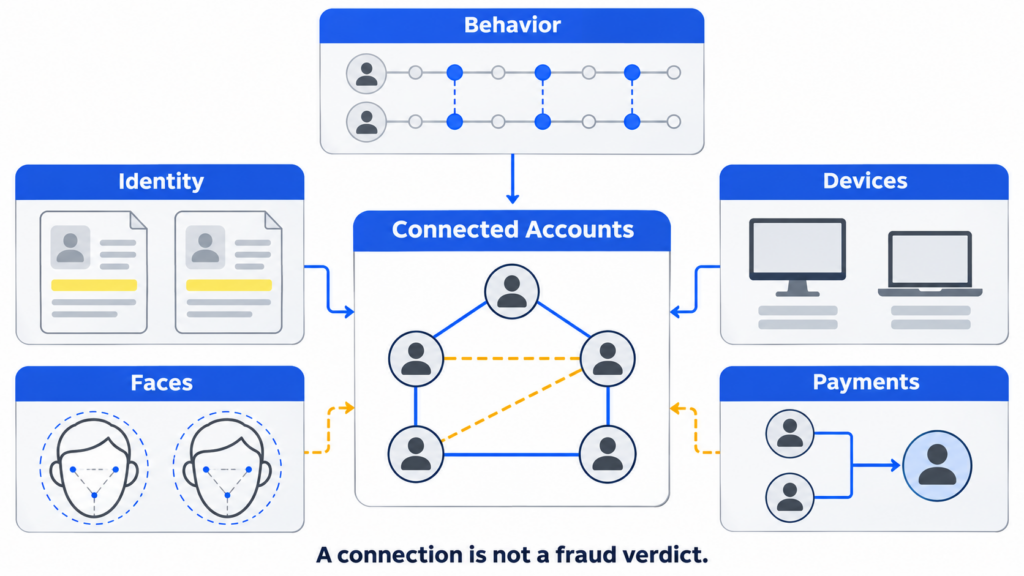
Useful evidence generally falls into four groups.
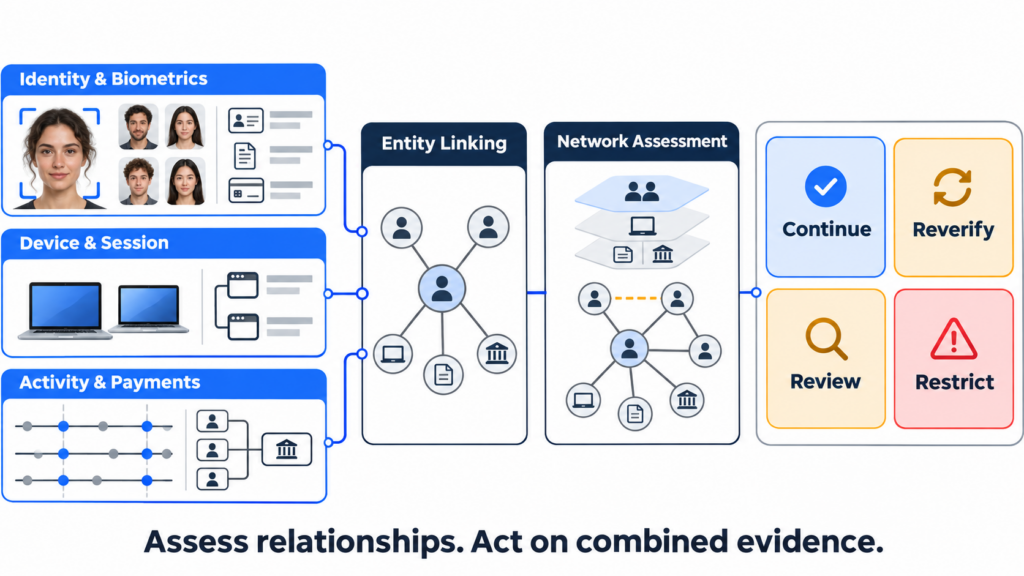
Identity relationships include reused document details, contact information, portraits, and inconsistencies between faces and claimed identities.
Technical relationships include device observations, session characteristics, and network infrastructure.
Financial relationships include shared payment instruments, beneficiaries, payout destinations, and transfers between accounts.
Behavioral relationships include similar timing, repeated application sequences, coordinated profile changes, and unusually aligned transaction patterns.
The strength of each connection depends on its reliability, frequency, and context. A common beneficiary may be an ordinary merchant. A shared device may belong to a household. An IP address may serve many unrelated users.
5. How Face Search Supports Entity Linking
Names, emails, and phone numbers can change between applications. Facial similarity can provide another connection to investigate.
Where legally permitted and appropriately governed, Face++ Face Searching can compare a facial sample against an enrolled collection and return similar candidates with confidence information.
This can support investigation of:
- A similar face appearing under different identity claims
- Repeated enrollment attempts
- Possible re-entry after account restriction
- Reused facial evidence across accounts
A search result is a candidate relationship—not proof of common control or fraud. Poor image quality, false matches, and spoofed media can affect interpretation.
Face++ 1:1 face comparison can support targeted identity checks, while liveness detection helps assess genuine presence. Neither independently explains why accounts are connected.
6. From Connections to Coordinated-Risk Evidence
A graph represents entities as nodes and relationships as links. Entities might include accounts, devices, documents, faces, and beneficiaries.
However, a crowded graph is not automatically a fraud network.
A practical assessment asks:
- How reliable is each link?
- Is the relationship current or historical?
- Does activity indicate shared control or ordinary association?
- Are several independent evidence types consistent?
- Is there confirmed abuse within the cluster?
- Could a legitimate explanation account for the pattern?
For example, a shared household device is weak evidence on its own. That same observation combined with conflicting identity claims and coordinated suspicious payouts may justify closer investigation.
7. Choose Proportionate Responses
Platforms should distinguish confirmed abuse, unresolved links, and innocent associations.
Possible responses include:
- Continuing ordinary activity
- Requesting identity reverification
- Applying additional checks to sensitive actions
- Sending a cluster for analyst review
- Restricting accounts supported by sufficient evidence
- Investigating connected accounts without automatically penalizing them
Do not automatically transfer one account’s fraud label to every connected customer.
Face++ biometric results can contribute to the evidence package, but the final action should reflect identity confidence, relationship strength, observed conduct, and applicable policy.
8. Monitor Beyond Onboarding
Connections can emerge after accounts have been approved. A new beneficiary, reused device, changed recovery channel, or confirmed fraud case may reveal previously hidden relationships.
Ongoing analysis should preserve timestamps, evidence provenance, confidence, and investigation outcomes. Historical links should not remain permanently decisive when their relevance has changed.
Measure confirmed fraud detection alongside false associations, unnecessary restrictions, review workload, and customer recovery outcomes.
Biometric and relationship data also require appropriate purpose limitation, access controls, retention policies, and legal assessment. Face-search capability does not authorize unrestricted cross-platform identification.
9. Frequently Asked Questions
Q1. Does sharing a device prove that accounts belong to a fraud network?
No. Families, workplaces, and shared environments can produce legitimate connections.
Q2. Can genuine identities participate in coordinated fraud?
Yes. Authentic identity evidence does not establish that later activity is legitimate.
Q3. Does Face++ Face Search identify the organizer?
No. It returns facial-similarity candidates within an enrolled collection. Establishing roles and control requires additional evidence.
Q4. Should every connected account be blocked?
No. Investigate the strength and meaning of the relationships before taking proportionate action.
10. Detect the Pattern, Not Just the Account
Coordinated fraud becomes clearer when platforms connect identity evidence with devices, behavior, and financial relationships.
Face++ face comparison, liveness detection, and appropriately governed face search can strengthen the identity layer. Combined with entity linking and contextual investigation, these capabilities help teams assess suspicious clusters without treating every shared attribute as proof of fraud.