Address verification can become a major source of friction in digital onboarding. A legitimate customer may enter an unfamiliar address format, submit a document in another language, or have no utility bill in their own name.
These problems are different from submitting fabricated evidence. Treating every discrepancy as fraud can increase abandonment and manual review. Treating every readable document as reliable can expose the platform to false address claims.
Effective address verification separates formatting, evidence quality, customer linkage, and authenticity before deciding what happens next.
1. Address Verification Involves Different Questions
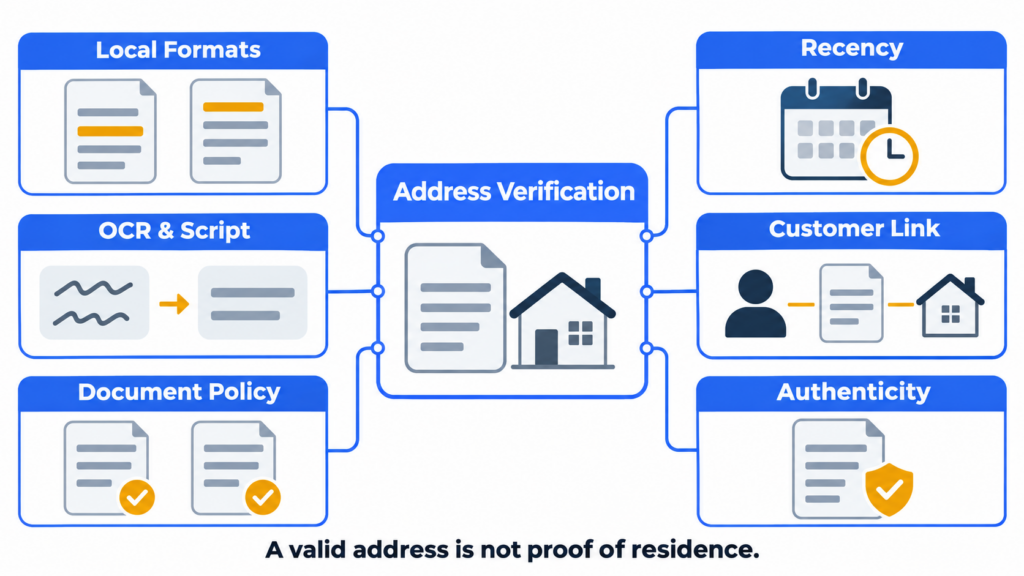
“Address verification” can describe several distinct checks:
- Format validation: Is the address structured correctly?
- Address existence: Does it correspond to a recognized location?
- Evidence assessment: Is the supporting document credible, current, and acceptable?
- Customer association: Does the evidence connect this customer to the claimed address?
A recognized address does not prove that the applicant lives there. Similarly, a document containing an address does not automatically establish current residence.
Requirements also vary by jurisdiction, product, and customer risk. Businesses should not assume that every KYC process requires the same standalone proof-of-address document.
2. International Address Formats Do Not Fit One Form
Addresses differ across countries in field order, administrative divisions, postal codes, building names, and unit identifiers.
A form designed around one market may reject legitimate customers because it requires:
- A state or province that does not apply
- A postal code where none is used
- A street number for a differently structured address
- Latin characters instead of the customer’s original script
- An apartment field that cannot accommodate local unit formats
Country-aware forms and validation rules reduce unnecessary corrections. Preserve the original address alongside its structured representation rather than forcing every location into one global template.
3. OCR and Transliteration Can Create Apparent Mismatches
Proof-of-address evidence may contain small text, complex layouts, multiple addresses, or several scripts.
OCR can confuse characters, omit unit numbers, or extract the issuer’s address instead of the customer’s. Transliteration can also produce different Latin spellings for the same location.
Platforms should compare address components and confidence levels rather than relying only on exact text equality.
Useful controls include:
- Distinguishing customer and issuer address regions
- Preserving original-script text
- Normalizing spacing and common abbreviations
- Comparing building and unit details separately
- Flagging uncertain extraction for confirmation
Face++ text-recognition capabilities can support extraction from document images. Address normalization, source validation, and residence assessment remain separate workflow responsibilities.
4. Accepted Documents and Recency Rules Vary
Common evidence may include utility bills, bank statements, government correspondence, tax records, or tenancy documents. Acceptance depends on the applicable policy and the evidence’s characteristics.
Customers can become stuck when the platform does not explain:
- Which document types are supported
- Whether digital originals are accepted
- Which date determines recency
- Whether the document must show the customer’s full name
- Whether every page is required
- What alternatives are available
A universal “issued within three months” rule should not be presented as a requirement for every market. Configure acceptance and recency rules for the relevant use case, and show them before upload.
5. Customers May Lack Evidence in Their Own Name
People living with family, sharing accommodation, renting informally, or recently relocating may not hold conventional address documents.
Automatically rejecting these applicants can exclude genuine customers without establishing that their claim is false.
Where permitted, alternative pathways may involve other credible records, approved electronic sources, or additional supporting evidence. Exceptions should follow documented policy rather than informal reviewer discretion.
The objective is sufficient assurance—not possession of one preferred document.
6. Genuine Evidence Can Still Be Outdated or Inconsistent
An applicant may have moved recently while their bank, utility provider, and identity-document issuer hold different addresses.
Differences may also reflect:
- Residential versus correspondence addresses
- Permanent versus temporary accommodation
- Previous names
- Missing apartment numbers
- Joint account holders
- Different issue and statement dates
Ask what the evidence actually establishes. A document may be genuine but insufficient to support the claimed current residence.
Give customers a specific next step, such as confirming an address component or submitting more recent evidence, instead of repeatedly returning a generic failure.
7. Authenticity and Customer Ownership Require Separate Checks
A well-formatted address can appear on a manipulated statement. A genuine document can also belong to another person.
Evidence assessment may examine issuer credibility, document structure, image integrity, field consistency, and authorized source checks where available.
Face++ 1:1 face comparison can help connect the applicant to a trusted identity portrait. Liveness detection can complement that check by assessing genuine presence.
However, many address documents contain no portrait. Biometrics therefore support the customer’s identity assurance; they do not authenticate the address document or prove residence at a location.
Likewise, IP location and device signals provide context—not standalone proof of a home address.
8. Route Failures According to Their Cause
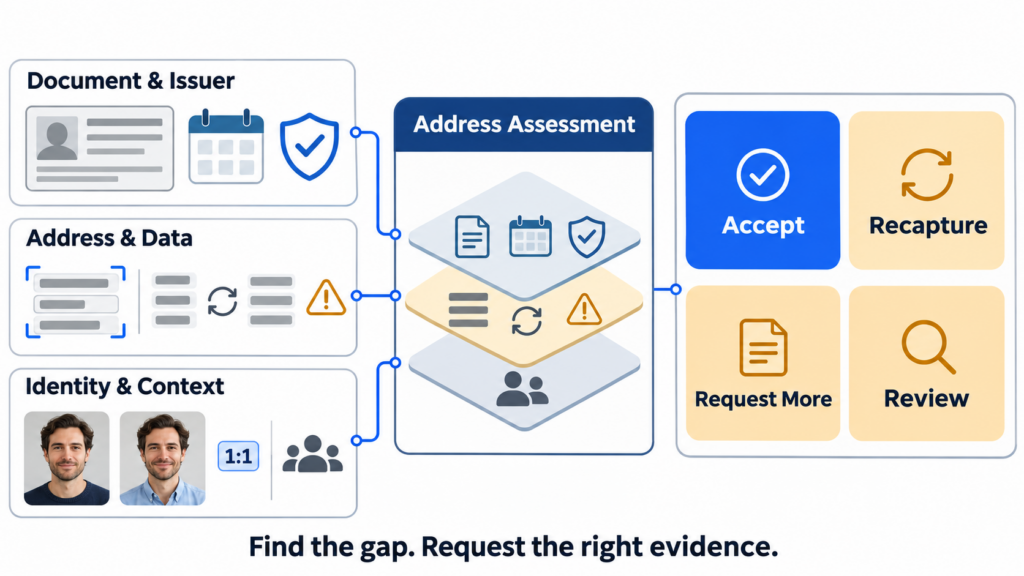
Different failures need different responses:
| Finding | Appropriate next step |
|---|---|
| Blur, glare, or cropped fields | Guided recapture |
| Uncertain OCR or formatting | Confirm or correct the extracted data |
| Unsupported or outdated evidence | Request an accepted alternative |
| Unresolved customer-address association | Additional evidence or review |
| Strong manipulation indicators | Fraud investigation and policy-based action |
An unmatched database result may reflect incomplete coverage rather than a false claim. Preserve uncertainty instead of turning every “not found” result into rejection.
9. Measure Both Verification Quality and Friction
Monitor completion, retries, time to decision, review rates, and confirmed fraud outcomes.
Break results down by country, language, document type, and failure reason. A high rejection rate in one market may reveal an unsuitable form or weak source coverage rather than higher customer risk.
Retain enough evidence and decision history for appropriate review while limiting collection, access, and retention of personal information.
10. Make Address Checks Explainable
Successful address verification combines local formatting, reliable extraction, suitable evidence, and customer context.
Face++ OCR and biometric capabilities can support the data-capture and identity layers within this architecture. Businesses should combine those signals with address-specific controls and give legitimate customers a clear recovery path.
The goal is to establish what the evidence supports—and request only what is needed to resolve the remaining uncertainty.