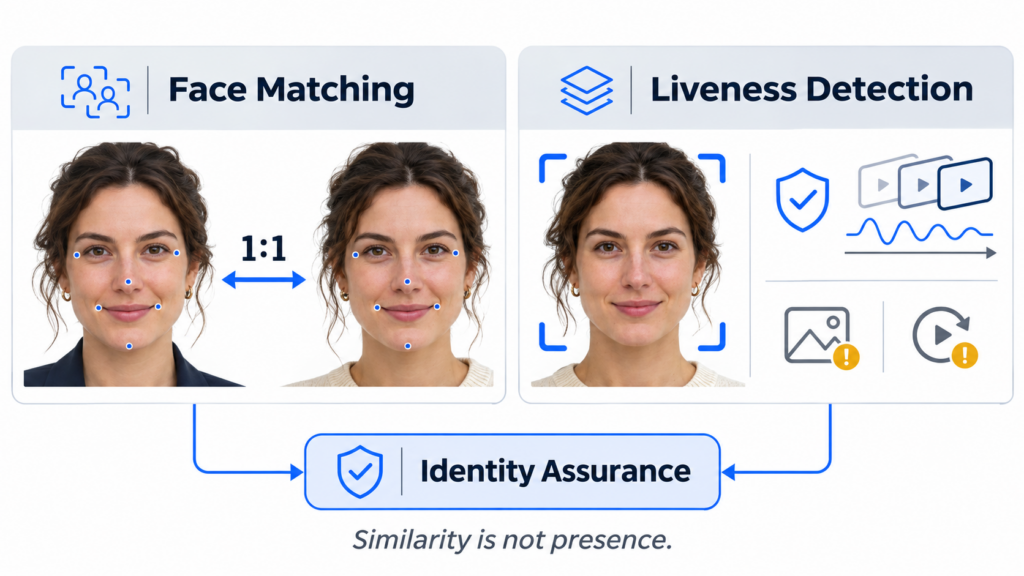
A face can closely resemble a document portrait without belonging to a live person participating in the verification session. A stolen photograph, replayed video, or manipulated facial image may preserve enough identity information to produce a strong comparison score.
This is why remote identity verification needs both face matching and liveness detection. Face matching evaluates identity similarity. Liveness detection helps assess genuine presence. Capture-integrity controls address whether the media reached the system through a trustworthy capture path.
Together, these controls provide stronger evidence than any one result alone.
1. What Face Matching Actually Verifies
Face matching compares two facial samples to evaluate whether they likely belong to the same person.
In remote onboarding, the comparison typically uses:
- A portrait extracted from identity evidence
- A current facial capture from the applicant
During account recovery or reverification, the reference may instead be a trusted enrollment portrait.
Face++ Face Comparing supports this 1:1 comparison and provides a confidence score for threshold-based assessment. The score represents evidence of facial similarity—not proof that the sample is live, the document is authentic, or the session is legitimate.
Businesses should validate thresholds for their specific product, population, capture conditions, and risk exposure.
2. Why a Strong Match Can Still Be Unsafe
Consider an attacker presenting a clear photograph of the legitimate customer. The facial features in that photograph genuinely resemble the reference portrait.
A comparison system evaluating similarity alone may therefore produce a strong result.
Related threats include:
- Printed facial photographs
- Images displayed on another screen
- Replayed facial videos
- Masks or other presentation artifacts
- Face-swapped or generated media
- Manipulated portraits in identity documents
These threats do not all follow the same attack path. Some are placed in front of a camera, while others involve replacing the digital media supplied to the verification system.
Increasing the face-match threshold does not independently solve either problem.
3. What Liveness Detection Adds
Liveness detection evaluates signals associated with a living subject present at capture. It forms part of the broader discipline of presentation attack detection, or PAD.
Depending on the implementation, analysis may examine image characteristics, temporal consistency, depth-related information, or responses to capture challenges.
Two common approaches are:
- Passive liveness: Evaluates the capture without requiring a specific user action.
- Active liveness: Requests an action or response and analyzes the resulting evidence.
Neither approach should be judged solely by how visible or demanding the interaction appears. Security depends on the implementation, attack coverage, testing, and capture environment.
Face++ offers liveness capabilities alongside face comparison, allowing businesses to assess genuine presence separately from facial similarity.
4. Why Liveness Does Not Replace Injection Protection
A presentation attack targets the capture process by placing an artifact—such as a printed photograph—in front of the sensor.
An injection attack introduces substituted media into the digital processing path. The verification service may receive manipulated images or video instead of the expected camera output.
Liveness and PAD can make some attacks harder, but they do not comprehensively protect every point where media could be substituted.
A layered deployment may also use:
- Capture-session binding and freshness checks
- Virtual-camera and modified-environment detection
- Device or application integrity signals
- Protected communications
- Media-manipulation analysis
- Server-side validation of session evidence
Deepfake analysis, liveness, and capture-integrity controls have related but distinct roles. Businesses should verify which attack types their selected deployment actually covers rather than assuming one product label guarantees complete protection.
5. The Reference Image Must Also Be Trustworthy
A live person can match a portrait on a manipulated document. In that situation, face matching and liveness may both succeed while the underlying identity claim remains false.
Platforms should therefore evaluate the reference evidence through appropriate document-authenticity, validity, data-consistency, and source checks.
For existing accounts, trusted enrollment images should be protected against unauthorized replacement. Otherwise, an attacker who changes the reference could undermine later comparisons.
Face++ face comparison helps bind a current capture to a reference portrait. The wider workflow must establish why that reference deserves trust.
6. Combining the Results Into a Decision
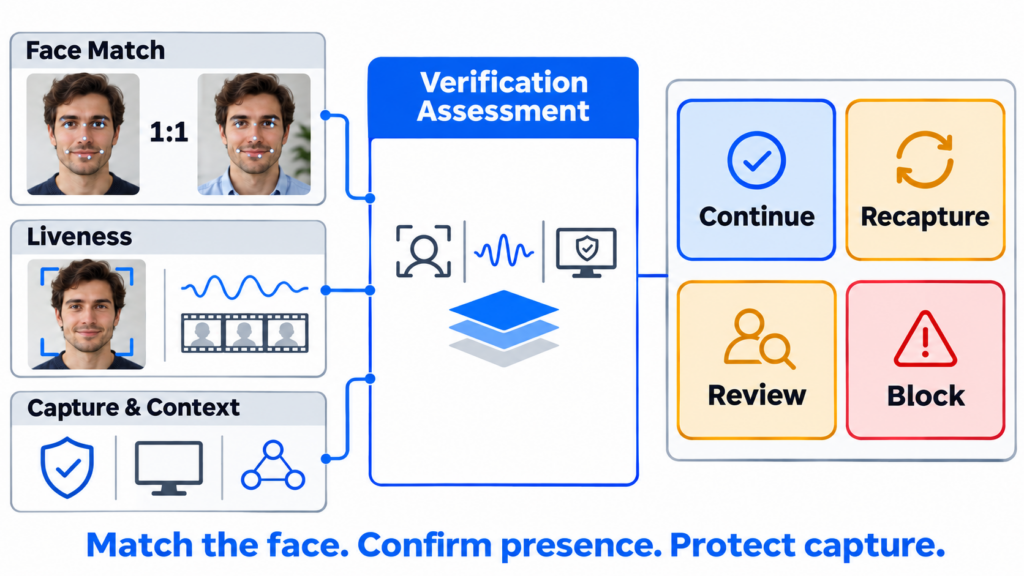
Face matching and liveness should remain separate decision inputs.
| Evidence pattern | Possible response |
|---|---|
| Strong match, satisfactory liveness, trusted capture | Continue if other required checks pass |
| Strong match, suspected spoofing | Stop or escalate; similarity does not override the concern |
| Low-quality or inconclusive capture | Provide guidance and request recapture |
| Satisfactory liveness, weak match | Reassess reference quality and identity consistency |
| Suspected media injection | Apply capture-integrity policy and investigate |
These are illustrative responses, not universal rules. A platform should distinguish an inconclusive result from confirmed attack evidence and provide appropriate review or alternative verification paths.
7. Balancing Security With Customer Experience
Blur, glare, poor lighting, camera limitations, and accessibility needs can affect legitimate customers.
A practical workflow should:
- Check capture quality early.
- Provide clear, actionable guidance.
- Limit unnecessary repeat attempts.
- Separate quality failures from suspected fraud.
- Offer appropriate alternative or assisted verification.
- Monitor false acceptance, false rejection, completion, and review rates.
Testing should reflect actual users, devices, and attack conditions. Strong results against one attack set should not be assumed to apply to all spoofing materials, deepfakes, or injection methods.
Collect only the biometric information needed for the purpose, explain its use, and apply appropriate access and retention controls.
8. Frequently Asked Questions
Q1. Does a high face-match score prove that the customer is live?
No. It indicates facial similarity. Genuine presence requires separate analysis.
Q2. Can liveness detection confirm the person’s identity?
Not by itself. A live person may still be the wrong person. Face matching connects the capture to the claimed identity reference.
Q3. Does asking someone to blink guarantee security?
No. A visible action is only one possible input. The system must analyze the evidence and account for replay, manipulated media, and capture-path threats.
Q4. Should every uncertain result lead to rejection?
No. Poor capture conditions may justify recapture, assisted verification, or review rather than a fraud conclusion.
9. Verify Similarity, Presence, and Capture Integrity
Remote identity assurance requires more than finding two similar faces.
Face++ face comparison and liveness detection can support the biometric layer. Combined with trusted identity evidence, capture-integrity controls, and contextual risk assessment, they help businesses distinguish a plausible facial image from a credible verification session.