A customer’s name matches a watchlist entry. Should the platform clear the alert, request more evidence, or stop the transaction? The name match alone cannot answer that question. The team must first establish whether the record refers to the same person or entity, then determine what the finding means under the applicable rules.
Anti-money laundering (AML) screening turns customer data into alerts that compliance teams can investigate. The workflow starts with reliable identity information and ends with a documented decision—not a similarity score.
1. Start With Reliable Customer Data
For individuals, screening may use the full name, original-script name, known aliases, date of birth, nationality, address, and document identifiers where appropriate. For companies, useful identifiers may include the registered name, registration number, jurisdiction, and relevant beneficial owners.
Before screening, standardize dates and spacing, account for differences in name order, and preserve original-script names alongside transliterations. Keep the source and verification status of important fields. A date of birth entered by an applicant should not carry the same weight as one verified against reliable identity evidence.
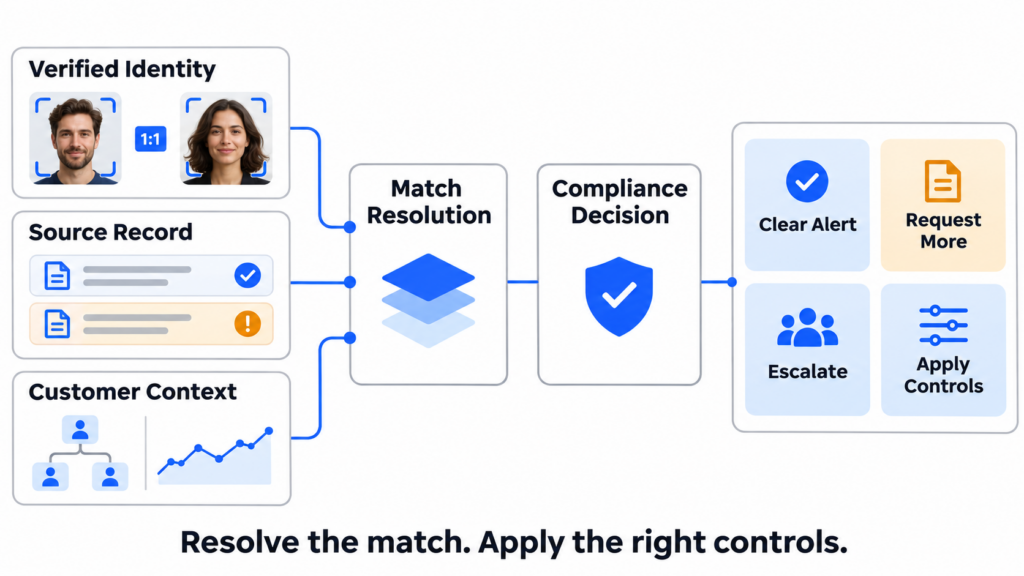
Face++ can support this upstream identity layer with document data extraction, document checks, 1:1 face comparison, and liveness detection. These controls help establish who is being screened. They do not establish sanctions status, political exposure, or the credibility of a media report.
2. Screen Against the Right Sources
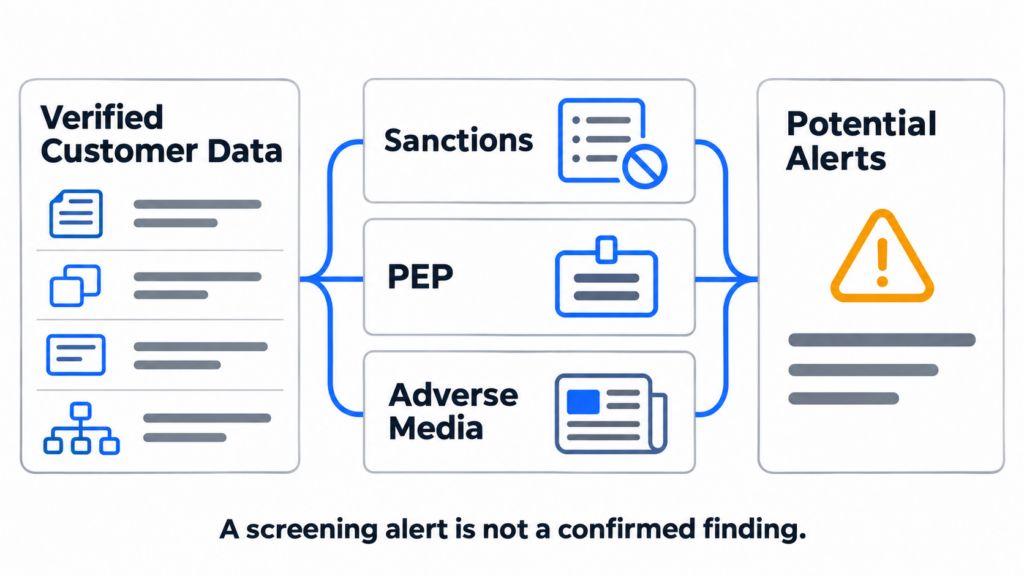
The sources a business uses depend on its applicable obligations, products, markets, and customer types. Three common screening categories answer different questions:
| Screening category | What it helps assess |
|---|---|
| Sanctions | Whether a person, entity, ownership interest, or activity may be subject to applicable restrictions |
| Politically exposed persons (PEPs) | Whether a prominent public role or a relevant family or associate relationship calls for additional due diligence |
| Adverse media | Whether credible public reporting raises a relevant concern that warrants investigation |
A PEP finding is not a sanctions match or evidence of wrongdoing. Likewise, an adverse media alert is a lead: the reviewer still needs to confirm who the article concerns, evaluate the source, and distinguish allegations from established findings.
3. Generate Candidate Matches Without Overstating Confidence
Screening engines can compare exact names, aliases, spelling variations, and transliterations. Fuzzy matching helps surface records that exact matching could miss, but it also produces alerts for unrelated people with similar names.
Keep match confidence separate from customer risk. Match confidence asks whether the customer and the record refer to the same party. Customer risk asks what a confirmed finding means for the relationship. A high-confidence match to a PEP record and a high-confidence match to a sanctions record require different follow-up.
4. Resolve Alerts With Independent Evidence
Review the full source record and compare available identifiers, such as date of birth, nationality, address, registration number, or identity-document number. Treat missing information as unknown, not as a mismatch. Document which identifiers support or contradict the match and which could not be verified.
For example, an applicant may share a name with a listed individual but have a different verified birth date and document identifier. Those differences may support clearing the alert after reviewing the full record. If the record contains only a name and the available evidence cannot distinguish the two people, request more information or escalate rather than forcing a decision. OFAC’s guidance similarly recommends evaluating the complete record and gathering additional details where needed.
5. Turn a Resolved Alert Into the Right Decision
Clearing an alert does not approve the customer. It means that the specific alert has been resolved. The rest of the customer due diligence process still applies.
- Clear the alert when reliable evidence rules out the match.
- Request more evidence when a material identifier or ownership detail is missing.
- Escalate for review when evidence conflicts, ownership is complex, or a credible finding warrants closer examination.
- Apply enhanced controls or restrictions as appropriate. Political exposure may call for enhanced due diligence or monitoring under applicable rules. For a confirmed sanctions match, determine which restrictions apply to the activity and whether any authorization or exemption is relevant. A risk score cannot override a legal prohibition.
Keep an audit trail of the source record and list version, evidence reviewed, rationale, reviewer or rule version, and final disposition. If the case is reopened later, the next reviewer should be able to see why the original decision was made.
6. Rescreen When the Customer or the Source Changes
An onboarding result reflects the information available at the time. A watchlist update, new public role, ownership change, or updated customer record can justify rescreening. Transaction monitoring serves a different purpose: it examines activity for unusual patterns. A transaction alert can trigger a customer review, but it is not itself a watchlist match. FATF places ongoing due diligence within the broader framework for managing financial-crime risk.
Track false-positive rates, time to resolve alerts, and cases reopened after new evidence arrives. Review those metrics together: a falling alert count could reflect better data and matching—or a configuration that now misses relevant records.
7. Where Face++ Fits in the Workflow
Face++ can help verify that an applicant matches a trusted document portrait and assess whether the facial capture is live. If a later review raises doubts about account ownership, face comparison and liveness can support reverification. The screening system and compliance team still need to resolve the external record and decide what action it requires.
The practical sequence is simple: verify who you are screening, resolve the alert with evidence, and apply the rules to the confirmed finding.