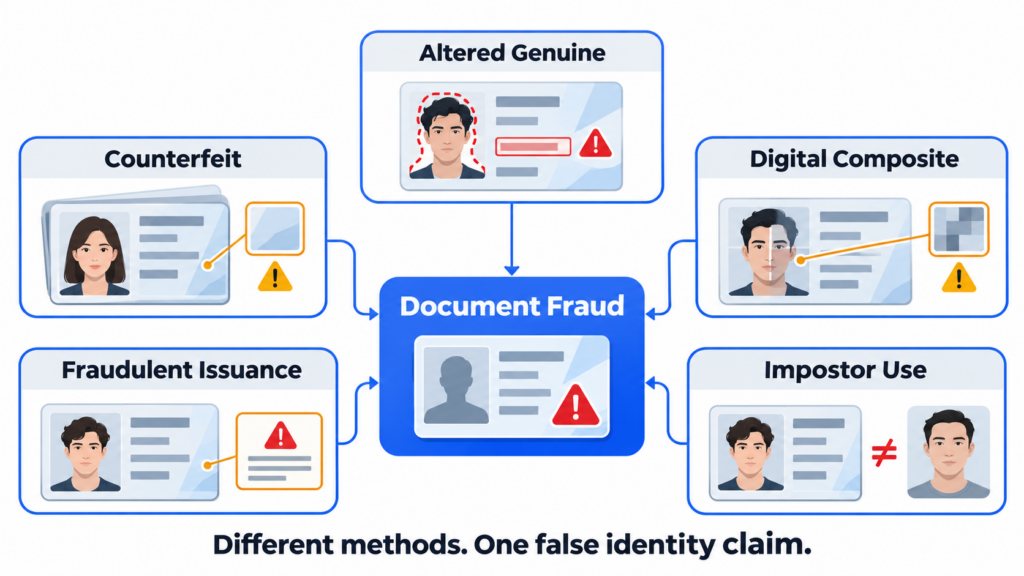
Identity-document fraud is not limited to completely counterfeit passports or ID cards. Criminals may alter genuine documents, assemble fabricated digital images, misuse legitimate credentials, or obtain authentic documents through false information.
Some fraudulent documents remain clear enough for OCR to read. Digital businesses must therefore evaluate authenticity, consistency, document ownership, and capture integrity—not simply whether text can be extracted.
1. What Is Document Forgery?
Document forgery generally means unlawfully changing a genuine document. It differs from counterfeiting, which involves producing an unauthorized imitation of an official document.
INTERPOL distinguishes several forms of document fraud:
- Counterfeit: Unauthorized reproduction of a genuine document
- Forgery: Alteration of a genuine document
- Pseudo document: A document that resembles official identification but is not legally recognized
- Fraudulently obtained genuine document: An authentic credential issued using false or misleading information
- Impostor use: A genuine document presented by someone other than its legitimate holder
These categories often overlap with impersonation, account takeover, synthetic identity fraud, illegal employment, financial fraud, and cross-border crime.
2. Completely Counterfeit Documents
A counterfeit document attempts to imitate the appearance of an officially issued credential without originating from the legitimate issuing authority.
At a high level, counterfeit documents may imitate:
- General document layout and dimensions
- Printed identity fields
- Holder portraits
- Background graphics
- Machine-readable zones or barcodes
- Holographic or optically variable elements
- Stamps, signatures, or issuer markings
The presence of these elements does not make a document authentic. Simulated security features may have incorrect positioning, typography, color behavior, material properties, or interaction with light.
Remote verification can be more difficult because a standard image may not capture tactile, ultraviolet, or angle-dependent features. Platforms should therefore combine visual analysis with data validation, document references, capture signals, and available electronic authentication.
3. Altered Genuine Documents
A fraudster may start with an authentic document and change selected elements while retaining the genuine document’s underlying materials and other security features.
Commonly targeted areas include:
- Portrait
- Name
- Date of birth
- Document number
- Nationality
- Address
- Issue or expiry date
- Machine-readable information
Warning signs may include irregular portrait boundaries, inconsistent fonts, displaced text, interrupted background patterns, laminate disturbance, or disagreement between printed and encoded information.
A forged document can appear more convincing than a complete counterfeit because much of the original credential remains genuine. Detection should examine the document as a connected system rather than approving each element independently.
4. Digitally Composited Document Images
In remote onboarding, fraudsters may submit an image that combines elements from several sources. For example, a document background, portrait, and identity fields may originate from different files.
Potential indicators include:
- Different sharpness or resolution across regions
- Misaligned text baselines
- Repeated background textures
- Inconsistent noise or compression
- Unnatural portrait transitions
- Rectangular editing boundaries
- Lighting or color differences
- Metadata or capture anomalies
High-quality digital compositing can remain readable and visually plausible after resizing or compression. OCR may accurately extract the manipulated information without determining whether the source image is genuine.
Face++ has similarly noted that screenshots, printouts, and manipulated document images may remain machine-readable, making authenticity analysis necessary alongside OCR.
5. Fraudulently Obtained Genuine Documents
Not every fraudulent identity document is physically fake.
A person may obtain a genuine credential by submitting false supporting information, exploiting weak enrollment processes, using a fabricated identity history, or impersonating another person during issuance.
Because the resulting document may contain legitimate materials, security features, and issuer signatures, visual inspection alone may not reveal the fraud. Businesses may need to evaluate:
- Source and issuance confidence
- Supporting identity evidence
- Historical customer information
- Beneficial ownership
- Device and account relationships
- Duplicate faces or reused attributes
- Previous fraud indicators
This demonstrates why document authenticity and identity legitimacy are related but separate questions.
6. Genuine Documents Used by Impostors
A genuine document can also be presented by someone who resembles the legitimate holder.
The document itself may pass authenticity, validity, and data checks. The remaining question is whether the applicant is the person to whom it was issued.
Face++ 1:1 face comparison can compare the document portrait with a current facial capture and return a confidence score with reference thresholds. Liveness detection adds genuine-presence analysis to help identify photographs, video replays, masks, or other spoofing attempts.
A strong document result should not override a failed holder-match or liveness result.
7. Printed, Screen-Based, and Recaptured Documents
Fraudsters may display a manipulated document on a screen, print it, or photograph it again. Recapture can flatten editing layers and obscure some manipulation traces.
Possible indicators include:
- Moiré patterns
- Display pixels or borders
- Screen glare
- Printer dots or paper texture
- Artificially uniform illumination
- Repeated compression
- Unnatural perspective
- Lack of expected physical depth or reflections
These indicators require contextual evaluation. Blur, glare, inexpensive cameras, and document wear can create similar effects for legitimate users, so one anomaly should not automatically determine the result.
8. Why Encoded and Electronic Data Matter
Passports and identity cards may contain machine-readable zones, barcodes, or electronic chips. Verification systems can compare visible fields with encoded information and expected document structures.
For electronic passports, ICAO describes chip validation as verifying the document’s digital signature to confirm that it was issued by a genuine authority and that stored biographical and biometric information has not been altered. Differences between authenticated chip data and printed information can indicate tampering.
However, chip authentication, readable OCR, and a facial match remain complementary evidence. No single successful check establishes the complete legitimacy of the customer and document.
9. How Fake Documents Are Used
Fraudulent identity documents may support:
- Opening accounts under false identities
- Taking over existing accounts
- Creating synthetic customer profiles
- Bypassing age or eligibility controls
- Applying for credit
- Receiving illicit funds
- Operating mule accounts
- Re-entering platforms after restriction
- Concealing beneficial ownership
- Impersonating legitimate customers
The risk can continue after onboarding. Fraudsters may initially maintain normal activity, build account credibility, and exploit increased access later.
10. A Layered Document-Fraud Defense
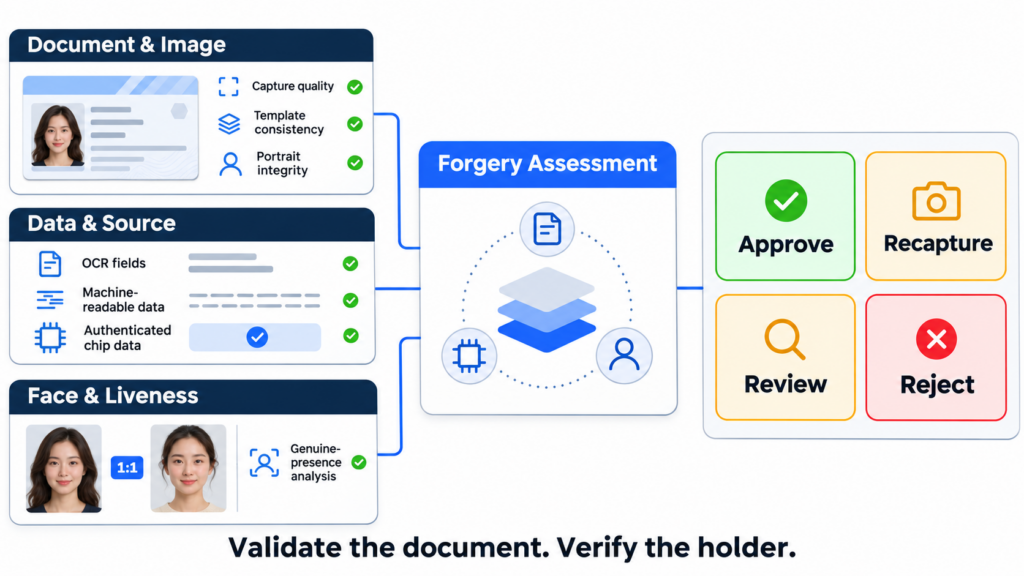
A practical remote-verification process can combine:
- Guided document capture and quality checks
- Document-type and template recognition
- OCR and field normalization
- Visual manipulation and recapture analysis
- Printed and encoded-data consistency checks
- Electronic-chip authentication where supported
- Face comparison with the document portrait
- Liveness and capture-integrity analysis
- Device, account, and session risk
- Risk-based decisioning or manual review
Face++ can support the OCR, facial comparison, liveness, and biometric identity-binding layers. These results should be combined with document-authenticity capabilities and broader risk evidence.
The objective is not to find one universal sign of forgery. It is to determine whether the document, its data, its holder, and the capture session form a credible and internally consistent identity claim.