Politically exposed person screening is not limited to presidents or senior government leaders. Depending on the applicable regulatory framework, PEP-related controls may cover domestic and foreign officials, senior figures in international organizations, family members, close associates, and beneficial owners connected to those individuals.
PEP status does not indicate criminal conduct. It identifies potential exposure to bribery, corruption, or misuse of public influence that may require proportionate customer due diligence.
1. What Is a Politically Exposed Person?
The Financial Action Task Force defines a PEP as someone who is or has been entrusted with a prominent public function. FATF treats PEP requirements as preventive measures—not an allegation that every PEP is involved in wrongdoing.
Examples may include:
- Heads of state or government
- Ministers and senior government officials
- Members of parliament or comparable legislative bodies
- Senior judges
- Central-bank board members
- Ambassadors and senior military officers
- Senior executives of state-owned enterprises
- Senior officials of major political parties
- Directors or board members of international organizations
Middle-ranking and junior public officials are generally excluded unless local rules or specific risk factors indicate otherwise. Exact definitions differ between jurisdictions, so businesses must apply the rules relevant to their markets and regulated activities.
2. Foreign, Domestic, and International-Organization PEPs
PEPs are commonly divided into three categories.
Foreign PEPs
Foreign PEPs hold or previously held prominent public functions in another country. FATF standards generally treat these relationships as presenting elevated risk requiring additional measures.
Domestic PEPs
Domestic PEPs hold prominent functions within the customer’s home jurisdiction. Their risk should still be assessed, but the appropriate controls may depend more heavily on the position, influence, geography, and surrounding circumstances.
International-Organization PEPs
These may include directors, deputy directors, board members, or individuals with equivalent senior functions in major international organizations.
The category is only the starting point. Two people with similar titles can present materially different risks because their authority, access to public funds, institutional safeguards, and continued influence may differ.
3. Do Former Officials Remain PEPs?
Leaving office does not always eliminate political exposure.
FATF recommends a risk-based approach rather than a universal expiration period. Relevant considerations include:
- Seniority of the former role
- Continuing formal or informal influence
- Connections with successors
- Ongoing access to officials or public resources
- Links between the former and current occupation
- Unresolved corruption allegations
- Continued involvement through companies or intermediaries
Some jurisdictions prescribe minimum periods for treating former officials as PEPs, while others require controls to continue until the remaining risk has sufficiently decreased. FATF guidance supports evaluating former PEPs according to residual influence instead of relying only on a fixed deadline.
4. Which Family Members May Be Included?
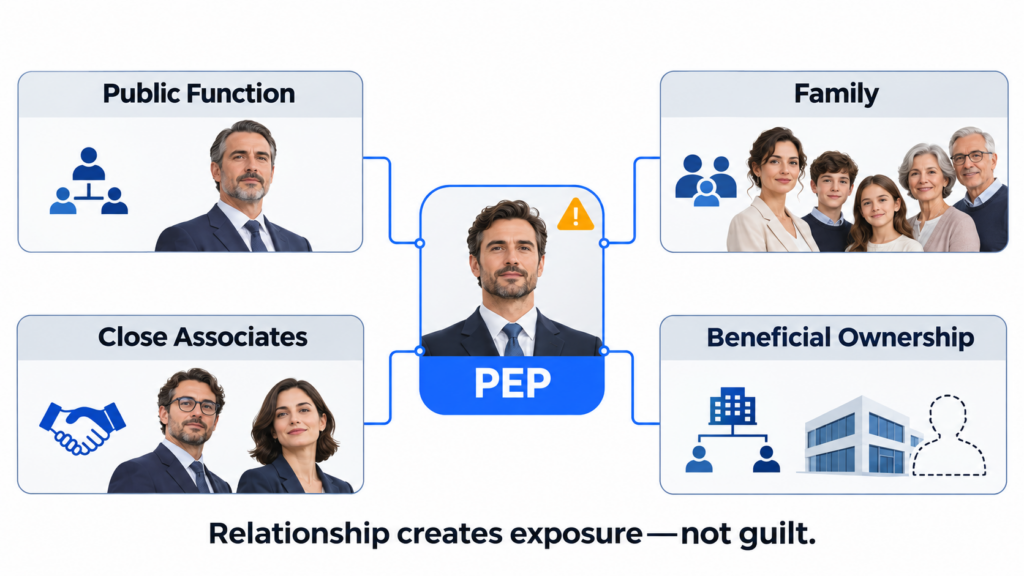
PEP controls commonly extend to close family members because assets, companies, or transactions may be placed in their names.
Depending on local law, relevant family members may include:
- Spouses or equivalent partners
- Children
- Spouses or partners of children
- Parents
- Siblings
- Other dependants or extended relatives in certain jurisdictions
There is no completely universal family boundary. FATF notes that appropriate definitions can depend on a country’s social, economic, and cultural structure. A relationship that creates substantial influence or financial dependency may be relevant even when it falls outside a narrow family definition. fatf-gafi.org
Family status should not automatically produce a high-risk decision. The organization should examine the relationship with the PEP, ownership connections, source of wealth, activity, and other relevant evidence.
5. Who Is a Close Associate?
A close associate is generally someone with a significant personal, professional, or financial relationship with a PEP.
Examples may include:
- Joint beneficial owners of a company or legal arrangement
- Business partners
- Individuals with close commercial relationships
- People who control an entity established for a PEP’s benefit
- Fellow directors with substantial shared interests
- Trusted advisers or intermediaries
- Other known close personal associates
The relationship should be supported by credible evidence. A shared employer, event attendance, or incidental contact does not necessarily establish a close association.
Businesses should also examine beneficial ownership. A customer may not personally be a PEP but may own, manage, or transact through an organization connected to one.
6. Why PEP Relationships Create Risk Exposure
Prominent public functions may provide influence over:
- Government procurement
- Public budgets
- Licences and concessions
- State-owned enterprises
- Regulatory decisions
- Public appointments
- Privatization or infrastructure projects
- Access to confidential government information
Relatives and associates may be used—knowingly or unknowingly—to hold assets, control businesses, transfer funds, or obscure beneficial ownership.
Risk depends on the combined context. Important factors include the individual’s authority, jurisdiction, industry, ownership structure, source of wealth, source of funds, expected activity, transaction behavior, and credible adverse information.
7. How Businesses Identify PEP Exposure
A PEP-screening workflow may compare customers, beneficial owners, directors, and related parties against suitable data sources.
Common matching attributes include:
- Full name and aliases
- Date of birth
- Nationality
- Country of residence
- Public role
- Appointment and departure dates
- Family or associate relationships
- Company ownership
- Identity-document information
Name similarity alone is insufficient. Common names, transliteration, incomplete records, and outdated information can create false positives. Potential matches should be resolved using secondary identifiers and credible supporting evidence.
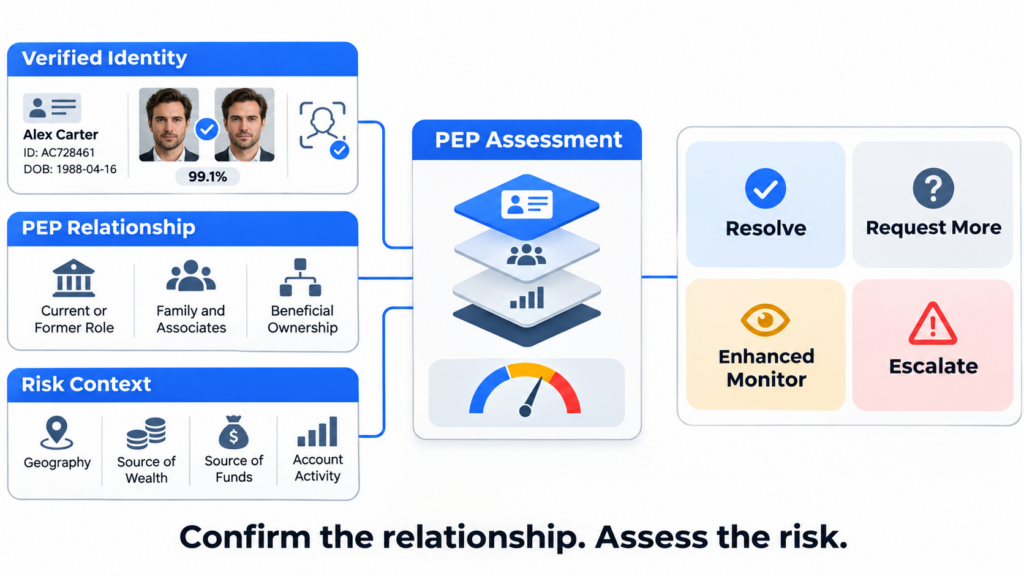
Face++ can support the identity-assurance layer. Its 1:1 face comparison capability evaluates whether a current facial capture and a trusted reference portrait likely belong to the same individual. Liveness detection can help establish genuine presence before verified customer information is submitted to a separate PEP-screening system.
8. What Happens After a PEP Match?
A possible match should trigger investigation, not automatic rejection.
A proportionate workflow may include:
- Confirming the customer’s identity
- Resolving the potential PEP record
- Determining the PEP category and current status
- Identifying relevant relatives and associates
- Understanding beneficial ownership
- Establishing source of wealth and source of funds
- Obtaining appropriate management approval
- Applying enhanced and ongoing monitoring
- Documenting the evidence and final decision
For example, UK requirements include senior-management approval, adequate source-of-wealth and source-of-funds measures, and enhanced ongoing monitoring for applicable PEP relationships.
9. Frequently Asked Questions
Q1. Is every public-sector employee a PEP?
No. PEP definitions generally focus on prominent public functions rather than middle-ranking or junior positions.
Q2. Is a PEP’s spouse automatically guilty of wrongdoing?
No. The relationship may create relevant exposure, but it is not evidence of criminal conduct.
Q3. Should businesses automatically reject PEPs?
Not generally. The appropriate response depends on applicable law, assessed risk, available evidence, and the organization’s policy.
Q4. Can biometric verification determine whether someone is a PEP?
No. Biometrics can help confirm that the person being screened matches trusted identity evidence. PEP status must be determined through appropriate screening data and compliance analysis.
10. Connect PEP Exposure to a Verified Identity
Effective PEP screening requires more than finding similar names. Businesses must confirm the customer’s identity, resolve the relationship, understand the individual’s influence, and evaluate risk in context.
Combining reliable PEP data with Face++ face comparison, liveness detection, beneficial-ownership analysis, and proportionate due diligence can help reduce false positives while directing enhanced controls toward relationships that genuinely require closer attention.