As financial and digital services move online, businesses need a reliable way to verify customers without requiring them to visit a branch or submit paper documents in person. This is where eKYC comes in.
eKYC, short for electronic Know Your Customer, is the digital process of verifying a customer’s identity before allowing them to open an account, access a regulated service, or complete a high-risk transaction. It replaces many manual checks with automated document verification, facial recognition, liveness detection, and data validation.
For banks, fintech companies, e-wallets, digital lenders, and online platforms, eKYC has become a core part of secure digital onboarding.
What Does eKYC Mean?
Traditional KYC requires organizations to collect and verify identity information such as a customer’s name, date of birth, address, and government-issued identity document. The process may involve physical forms, in-person inspection, and manual review.
eKYC performs the same basic function through digital channels.
A typical process asks the user to capture an identity document and take a selfie or short video. The system then checks whether the document is valid, whether the face matches the document holder, and whether the person is physically present rather than using a photo, replay, mask, or manipulated video.
The objective is to confirm that the document is genuine, the data is accurate, the user matches the document photo, and the session shows no obvious fraud signals.
How Does the eKYC Process Work?
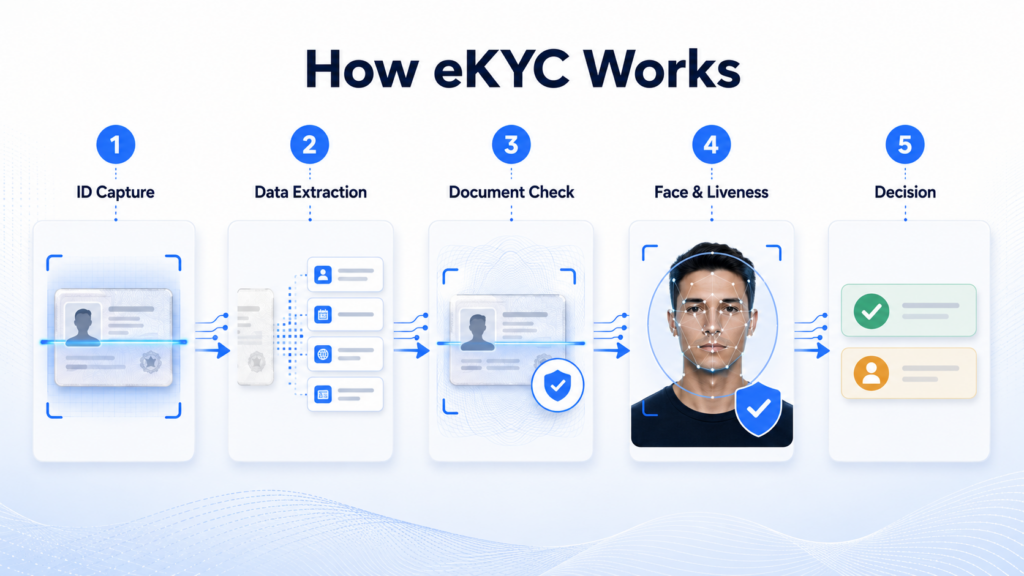
Although workflows vary by industry and country, most eKYC systems include several common steps.
1. Identity Document Capture
The user photographs or scans a government-issued document, such as a passport, national ID card, residence permit, or driver’s license.
The system first evaluates image quality. It checks whether the document is fully visible, correctly positioned, sharp, and free from excessive glare or blur. Poor-quality images may be rejected before further analysis.
2. OCR and Data Extraction
Optical character recognition, or OCR, reads the text printed on the document and converts it into structured data.
The system may extract the customer’s name, date of birth, document number, nationality, issue date, expiry date, and address. This reduces manual entry and helps prevent input errors.
3. Document Authenticity Verification
A secure eKYC process does more than read text. It also checks whether the document appears authentic.
Document verification may examine layout, fonts, security elements, photo placement, data consistency, tampering traces, screenshot patterns, and recapture signals. More advanced systems can identify altered names, replaced photos, edited expiry dates, or re-photographed documents.
4. Selfie Capture and Liveness Detection
The user is then asked to take a selfie or complete a short facial capture.
Liveness detection helps confirm that the system is interacting with a real person rather than a printed image, screen replay, mask, deepfake, or injected video stream.
Passive liveness can work in the background with minimal user action, while active liveness may ask the user to turn their head, blink, or follow an on-screen instruction.
5. Face Matching
The live facial image is compared with the portrait on the identity document.
Face matching measures the similarity between the two images and produces a confidence score. If the score meets the required threshold, the system can determine that the person presenting the document is likely to be its rightful owner.
6. Risk Decision
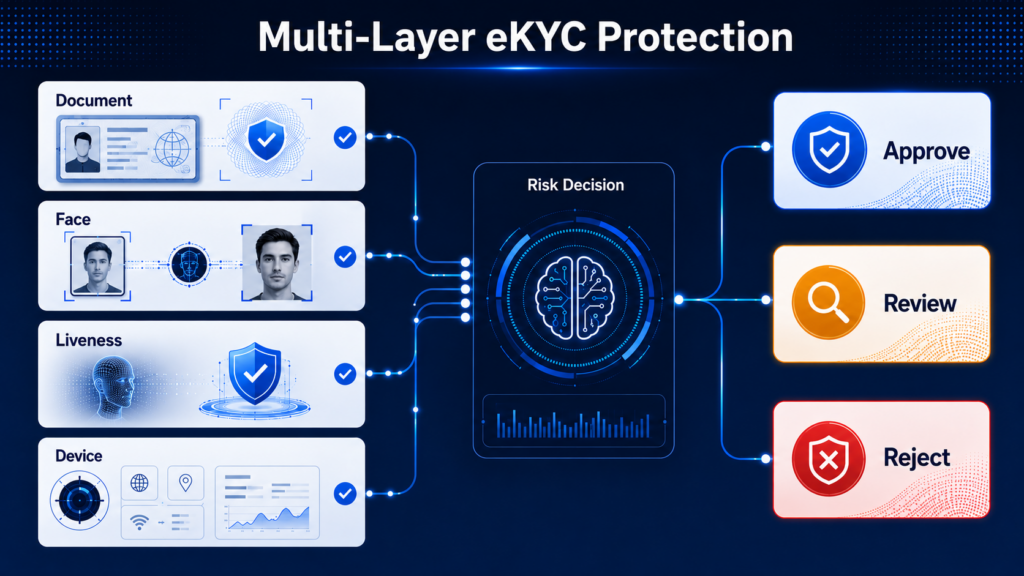
Finally, the eKYC platform combines document, facial, device, and session signals to make a decision.
A low-risk applicant may be approved automatically. A medium-risk applicant may be asked to complete another verification step. A high-risk application may be rejected or sent for manual review.
This risk-based approach helps businesses balance fraud prevention with onboarding speed.
What Technologies Are Used in eKYC?
Modern eKYC platforms combine several technologies rather than relying on a single check.
OCR extracts identity information. Computer vision analyzes document structure and image quality. Facial recognition compares a selfie with the document portrait. Liveness detection identifies presentation attacks and digital injection attempts. Device and session analysis can detect suspicious environments, such as emulators, proxy connections, or repeated account creation from the same device.
The strength of an eKYC system depends on how well these signals work together. A document may appear valid, but the same session may also show a face mismatch or risky device.
Why Do Businesses Use eKYC?
eKYC allows businesses to verify customers remotely while maintaining strong identity assurance.
Faster onboarding: Automated verification can often be completed in seconds or minutes, helping reduce customer abandonment.
Lower operating costs: Automation reduces the need for staff to review every application manually.
Better fraud detection: eKYC can identify document manipulation, identity theft, impersonation, deepfakes, and multi-account abuse during onboarding.
Improved customer experience: Users can verify their identity from a mobile device or computer without visiting a physical location.
Stronger compliance support: eKYC creates structured verification records, audit trails, and risk decisions that can support internal and regulatory requirements.
Where Is eKYC Used?
Banks and digital banks use eKYC for remote account opening. E-wallets use it before enabling payments or transfers. Digital lenders use it to reduce application fraud and synthetic identity risk. Insurance companies use it during enrollment and claims verification. Trading and cryptocurrency platforms use it to support customer due diligence.
Telecom operators may use eKYC for SIM registration, while marketplaces and gig platforms use it to verify sellers, drivers, or service providers. It can also be triggered during account recovery, profile changes, unusual transactions, or high-value withdrawals.
What Are the Main Risks in eKYC?
Fraudsters may use stolen documents, edited document images, re-photographed IDs, face swaps, deepfake videos, screen replays, masks, or virtual camera injection. They may also create multiple accounts using different identities or reuse the same device across a fraud network.
For this reason, businesses should not treat eKYC as a simple document upload process. A reliable system should combine document checks, liveness detection, face matching, device intelligence, and risk-based decisioning.
It should also provide fallback options, such as step-up verification and manual review.
How Can Businesses Choose an eKYC Solution?
Businesses should first confirm that the provider supports the document types and countries relevant to their target market.
The system should perform reliably across different lighting conditions, camera qualities, skin tones, document formats, and user devices. It should also protect against presentation attacks, deepfakes, document manipulation, and injection attacks.
Integration flexibility matters as well. Organizations may require mobile or web SDKs, APIs, configurable risk rules, audit logs, manual review tools, and suitable deployment options.
How Face++ Supports eKYC
Face++ provides computer vision and facial recognition capabilities that support important stages of the eKYC process.
These capabilities support face detection, facial quality assessment, and 1:1 face comparison, helping businesses determine whether a captured face is suitable for verification and matches the document portrait.
When integrated with document verification, liveness detection, and risk management systems, facial recognition can strengthen remote onboarding while keeping the customer journey simple.
Conclusion
eKYC is the digital foundation of modern customer identity verification. It allows businesses to confirm identity remotely, automate onboarding, reduce fraud, and support compliance without relying entirely on physical branches or manual checks.
The most important point is that eKYC is not a single technology. It is a coordinated process that combines document analysis, OCR, facial recognition, liveness detection, and risk decisioning.
As digital fraud becomes more advanced, effective eKYC will increasingly depend on multi-layer protection. Businesses that combine identity verification with device, behavioral, and fraud signals will be better positioned to approve legitimate customers quickly while stopping suspicious applications earlier.