Digital identity verification has become one of the most important trust layers in the online economy. Banks, fintech platforms, digital wallets, marketplaces, gaming platforms, social networks, and sharing-economy businesses all rely on remote identity checks to confirm whether a user is real, eligible, and trustworthy. In many digital journeys, identity verification is the first line of defense before a user can open an account, access funds, apply for credit, reset credentials, or perform high-risk transactions.
For years, digital identity verification mainly focused on two questions: is the identity document authentic, and does the person submitting it match the document portrait? This model worked well against many traditional fraud attempts, such as fake documents, stolen IDs, printed photos, screen replays, or basic face spoofing. But the threat landscape is now changing quickly.
Deepfakes are becoming a major threat because they challenge the basic assumption behind remote verification: that a face, a video, or a voice can be trusted as evidence of real human presence. With generative AI, attackers can create synthetic faces, manipulate videos, clone voices, animate still images, and simulate real-time interactions. This makes identity fraud more scalable, more convincing, and more difficult to detect with basic verification methods.
From Traditional Spoofing to AI-Generated Identity Attacks
Traditional biometric spoofing often relied on simple presentation attacks. Fraudsters might hold up a printed photo, replay a video from another device, wear a mask, or submit a manipulated image. These attacks were still serious, but many of them left detectable signals. Poor lighting, screen reflections, flat image texture, unnatural motion, or low-quality capture could often be identified by modern liveness detection systems.
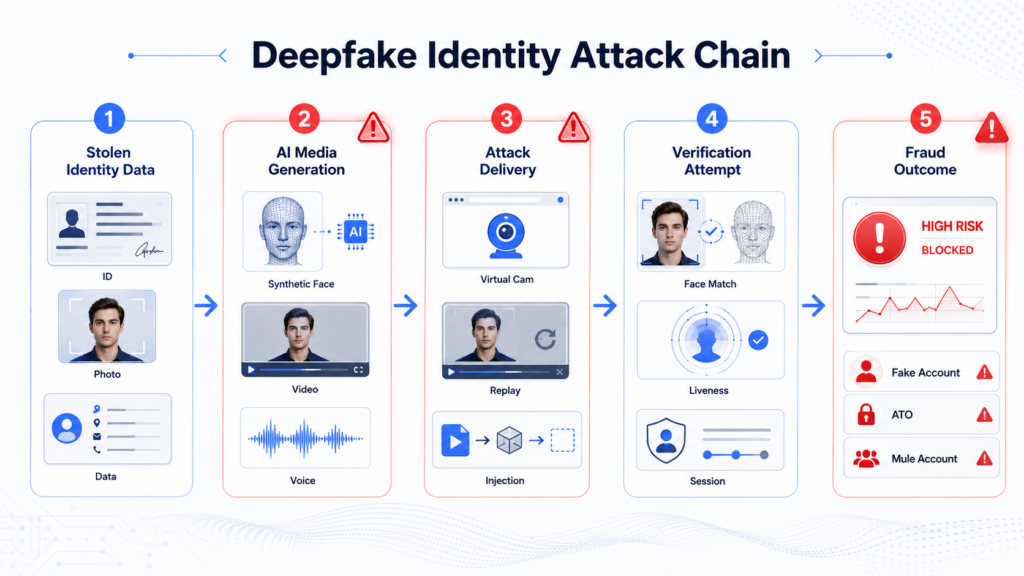
Deepfake attacks introduce a more advanced risk model. Instead of presenting a static fake, attackers can generate dynamic media that imitates a real person’s facial appearance, expressions, blinking, head movement, and even speech patterns. A stolen identity document can be combined with an AI-generated face. A public profile image can be animated into a short video. A live verification session can be manipulated through virtual camera tools or injection attacks.
The key difference is scalability. Deepfake creation is no longer limited to highly skilled specialists. Generative AI tools have lowered the cost and technical barrier of synthetic media production. Fraudsters can test multiple identities, iterate quickly, and combine deepfake content with stolen data, proxy networks, device farms, and automated onboarding scripts. As a result, deepfake fraud is no longer only a media manipulation issue. It is becoming a digital identity infrastructure risk.
Why Identity Verification Is a High-Value Target
Digital identity verification controls access to business value. Once a fraudster passes onboarding or account recovery, they may gain access to financial accounts, payment functions, credit products, platform privileges, or sensitive personal data. This makes identity verification a natural target for deepfake-enabled attacks.
In financial services, deepfakes can support fake account opening, mule account creation, loan fraud, unauthorized account recovery, and step-up verification bypass. In digital wallets and payment platforms, they can help fraud rings scale multi-account abuse or move funds through synthetic identities. In marketplaces and gig platforms, deepfakes can be used to create fake sellers, drivers, couriers, or service providers. In social platforms, they can enable impersonation, romance scams, and trust-based manipulation.
The risk is especially high in remote-first markets where users complete onboarding entirely through mobile or web channels. When there is no physical branch, counter staff, or in-person identity check, the platform must depend on digital signals. If those signals can be artificially generated or manipulated, the trust model becomes exposed.
Deepfakes Break the “Seeing Is Verifying” Assumption
The core problem with deepfakes is that they blur the line between visual realism and identity truth. A face may look real but still be synthetic. A video may show movement but still be generated. A selfie may match an ID portrait but still come from a manipulated media pipeline rather than a live camera. A voice may sound human but still be cloned.
This breaks the traditional assumption that visual presence equals real presence. For digital identity verification, that distinction matters. The goal is not simply to determine whether an image looks like a human face. The goal is to determine whether a genuine person is physically present, using a trusted capture process, and whether that person is the legitimate owner of the identity being presented.
Basic face matching alone cannot answer this question. A 1:1 comparison can determine whether two faces are visually similar, but it does not necessarily prove that the submitted face is live, unmodified, or captured from a legitimate camera session. Basic liveness detection also may not be enough if it only checks simple motion, blinking, or head movement. Deepfake systems can increasingly simulate these behaviors.
This is why digital identity verification needs to evolve from single-point biometric checks to layered identity risk analysis.
Common Deepfake Attack Patterns in Digital Identity Verification
Deepfake-enabled identity fraud can appear in several forms.
The first pattern is synthetic selfie submission. A fraudster may create or manipulate a face image to match a stolen or fabricated identity document. This can be used during account opening, loan applications, wallet registration, or platform onboarding.
The second pattern is face animation. A still image can be animated to simulate facial movement, blinking, or head turns. This type of attack is designed to bypass weak liveness checks that only look for basic motion.
The third pattern is video replay. Attackers may replay a pre-recorded video through a screen or virtual camera. In more advanced cases, the replayed content may be enhanced or generated by AI to appear more natural.
The fourth pattern is real-time face swapping. A fraudster can use software to replace their own face with another person’s face during a live verification session. This is particularly dangerous when the platform does not detect virtual cameras, abnormal media streams, or injection attempts.
The fifth pattern is deepfake-assisted account takeover. If an attacker already has stolen credentials, personal data, or access to a victim’s device, deepfake media can be used to pass account recovery or high-risk step-up verification.
The sixth pattern is coordinated fraud network activity. Deepfakes are often not used alone. They may be combined with document tampering, synthetic identities, device farms, emulators, proxy IPs, repeated registrations, and abnormal behavioral patterns. In this scenario, deepfake detection must be part of a broader fraud intelligence framework.
Why Basic Liveness Is No Longer Enough
Liveness detection remains essential, but its role needs to expand. In the past, liveness was often designed to detect whether the input was a real person rather than a photo or replay. In the deepfake era, the question is more complex: is this a genuine live human capture, from a trusted device and camera path, without AI generation, face manipulation, replay, or injection?
To answer this, modern liveness detection needs to analyze multiple dimensions. It should evaluate facial texture, depth cues, lighting consistency, motion patterns, temporal coherence, capture quality, and signs of synthetic generation. It should also detect whether the media stream has been tampered with before reaching the verification system.
However, liveness should not operate in isolation. A strong identity verification workflow needs to connect face signals with document signals, device intelligence, session behavior, and historical risk indicators. A face may pass a single check, but the overall session may still be suspicious if the device is an emulator, the IP location is inconsistent, the document image shows recapture traces, or the same device has created many accounts.
Deepfake defense is therefore not only a model accuracy problem. It is a risk orchestration problem.
Building a Layered Defense Against Deepfake Fraud
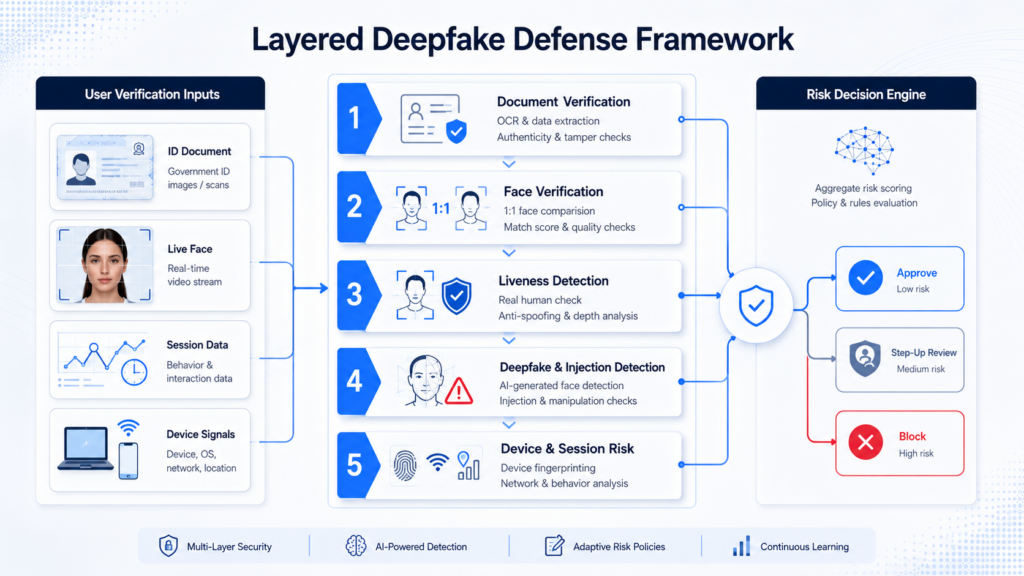
A modern digital identity verification strategy should include multiple layers of protection.
The first layer is document verification. Platforms need to check whether the submitted identity document is authentic, complete, unaltered, and consistent with the expected format. OCR can extract structured data, but authenticity analysis should also detect tampering, screenshots, recapture traces, image editing, and abnormal document texture.
The second layer is face verification. The user’s live face should be compared with the portrait on the identity document to confirm identity consistency. High-accuracy face matching is critical, especially in markets with diverse document formats, image quality levels, and user capture environments.
The third layer is advanced liveness detection. This layer should confirm that the biometric input comes from a real person in a real session. It should detect presentation attacks such as printed photos, screen replays, masks, and manipulated media.
The fourth layer is deepfake and injection attack detection. Platforms need to identify signs of AI-generated faces, virtual cameras, face swaps, replayed videos, and abnormal media pipelines. This is increasingly important for both mobile and web-based onboarding.
The fifth layer is device and session risk analysis. Device fingerprinting, emulator detection, IP reputation, proxy signals, geolocation consistency, session behavior, and repeated registration patterns can provide valuable context. Many deepfake attacks become easier to detect when they are linked to abnormal device or network behavior.
The final layer is risk-based decisioning. Instead of applying the same rule to every user, platforms should combine all signals into a unified risk engine. Low-risk users can be approved quickly. Medium-risk users can be routed to step-up verification or manual review. High-risk attempts can be blocked, logged, and connected to fraud investigation workflows.
Balancing Security, Compliance, and User Experience
Deepfake fraud creates a difficult business challenge. If verification is too weak, platforms face fraud loss, compliance exposure, operational burden, and reputational risk. If verification is too strict, legitimate users may experience false rejection, onboarding friction, and lower conversion rates.
The right approach is adaptive verification. Not every user needs the highest-friction journey. Instead, the verification process should respond to risk level. A normal user with a trusted device and clean identity signals should pass smoothly. A suspicious user with synthetic media indicators, abnormal device signals, or inconsistent document data should trigger stronger checks.
For regulated industries, auditability is equally important. Fraud and compliance teams need clear evidence behind each decision. They need to understand which signals were suspicious, whether liveness failed, whether the document was abnormal, whether the device was risky, and why the final decision was made. This helps support investigation, regulatory review, model improvement, and fraud operations.
Preparing for the Next Wave of Identity Fraud
Deepfake technology will continue to improve. Attackers will test verification systems, learn from failed attempts, and adapt their methods. Future identity fraud will likely become more multimodal, combining face manipulation, voice cloning, document fraud, behavioral automation, and device-level evasion.
This means businesses need to move from static identity checks to continuous identity trust. Verification should not be treated as a one-time onboarding step. It should protect the full user lifecycle, including registration, login, account recovery, profile changes, new device binding, high-value transactions, and suspicious activity review.
Face++ helps businesses strengthen this trust layer with advanced face recognition, face comparison, and liveness detection technologies. By combining biometric verification with anti-spoofing and risk-aware workflows, enterprises can better distinguish genuine users from synthetic or manipulated identities.
Deepfakes are becoming a major threat because they attack the foundation of digital trust. They make it harder to know whether the person behind the screen is real, present, and legitimate. In the AI fraud era, seeing is no longer enough. To protect digital identity verification, organizations need layered, intelligent, and adaptive defenses that understand the full identity interaction, not just the face on the screen.