For any business that needs to verify user identity, Know Your Customer (KYC) is no longer just a compliance requirement. It has become a core part of user onboarding, fraud prevention, risk control, and customer experience.
In the past, KYC was mainly handled through physical branches, paper documents, manual checks, and face-to-face verification. This worked when customer interactions happened offline. But as banking, fintech, lending, insurance, mobility, gaming, and digital platforms move online, traditional KYC processes often struggle to keep up with the speed, scale, and fraud risks of digital onboarding.
This is where electronic Know Your Customer, or eKYC, becomes increasingly important. eKYC enables businesses to verify customer identities remotely by using digital document verification, OCR, face comparison, liveness detection, and automated risk checks.
So, what is the real difference between eKYC and traditional KYC? And why should digital businesses care?
What Is Traditional KYC?
Traditional KYC refers to identity verification processes that are usually performed manually or in person. A customer may be required to visit a branch, submit physical copies of identity documents, fill out paper forms, and wait for a staff member to review the information.
In a traditional process, verification often depends on manual inspection. Staff members check whether the identity document appears authentic, compare the document photo with the person in front of them, and confirm whether the information matches internal records or regulatory requirements.
This approach can be effective in controlled offline environments. It allows businesses to interact directly with customers and review original documents. However, it also creates operational limitations.
Traditional KYC can be slow, expensive, and difficult to scale. It requires trained staff, physical service points, document storage, and manual review workflows. For businesses serving users across regions, countries, or time zones, traditional KYC can quickly become a bottleneck.
It also creates friction for customers. Users may need to travel to a branch, wait in line, provide repeated information, or wait days for account approval. In a digital-first market, this level of friction can directly impact conversion rates and customer acquisition.
What Is eKYC?
eKYC is the digital version of customer identity verification. Instead of requiring users to complete verification in person, eKYC allows them to submit identity information through a mobile app, website, or digital platform.
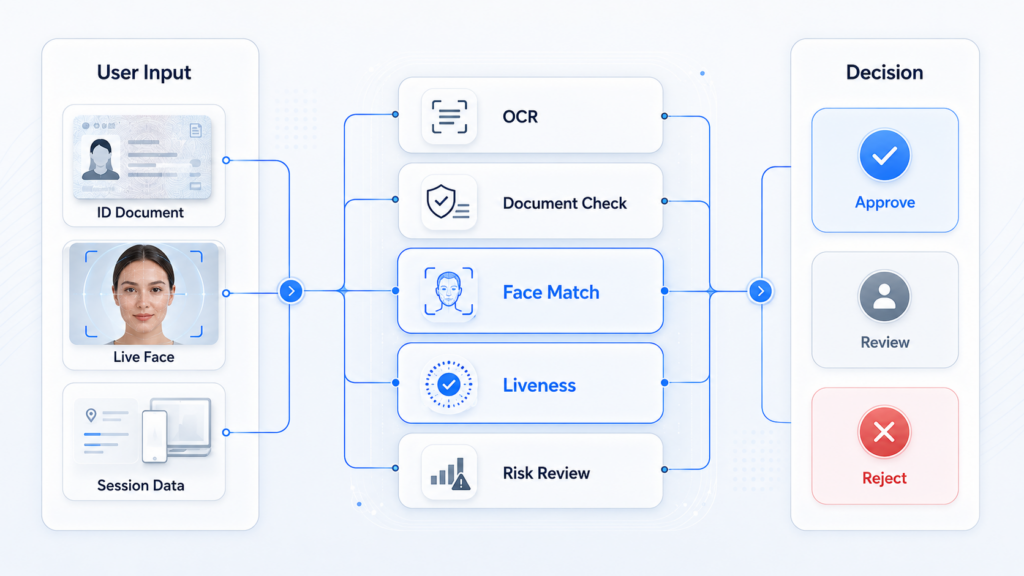
A typical eKYC workflow may include several steps. First, the user captures an image of their identity document, such as a passport, national ID card, or driver’s license. OCR technology extracts key information from the document, including name, date of birth, document number, and expiration date. Document verification technology checks whether the document image shows signs of tampering, forgery, screenshots, recapture, or other abnormal patterns.
Next, the user may be asked to take a selfie or complete a short video-based liveness check. Face comparison technology verifies whether the live face matches the portrait on the identity document. Liveness detection helps confirm that the user is a real person physically present during the verification process, rather than a printed photo, screen replay, mask, or deepfake attempt.
Depending on the business requirements, eKYC can also include device signals, IP risk, behavioral patterns, database checks, watchlist screening, or manual review for higher-risk cases.
The key difference is that eKYC turns identity verification into a remote, automated, and scalable digital process.
eKYC vs Traditional KYC: Key Differences
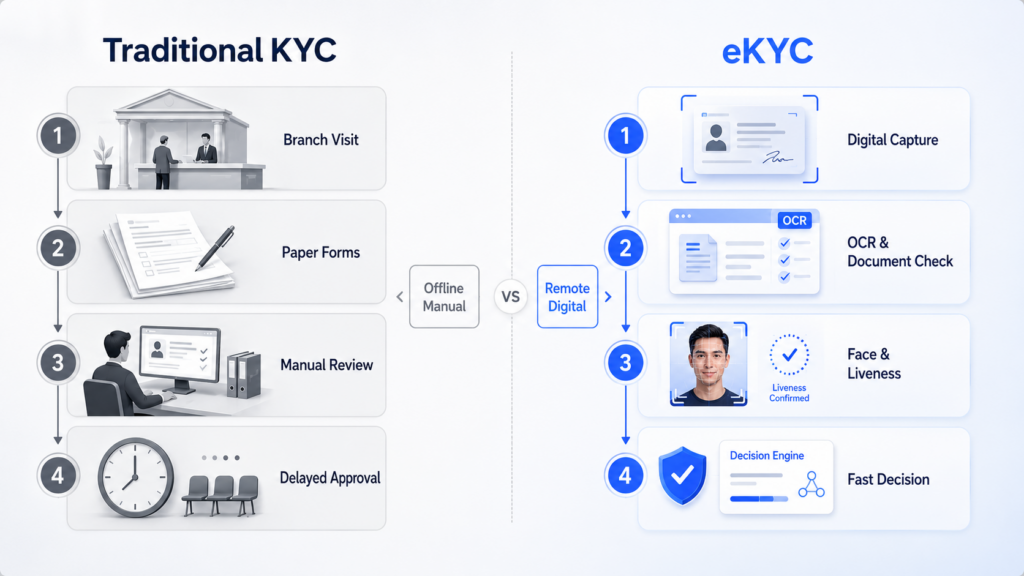
The first major difference is the customer journey.
Traditional KYC usually requires offline interaction. Customers may need to visit a branch or submit physical documents. eKYC allows users to complete identity verification remotely, often within minutes, using a smartphone or computer. For digital businesses, this can significantly reduce onboarding friction.
The second difference is speed.
Manual KYC can take hours, days, or even longer, especially when review teams are overloaded. eKYC can automate many verification steps in real time, such as OCR extraction, face matching, and liveness detection. This helps businesses approve legitimate users faster while routing suspicious cases to manual review.
The third difference is scalability.
Traditional KYC depends heavily on human resources. As user volume grows, businesses need more staff, more review capacity, and more physical infrastructure. eKYC is easier to scale across large user bases because automated checks can process high volumes of applications consistently.
The fourth difference is fraud detection.
Traditional KYC relies mainly on human judgment. While experienced reviewers can identify obvious fraud, they may struggle with sophisticated digital threats, such as high-quality document manipulation, screen recapture, synthetic identities, deepfake videos, or virtual camera injection. eKYC systems can combine multiple technical signals to detect suspicious patterns that may be difficult to identify manually.
The fifth difference is data consistency.
Manual review can vary by reviewer experience, workload, and interpretation. eKYC can standardize verification rules, risk thresholds, and decision logic across markets. This helps businesses maintain more consistent onboarding decisions and audit trails.
Why Digital Businesses Are Moving Toward eKYC
For digital businesses, identity verification is not just a compliance checkpoint. It is part of the product experience.
When onboarding is slow, users drop off. When verification is too loose, fraud risk increases. When review processes are inconsistent, businesses face both operational inefficiency and compliance exposure.
eKYC helps address these challenges by balancing speed, security, and scalability.
For fintech platforms, eKYC can help verify users before account opening, payments, lending, or wallet activation. For digital banks, it supports remote customer onboarding without relying only on physical branches. For mobility and delivery platforms, eKYC can help verify drivers, riders, and service providers. For social, gaming, and marketplace platforms, it can support age verification, account recovery, anti-fraud controls, and trust and safety workflows.
In all these scenarios, businesses need to answer the same basic question: is this user who they claim to be?
eKYC provides a digital framework for answering that question at scale.
Does eKYC Replace Traditional KYC Completely?
Not always.
In many industries, eKYC and traditional KYC can work together. Low-risk users may complete automated eKYC and receive fast approval. Medium-risk cases may require additional verification, such as step-up authentication or extra document checks. High-risk cases may be routed to manual review or rejected based on the company’s risk policy.
This hybrid model is especially useful for regulated businesses. It allows companies to improve user experience without removing human oversight from complex or suspicious cases.
The goal is not simply to replace people with automation. The goal is to use automation for repetitive, high-volume verification tasks, while allowing human reviewers to focus on cases that genuinely need investigation.
What Should Businesses Look for in an eKYC Solution?
When choosing an eKYC solution, businesses should look beyond basic document upload and selfie capture. A strong eKYC workflow should support multiple layers of identity verification.
Document verification is essential. The system should be able to extract data accurately and detect potential manipulation, expired documents, poor image quality, screenshots, or recaptured documents.
Face verification is also important. The platform should compare the user’s live face with the document portrait and return a reliable match result.
Liveness detection is critical in remote onboarding. It helps defend against presentation attacks such as printed photos, video replays, masks, and increasingly sophisticated deepfake-based attacks.
Global document coverage matters for companies expanding across markets. A business operating in multiple countries needs to support different ID types, languages, layouts, and document quality conditions.
Finally, businesses should consider integration flexibility. eKYC should fit into existing mobile apps, web platforms, backend systems, risk engines, and compliance workflows. SDKs, APIs, dashboards, audit logs, and configurable review rules all affect how smoothly the solution can be deployed.
The Future of KYC Is Digital, Risk-Based, and Multi-Layered
Traditional KYC was designed for an offline world. eKYC is designed for digital business.
As more customer journeys move online, businesses need identity verification that is fast enough for digital onboarding, secure enough to prevent fraud, and flexible enough to meet different market and compliance requirements.
The most effective approach is not a single check, but a multi-layered identity verification framework. Document checks, OCR, face comparison, liveness detection, and risk-based review all work together to create a stronger onboarding process.
For digital businesses, eKYC is no longer only a back-office compliance tool. It is a strategic capability that supports growth, trust, and fraud prevention.
By adopting the right eKYC approach, businesses can onboard legitimate users faster, reduce manual workload, strengthen fraud defenses, and build safer digital services from the first point of customer interaction.