Know Your Customer (KYC) is often treated as a one-time onboarding requirement. A user submits an identity document, completes face verification and liveness detection, and receives access to the platform.
That initial verification is essential, but it only confirms identity at a specific moment. Customer information can change, documents can expire, accounts can be compromised, and user behavior can become riskier over time. A customer who appeared legitimate during registration may not remain low risk throughout the entire relationship.
Ongoing KYC addresses this gap by continuously monitoring identity-related risk and triggering additional checks when meaningful changes or suspicious events occur.
What Is Ongoing KYC?
Ongoing KYC, also known as continuous KYC or perpetual KYC, is the process of keeping customer identity and risk profiles up to date after onboarding.
Rather than repeating the complete KYC process at fixed intervals for every customer, digital platforms can monitor relevant signals and initiate targeted reverification when risk changes.
An ongoing KYC program may include:
- Monitoring changes to customer information
- Tracking document validity and expiration
- Detecting unusual device or account activity
- Reviewing changes in customer risk classification
- Screening customers against updated watchlists
- Reassessing accounts after high-risk events
- Requesting identity reverification when necessary
The objective is not to verify every customer continuously. It is to maintain confidence that the person controlling an account remains the legitimate user and that the customer profile still reflects current risk.
Why One-Time KYC Creates Long-Term Gaps
A successful onboarding check does not protect an account indefinitely.
After onboarding, an attacker may obtain the user’s password, take control of a trusted device, change account details, or manipulate an account recovery process. Fraudsters may also create legitimate-looking accounts and wait before initiating suspicious activity.
Static KYC records can become outdated for several reasons:
- Identity documents expire or are replaced
- Addresses, occupations, or beneficial ownership details change
- Previously low-risk customers enter higher-risk activities
- Account credentials are stolen
- New fraud patterns emerge
- Regulatory and sanctions data is updated
If these changes are not detected, the platform may continue relying on an identity decision made months or years earlier.
Ongoing KYC vs. Periodic KYC Reviews
Traditional periodic KYC reviews are usually conducted according to a fixed schedule. High-risk customers may be reviewed annually, while lower-risk customers may be reviewed every few years.
This model is predictable, but it can create a long delay between a risk change and the next scheduled review. It may also create unnecessary friction by requiring customers with no meaningful changes to repeat the entire process.
Ongoing KYC uses risk events to supplement or replace some fixed reviews. A platform can reassess a customer when a relevant signal appears, such as:
- A login from an unfamiliar device or location
- A password reset or account recovery request
- A change to the registered name, address, or phone number
- The addition of a new payment beneficiary
- A high-value withdrawal
- Unusual transaction velocity
- Repeated failed verification attempts
- A document approaching expiration
This event-driven approach allows businesses to focus stronger controls on sessions and customers that present elevated risk.
The Role of Continuous Identity Risk Monitoring
Ongoing KYC requires a unified view of identity, device, behavior, and transaction signals. These signals should not be assessed in isolation.
For example, a customer changing an address may be legitimate. However, an address change combined with a new device, an unusual IP location, and an immediate high-value withdrawal may indicate account takeover.
Continuous identity risk monitoring connects these signals to determine whether the platform should allow the activity, request additional verification, or block the session.
Identity and Profile Signals
Platforms should monitor changes to names, addresses, contact details, identity documents, and other important customer information. Significant or inconsistent changes may require document verification or additional review.
Device and Session Signals
New devices, emulators, VPNs, proxy networks, abnormal IP locations, and device fingerprint changes can indicate that someone other than the verified user is controlling the account.
Behavioral Signals
Changes in navigation patterns, typing behavior, transaction habits, or account management activity can reveal risk that is not visible in static identity records.
Face and Liveness Verification
Face verification can confirm whether the current user matches the previously verified identity. Liveness detection helps establish that the submitted facial media comes from a real, present person rather than a printed image, replayed video, deepfake, or manipulated stream.
Face checks are especially valuable during account recovery, sensitive profile changes, new-device activation, and high-risk transactions.
External Risk Data
Updated sanctions, politically exposed person, adverse media, and fraud intelligence data may change a customer’s risk classification even when their account behavior remains stable.
Building a Risk-Based Ongoing KYC Workflow
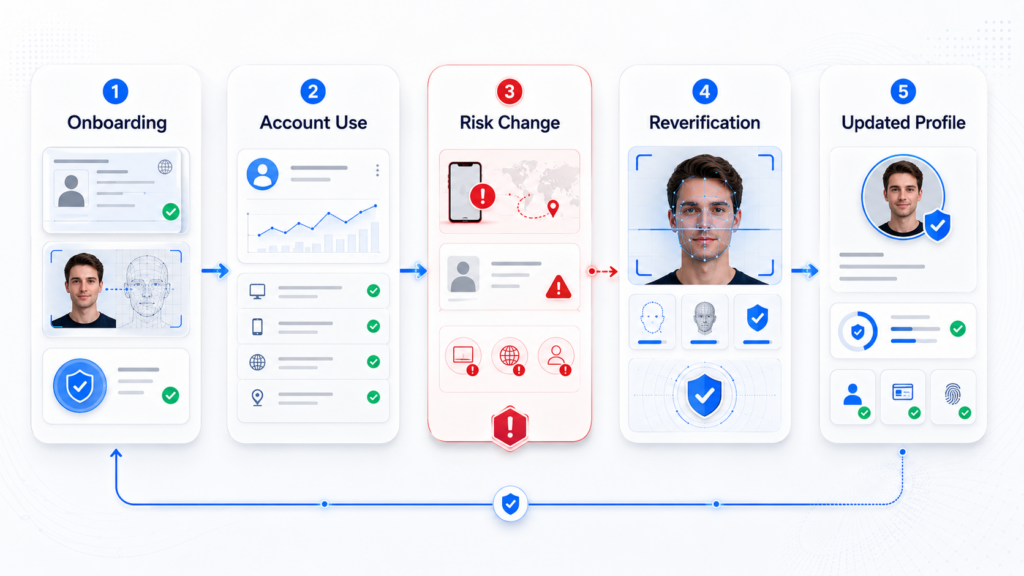
A practical ongoing KYC workflow starts with continuous signal collection. A risk engine then evaluates the customer profile, current session, historical behavior, and triggering event.
The platform can route customers into different actions:
- Low risk: Continue without additional friction
- Medium risk: Request face verification or passive liveness
- High risk: Require stronger identity and document reverification
- Critical risk: Block the action or route the case to manual review
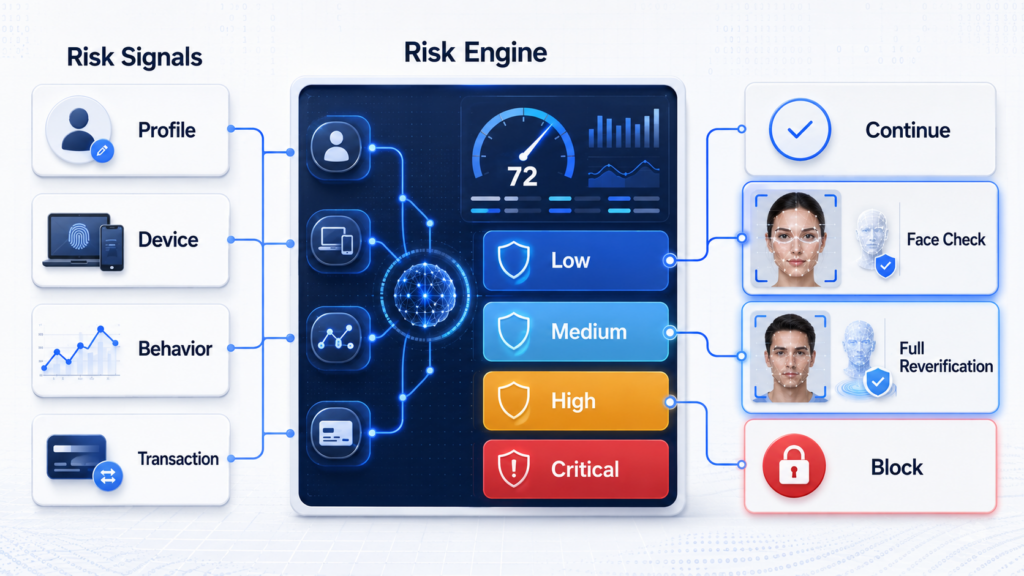
This layered approach avoids applying the same verification burden to every customer. Low-risk users receive a smoother experience, while suspicious sessions face stronger controls.
Risk rules should also reflect the action being performed. Viewing an account balance does not require the same assurance as changing ownership information or initiating a large withdrawal.
Implementation Priorities for Digital Platforms
Businesses introducing ongoing KYC should first identify the events that create meaningful identity risk. These triggers should be connected to clear verification actions and escalation rules.
Key implementation priorities include:
- Create a unified customer risk profile. Connect onboarding results with device, session, behavioral, and transaction data.
- Define event-based triggers. Prioritize account recovery, sensitive profile changes, new devices, document expiration, and unusual transactions.
- Use proportional verification. Match the level of friction to the risk level and business action.
- Protect biometric verification. Combine face matching with liveness detection and capture-integrity controls.
- Maintain auditability. Record the signals, decisions, verification results, and reviewer actions associated with each case.
- Review performance continuously. Monitor false rejections, step-up completion, fraud detection, and manual review volumes.
Privacy and data protection must remain central. Platforms should collect only the information needed for defined security and compliance purposes, apply appropriate retention controls, and protect identity and biometric data throughout its lifecycle.
Conclusion
KYC should not end when a customer completes onboarding. Identity risk continues to evolve as customer information, account access, behavior, and external risk data change.
Ongoing KYC helps digital platforms detect these changes earlier and respond with proportionate verification. By combining continuous risk monitoring with event-driven face verification, liveness detection, device intelligence, and risk-based decisioning, businesses can strengthen account security while minimizing unnecessary friction for legitimate users.