Face verification is widely used in digital onboarding, account recovery, login authentication, and high-risk transaction approval. However, as facial recognition systems become more common, attackers are moving beyond physical presentation attacks such as printed photos or replayed videos.
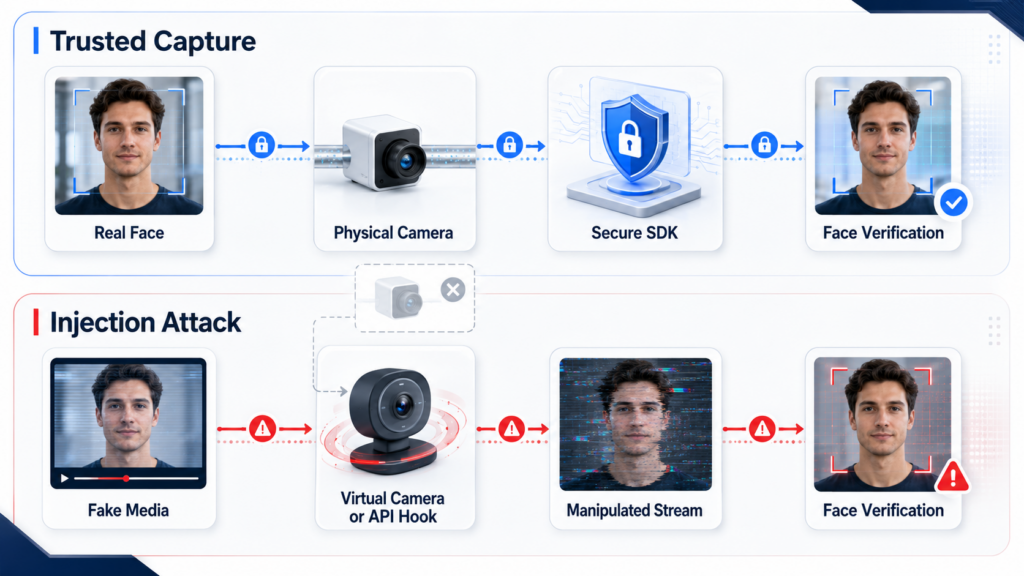
Digital injection attacks target the image capture pipeline itself. Instead of presenting fake content to a physical camera, attackers inject manipulated images or video streams directly into an application, SDK, virtual camera, or device interface. This can allow high-quality deepfakes, prerecorded videos, or synthetic faces to reach the verification system without ever appearing in front of a real camera.
Detecting these attacks requires more than conventional face matching. Businesses need a layered approach that combines capture integrity, liveness detection, device intelligence, and risk-based decisioning.
What Is a Digital Injection Attack?
A digital injection attack occurs when fraudulent visual content is inserted into the face verification process through software manipulation. The injected content may be a stolen selfie, a prerecorded video, a face-swapped video, or a fully synthetic identity generated by AI.
Common injection methods include:
- Replacing the live camera stream with a virtual camera
- Hooking or modifying camera APIs
- Tampering with the face capture SDK
- Running the verification process inside an emulator
- Streaming prerecorded or deepfake video into the application
- Manipulating communication between the client and verification server
Unlike presentation attacks, these methods can bypass the physical camera. The injected media may therefore avoid visual defects typically associated with screens, printed photos, or masks.
Why Traditional Liveness Checks May Not Be Enough
Traditional liveness detection often analyzes whether the captured person displays natural facial characteristics or completes a requested action. These checks remain important, but digital injection creates a different risk.
An attacker can prepare a video that contains blinking, head movement, facial expressions, or challenge-response actions. Generative AI can also produce realistic motion in real time. If the verification system evaluates only the final video frames, the content may appear sufficiently lifelike.
The system must therefore determine not only whether the face looks live, but also whether the media came from a trusted capture process.
This distinction creates two separate questions:
- Is the face a real, live person?
- Was the face captured securely through the expected camera and application environment?
A strong verification process must answer both.
Key Signals for Detecting Injection Attacks
1. Capture Pipeline Integrity
The first defense is verifying that the image or video originated from an authorized capture component.
Applications should protect the connection between the camera, capture SDK, and backend verification service. Integrity controls can help identify modified SDKs, altered application packages, unexpected media sources, or attempts to bypass the normal capture flow.
Server-side checks should also validate session identifiers, timestamps, capture sequences, and request signatures. A valid face image submitted through an invalid process should still be treated as suspicious.
2. Virtual Camera and API Manipulation
Virtual cameras are legitimate tools, but they can also be used to replace a physical camera feed with prerecorded or generated content.
Detection mechanisms can inspect camera properties, device capabilities, media metadata, and inconsistencies between the declared capture environment and the actual data stream. Unexpected resolutions, frame rates, encoding patterns, or camera identifiers may indicate that the media did not originate from the expected hardware.
No single anomaly proves fraud. Multiple signals should be evaluated together to reduce false positives.
3. Device and Runtime Risk
Injection attacks often rely on compromised environments, including rooted devices, jailbroken devices, emulators, debugging frameworks, or application-hooking tools.
Device risk analysis can identify:
- Root or jailbreak indicators
- Emulator or virtual machine characteristics
- Debugging and instrumentation tools
- Application package modification
- Suspicious screen capture or overlay activity
- Abnormal camera permissions
- Device fingerprint inconsistencies
These signals add important context. A technically convincing face video becomes much riskier when it originates from an emulator or modified application.
4. Advanced Liveness Analysis
Liveness detection remains a core layer because many injected videos still contain detectable inconsistencies.
A modern liveness engine can analyze facial texture, depth cues, lighting behavior, motion continuity, image noise, compression patterns, and temporal consistency across frames. It may also detect artifacts associated with face swapping, reenactment, or generative video.
Passive liveness provides a low-friction experience for normal users, while active challenges can be introduced when the session presents elevated risk. Challenge instructions should be dynamic and difficult to predict in advance.
5. Deepfake and Synthetic Media Indicators
AI-generated faces may show subtle inconsistencies in facial boundaries, local textures, reflections, motion, or synchronization between different facial regions. These signals can be analyzed across multiple frames instead of evaluating a single selfie.
However, deepfake detection should not operate as an isolated binary check. Generative models continue to improve, and compression or poor network conditions may create similar artifacts. Deepfake indicators should contribute to an overall risk score alongside capture, device, and behavioral signals.
6. Session and Behavioral Anomalies
The wider verification journey can reveal fraud that is not visible in the face itself.
Risk indicators may include repeated attempts with different identities, unusually fast completion, frequent switching between devices, mismatched IP and device locations, or multiple accounts using related device fingerprints.
Connecting face verification with session history makes it harder for attackers to test different injection methods repeatedly without detection.
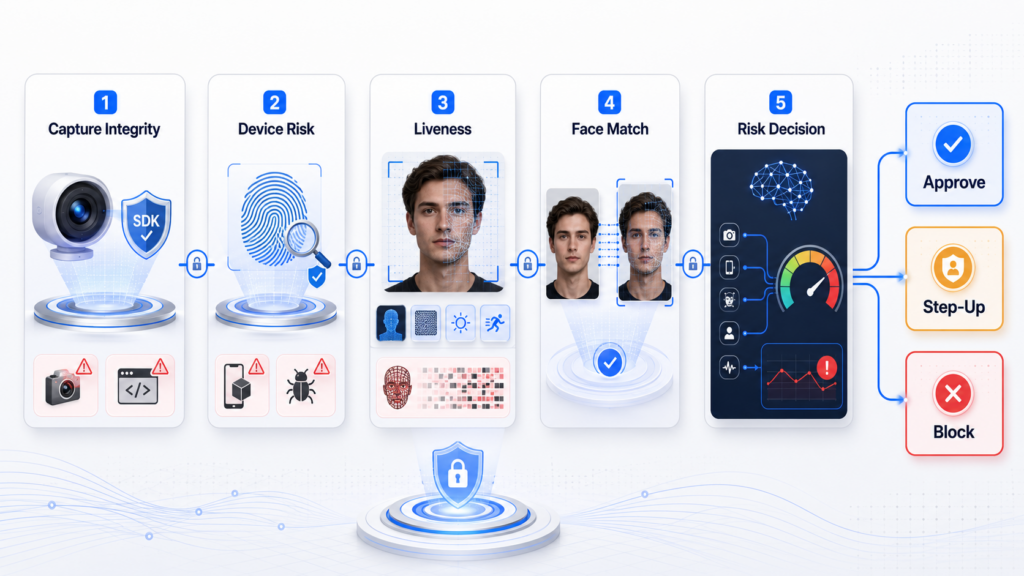
Building a Layered Detection Workflow
An effective workflow begins before the face reaches the recognition engine.
The application first validates the device, application, and capture environment. The captured media then passes through liveness and manipulation analysis. Face matching determines whether the live face corresponds to the identity document or enrolled account. Finally, a risk engine combines all available signals and assigns an appropriate action.
Low-risk sessions can continue automatically. Medium-risk sessions may require an additional liveness challenge or another identity factor. High-risk sessions can be blocked or routed to manual review.
This risk-based model avoids applying maximum friction to every user while maintaining stronger controls for suspicious sessions.
Practical Priorities for Digital Businesses
Businesses implementing face verification should prioritize four capabilities:
- Secure SDK and API integration
- Combined liveness and capture-integrity analysis
- Device, session, and behavioral risk monitoring
- Configurable risk-based decision rules
Detection models and rules should also be updated as attackers adopt new virtual-camera tools and generative techniques. Logging rejected and suspicious sessions provides valuable evidence for improving future defenses.
Conclusion
Digital injection attacks challenge a basic assumption of face verification: that submitted media came from a real camera during a legitimate session. Protecting against them requires visibility into the complete journey from camera capture to final identity decision.
By combining capture integrity, device intelligence, advanced liveness detection, deepfake analysis, face matching, and risk-based orchestration, businesses can detect attacks that would be difficult to identify from facial appearance alone. Face++ face verification and liveness capabilities can serve as core components within this layered identity security architecture.