Remote identity verification traditionally assumes that the face captured during onboarding, login, or account recovery belongs to a real person using a genuine camera. Deepfake technology challenges that assumption by enabling attackers to synthesize faces, manipulate facial movement, and inject artificial media into verification workflows.
Deepfakes are not one attack method. They can target the document portrait, the live face capture, the camera pipeline, or the wider customer journey. Digital platforms therefore need to identify both the manipulated content and the way it enters the verification process.
1. Face-Swap Attacks
A face swap replaces the face of the person operating the device with the appearance of another individual.
The source identity may come from:
- Social-media photographs
- Stolen selfies
- Compromised customer profiles
- Identity-document portraits
- Previously captured verification footage
Some attacks process recorded video in advance, while more advanced tools can perform the swap during a live session. The resulting face may blink, turn, speak, and follow basic instructions while still representing the wrong person.
Face comparison alone may produce a high score if the generated face closely resembles the trusted reference. Platforms must therefore evaluate genuine presence, capture integrity, and manipulation signals separately.
2. Facial Reenactment and Expression Manipulation
Facial reenactment transfers the movements or expressions of one person onto another face. Instead of replacing the complete face, the attacker may manipulate:
- Eye movement
- Blinking
- Head pose
- Mouth movement
- Facial expressions
- Challenge-response actions
This technique can make a static or prerecorded identity appear interactive. It is especially relevant when a liveness process relies on predictable actions such as blinking, smiling, or turning the head.
Dynamic and randomized challenges can increase attack difficulty, but they should be combined with passive liveness, media analysis, and trusted-capture controls.
3. Lip-Sync and Voice-Enhanced Deepfakes
A lip-sync attack modifies mouth movements so that a face appears to speak selected words. It may also be combined with synthetic or cloned audio.
This can target verification workflows that ask users to:
- Read numbers or phrases
- Repeat a randomized instruction
- Confirm account information
- Participate in a video interview
- Authorize a sensitive transaction
Audio-visual synchronization should not be treated as proof of genuine presence. Modern generated media can reproduce both speech and corresponding facial movement.
4. Fully Synthetic Faces
Not every deepfake impersonates a real customer. Generative models can create a fictional face that does not belong to any real person.
A synthetic face may be combined with fabricated or partially genuine identity data to create an artificial customer profile. Attackers may reuse or modify the same generated identity across multiple accounts, devices, or documents.
Where legally permitted and appropriately governed, 1:N biometric search can help identify repeated or related facial identities. Device relationships, document reuse, payment instruments, and behavioral patterns can provide additional evidence.
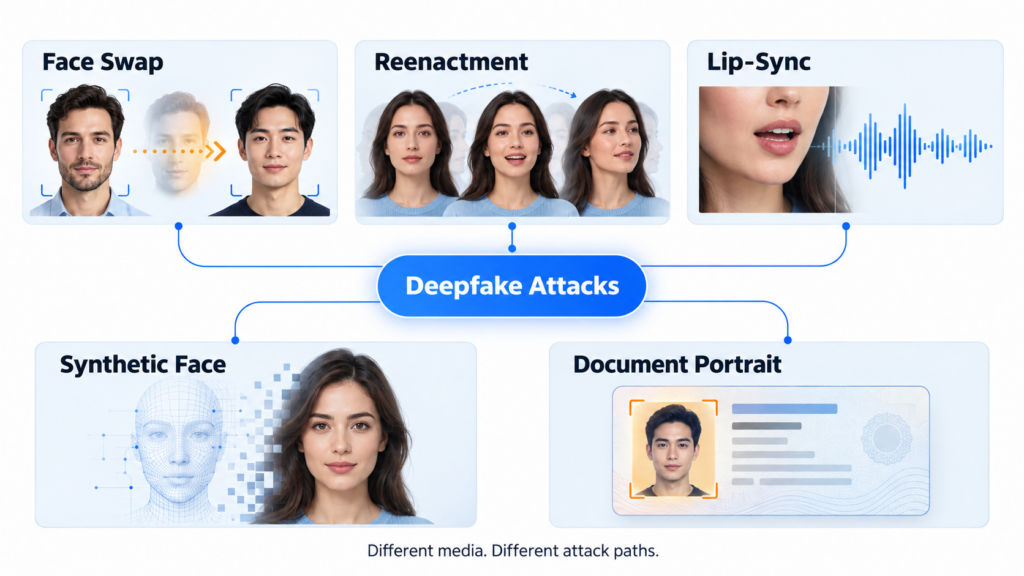
5. Manipulated Document Portraits and Face Morphs
Deepfake techniques can also target the portrait printed or displayed on identity evidence.
An attacker may:
- Replace the original document portrait
- Blend two faces into one composite image
- Generate a portrait matching fabricated identity data
- Modify a stolen portrait to resemble the applicant
- Use the same synthetic face across several documents
NIST describes face morphing as combining photographs of different people into one image and notes that morph-detection software can help flag suspicious portraits.
Document authenticity, portrait integrity, OCR consistency, and current-face comparison should therefore be evaluated together.
6. Screen-Based Deepfake Presentation Attacks
A deepfake may be displayed on another screen and presented to the physical camera. This combines generated media with a conventional presentation attack.
Possible indicators include:
- Moiré patterns
- Screen glare
- Display pixels
- Flat depth characteristics
- Unnatural reflections
- Repeated video frames
- Inconsistent lighting or motion
ISO/IEC 30107 provides terminology and a framework for biometric presentation attack detection. NIST’s remote identity-proofing guidance also requires presentation attack detection when biometric characteristics are collected remotely.
However, presentation-attack detection does not address every attack that bypasses the physical camera.
7. Digital Injection Attacks
A digital injection attack inserts manipulated media directly into the capture or transmission pipeline instead of showing it to a camera.
The injected content may be a face-swapped video, animated portrait, stolen recording, or fully synthetic person. Because the media bypasses normal camera capture, it may not contain screen reflections, print texture, or other presentation clues.
NIST conference materials identify injection attacks as a major threat to remote identity verification. Face++ similarly distinguishes media appearance from capture integrity: a face may look live while still arriving through a manipulated camera or application path.
Defenses should therefore assess application integrity, camera provenance, device risk, virtual environments, API manipulation, and secure transmission alongside liveness.
8. Deepfakes in Account Recovery and High-Risk Actions
Attackers may deploy deepfakes after onboarding rather than during initial registration.
High-risk targets include:
- Password or account recovery
- New-device enrollment
- Contact-information changes
- Beneficiary creation
- High-value payments
- Crypto withdrawals
- Remote support sessions
These events may rely on an existing trusted portrait, giving the attacker a clear biometric target. A platform should combine fresh face verification and liveness with device history, account behavior, transaction context, and recovery-channel risk.
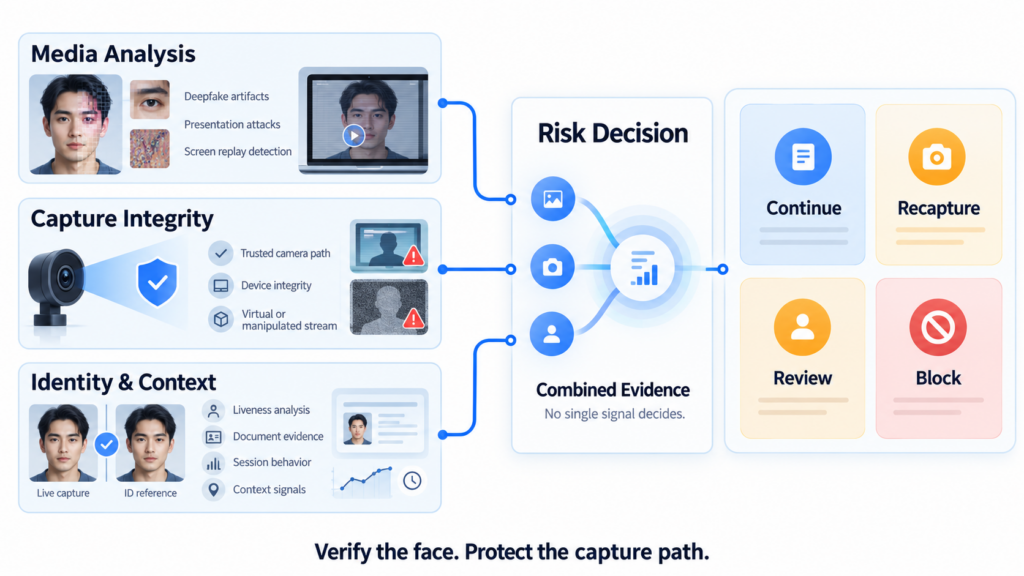
9. Building Layered Deepfake Defenses
No single detector can reliably address every deepfake attack. A stronger remote identity workflow combines:
- Document and portrait-integrity analysis
- Face comparison against trusted evidence
- Presentation attack detection
- Liveness and genuine-presence analysis
- Deepfake and synthetic-media detection
- Capture-path and injection protection
- Device, session, and behavioral intelligence
- Cross-account relationship analysis
- Risk-based recapture, review, or restriction
Face++ Face Comparing can return a confidence score and thresholds for assessing whether two faces likely belong to the same person. Its liveness capabilities help evaluate genuine presence and spoofing risk. These signals should contribute to a wider risk decision rather than operate as isolated approvals.
10. Frequently Asked Questions
Q1. Is every presentation attack a deepfake?
No. Printed photos, conventional video replays, and physical masks are presentation attacks but may not contain AI-generated media.
Q2. Can liveness detection stop every deepfake?
No single liveness method can address every attack. Protection should include presentation detection, injection defense, secure capture, device intelligence, and risk-based decisioning.
Q3. Can face comparison identify manipulated media?
Face comparison answers whether two faces appear similar. A high similarity score does not independently prove that the current media is live, authentic, or securely captured.
Q4. How does Face++ support deepfake-resistant verification?
Face++ face comparison and liveness detection can support identity matching and genuine-presence analysis. They should be integrated with document, device, capture-integrity, and behavioral controls.
11. Protect the Entire Verification Path
Deepfake attacks can manipulate identity evidence, facial appearance, movement, speech, and the capture channel itself. Evaluating only the final face image leaves important parts of the attack surface unprotected.
By combining Face++ face comparison and liveness detection with document analysis, injection defense, trusted capture, device intelligence, and contextual risk signals, digital platforms can make remote identity verification more resilient as synthetic-media techniques evolve.