Identity verification confirms who a customer is, while sanctions and PEP screening compare that identity against structured compliance lists. However, significant customer risk may appear first in news reports, regulatory announcements, court records, or other public information.
Adverse media screening—also called negative news screening—helps businesses identify credible information that may indicate financial crime, fraud, corruption, or reputational risk before it appears in a formal watchlist.
1. What Is Adverse Media Screening?
Adverse media screening searches relevant public information for negative or risk-related reporting connected to a customer, business, beneficial owner, director, or counterparty.
Depending on the organization’s risk model, relevant categories may include:
- Money laundering
- Fraud and identity crime
- Bribery and corruption
- Terrorist financing
- Organized crime
- Human trafficking
- Cybercrime
- Tax crime
- Regulatory enforcement
- Environmental or other predicate offenses
The objective is not to collect every negative mention. It is to identify credible information that may affect customer due diligence, enhanced due diligence, transaction monitoring, or account-risk decisions.
2. Adverse Media vs Sanctions and PEP Screening
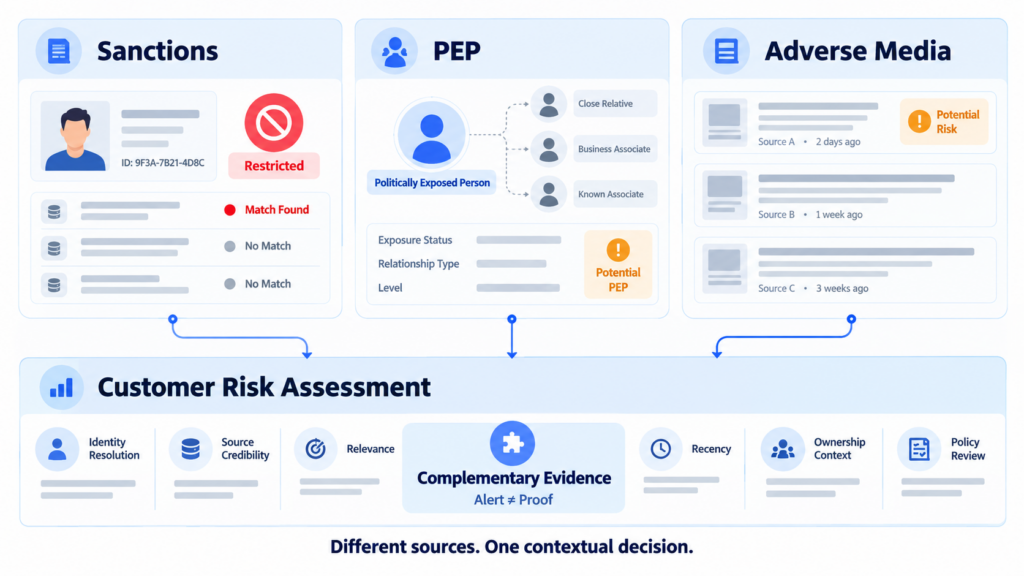
These controls use different sources and answer different questions:
- Sanctions screening: Is the person or entity subject to applicable restrictions?
- PEP screening: Does the person hold a politically exposed role that may require additional risk controls?
- Adverse media screening: Is credible public information associated with potential misconduct or financial-crime risk?
Sanctions and PEP data are generally structured around defined records. Adverse media is less structured and may contain incomplete names, unverified allegations, duplicated articles, or conflicting information.
A customer may therefore trigger adverse media without appearing on any sanctions or PEP list. Equally, a negative article does not automatically prove wrongdoing.
3. What Sources Can Be Screened?
Adverse media screening may consider information from:
- Established news organizations
- Regulatory and supervisory authorities
- Law-enforcement announcements
- Court and insolvency records
- Government publications
- Corporate filings
- Specialist risk databases
- Other credible public sources
Source quality matters. A regulatory notice or court judgment normally carries different evidential weight from an anonymous post, duplicated article, or unsupported allegation.
The screening process should assess the source, publication date, jurisdiction, relevance, corroboration, and status of the reported event.
4. Why Identity Accuracy Matters
Adverse media alerts often begin with a name match. This creates significant false-positive risk when the customer has a common name or when the article contains limited identifying information.
Match resolution may compare:
- Full name and aliases
- Date of birth or age
- Nationality and residence
- Address or operating location
- Employer and occupation
- Company directorships
- Beneficial ownership
- Photographs or other identifiers
- Timeline consistency
Face++ can support the identity-assurance layer before adverse media screening. OCR can structure identity information, while 1:1 Face Comparing can evaluate whether the applicant matches a trusted portrait and return a confidence score with reference thresholds. www.faceplusplus.com
Biometric verification does not determine whether an article concerns the customer, but it helps ensure that the screening workflow begins with a correctly established identity.
5. How Adverse Media Reveals Hidden Risk
Formal lists may reflect only certain legally defined or officially recorded risks. Adverse media can provide earlier or broader context, such as:
- A customer being investigated but not charged
- A company being linked to suspicious intermediaries
- A beneficial owner facing corruption allegations
- Repeated fraud complaints across markets
- A director connected to previously dissolved businesses
- Regulatory action in another jurisdiction
- Criminal proceedings that are still ongoing
These signals can help the organization decide whether to request additional evidence, understand source of funds, investigate ownership, increase monitoring, or initiate enhanced due diligence.
The EBA’s risk-factor guidelines describe a risk-based framework for identifying, assessing, and managing money-laundering and terrorist-financing risk. European Banking Authority
6. Why Adverse Media Screening Produces False Positives
Common causes include:
- Shared or common names
- Inconsistent transliteration
- Articles copied by multiple publishers
- Outdated or corrected reporting
- Missing dates of birth
- Confusion between individuals and companies
- Reporting about an associate rather than the customer
- Unverified allegations presented without context
Automated screening should therefore support investigation rather than replace it. A reviewer may need to determine whether the subject is the same person, whether the source is credible, whether the information remains current, and whether it is relevant to the customer relationship.
7. Screening During Onboarding and Ongoing Monitoring
Adverse media screening can take place during initial onboarding, but customer risk may change later.
Useful screening events may include:
- Periodic KYC reviews
- Changes in ownership or control
- High-risk transactions
- New counterparties or beneficiaries
- Account recovery
- Changes in occupation or business activity
- New regulatory or criminal reporting
- Significant changes in customer behavior
Ongoing monitoring should prioritize relevant changes rather than repeatedly escalating the same resolved article. Systems should retain previous decisions, supporting evidence, publication history, and review outcomes.
8. Building a Risk-Based Review Process
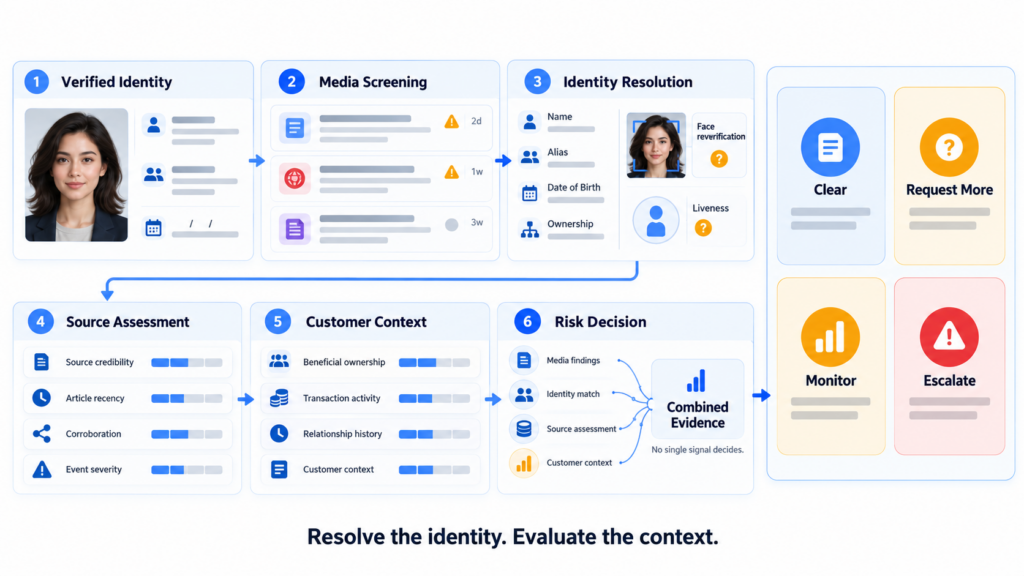
A practical adverse media workflow can include:
- Establish and verify the customer’s identity.
- Screen the customer and relevant related parties.
- Classify potentially relevant risk categories.
- Resolve the identity using secondary attributes.
- Assess source credibility and article relevance.
- Consider recency, severity, and event status.
- Combine findings with ownership, transactions, and customer risk.
- Clear, request more information, monitor, escalate, or restrict.
The FFIEC describes customer due diligence as an ongoing process based on understanding customer relationships and developing customer-risk profiles. It also notes that risk indicators are not necessarily conclusive when considered individually. bsaaml.ffiec.gov
The final decision should be documented and proportionate. One article, one name similarity, or one biometric result should not determine the outcome alone.
9. Frequently Asked Questions
Q1. Does adverse media prove criminal activity?
No. It identifies information requiring assessment. Allegations, investigations, charges, judgments, and regulatory findings carry different levels of evidential weight.
Q2. Is adverse media screening the same as sanctions screening?
No. Sanctions screening checks formal restrictions. Adverse media screening reviews relevant public reporting that may reveal broader customer risk.
Q3. Should every negative article trigger enhanced due diligence?
Not necessarily. The response should depend on identity confidence, source credibility, relevance, severity, recency, and the organization’s risk-based policy.
Q4. How does Face++ support adverse media screening?
Face++ OCR, face comparison, and liveness detection can help establish that the person being screened matches the submitted identity evidence. Dedicated compliance systems are still required for media sourcing, article analysis, and risk decisions.
10. Connect Public Risk Information to Verified Identity
Adverse media screening can reveal risks that structured lists and onboarding forms do not show. Its value depends on accurate identity resolution, credible sources, contextual review, and ongoing monitoring.
By combining adverse media intelligence with Face++ identity verification, beneficial-ownership analysis, transaction monitoring, and risk-based decisioning, digital platforms can identify hidden customer risk without treating every negative mention as confirmed misconduct.