Verifying a customer’s identity does not establish whether a business is legally permitted to transact with that person or organization. Sanctions screening addresses this separate question by comparing customers and related parties against applicable sanctions data.
When integrated with KYC, beneficial-ownership checks, transaction monitoring, and Face++ identity verification, sanctions screening helps digital businesses identify prohibited relationships while reducing the risk of screening the wrong person.
1. What Is Sanctions Screening?
Sanctions screening checks individuals, companies, organizations, vessels, and other relevant parties against sanctions lists issued by governments and international authorities.
Depending on the business, jurisdiction, and transaction, screening may cover:
- Customers and account holders
- Beneficial owners and controlling persons
- Directors and authorized representatives
- Payment senders and beneficiaries
- Merchants, suppliers, and counterparties
- Banks and financial intermediaries
- Relevant countries, regions, vessels, or entities
Sanctions programs can impose asset freezes, transaction restrictions, trade controls, or other prohibitions. FATF Recommendations 6 and 7 address targeted financial sanctions related to terrorism, terrorist financing, and proliferation financing.
Exact obligations depend on the applicable legal framework. A global business may need to consider multiple sanctions regimes rather than relying on one universal list.
2. Sanctions Screening, KYC, and AML: What Is the Difference?
These controls answer related but different questions:
- KYC: Who is the customer?
- Sanctions screening: Is the customer or related party subject to applicable restrictions?
- AML monitoring: Does the relationship or activity indicate money-laundering or financial-crime risk?
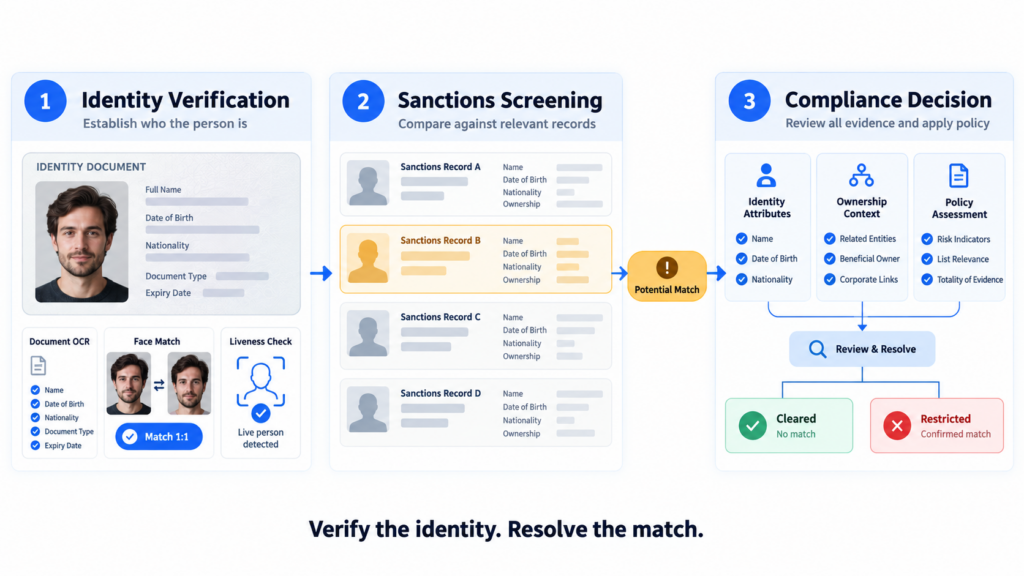
A customer can pass identity verification but still match a sanctions record. Conversely, a name may resemble a listed person even though the verified customer is someone else.
This is why identity verification and sanctions screening should be connected. Accurate identity data improves screening quality, while screening results determine whether additional compliance action is required.
3. What Information Is Used for Screening?
Screening only a name can generate large numbers of false positives. Effective match resolution may compare:
- Full name and aliases
- Date of birth
- Nationality
- Country of residence
- Address
- Identity-document information
- Company registration details
- Beneficial ownership
- Role or organizational relationship
- Other identifiers supplied by the sanctions authority
OFAC’s sanctions-search tool uses fuzzy logic to identify potential name matches across its sanctions lists, illustrating why an alert may represent a similarity rather than a confirmed identity match.
OCR can extract structured information from identity evidence, while data normalization can manage different name orders, scripts, spelling variations, and transliterations. The organization must then evaluate whether the available attributes correspond to the sanctions record.
4. Why Sanctions Screening Produces False Positives
False positives can occur when:
- A customer has a common name
- Records contain incomplete identifiers
- Names are transliterated differently
- Dates of birth are missing or approximate
- Aliases overlap with legitimate customers
- Customer data is inaccurate or outdated
- Different people share similar identity attributes
A potential match should therefore be resolved using secondary information rather than treated automatically as a confirmed sanctions hit.
Depending on policy, the platform may clear an obvious false positive, request more evidence, suspend the transaction, or escalate the case to a qualified compliance reviewer.
5. Where Face++ Supports the Workflow
Face++ does not determine whether a person is sanctioned. It supports the identity-assurance layer that establishes who is being screened.
A digital onboarding workflow can use Face++ capabilities to:
- Capture the customer’s identity evidence
- Extract relevant fields through OCR
- Compare the current face with the document portrait
- Perform liveness detection
- Bind the verified person to the screened identity data
- Send the verified data to the appropriate sanctions-screening system
Face++ 1:1 Face Comparing returns a confidence score and reference thresholds for evaluating whether two facial images likely belong to the same person.
This helps reduce identity substitution, but it does not resolve the sanctions alert itself. Match resolution still requires sanctions data, applicable rules, and compliance analysis.
6. Why Ongoing Screening Is Necessary
A customer who was not listed during onboarding may become subject to sanctions later. Authorities may also add aliases, identifiers, ownership information, or new restrictions.
OFAC states that sanctions programs can change frequently and recommends checking its official information regularly. Its Sanctions List Service provides downloadable access to current SDN and non-SDN data.
Businesses may therefore screen:
- During onboarding
- Before executing relevant transactions
- When beneficiaries or counterparties are added
- After customer or ownership information changes
- When sanctions data is updated
- During periodic KYC reviews
- When risk indicators trigger reverification
Where account ownership is uncertain, Face++ face reverification and liveness detection can confirm whether the person performing the action matches the previously verified customer.
7. Building a Risk-Based Screening Workflow
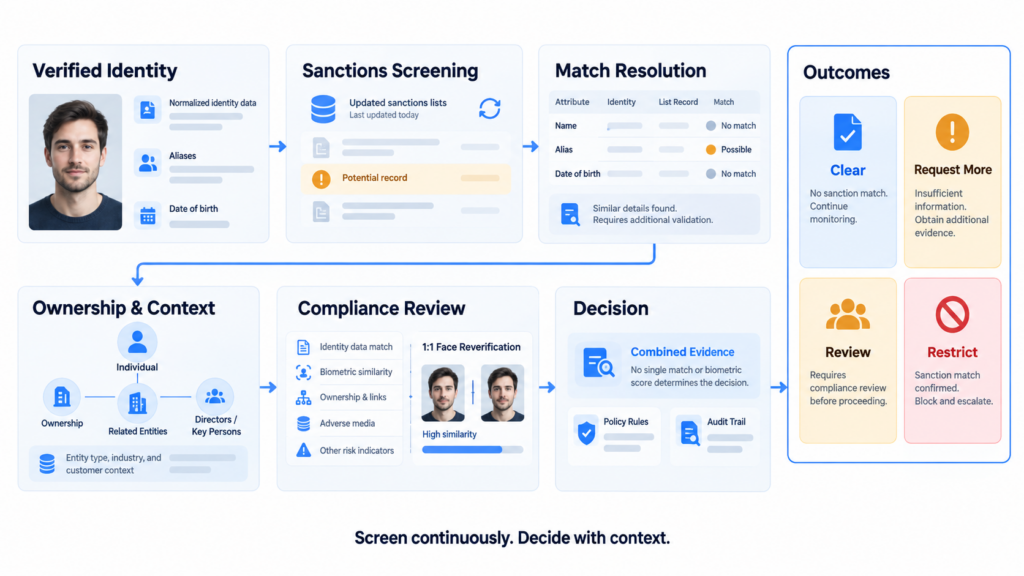
A practical sanctions-screening workflow can include:
- Verify and normalize customer information.
- Screen relevant people and entities.
- Generate potential matches using configurable matching rules.
- Compare secondary identity attributes.
- Investigate ownership and control relationships.
- Apply jurisdiction-specific restrictions and licenses.
- Approve, request more information, review, or restrict.
- Preserve evidence and rescreen when relevant data changes.
The system should record the list source, version, screening time, matched attributes, resolution rationale, reviewer actions, and final decision.
An individual name match, biometric score, or geographic signal should not determine the result alone. The decision must reflect combined evidence and the applicable sanctions regime.
8. Frequently Asked Questions
Q1. Is sanctions screening the same as PEP screening?
No. Sanctions screening identifies parties subject to applicable restrictions. PEP screening identifies political exposure that may require additional risk assessment or enhanced due diligence.
Q2. Does a sanctions alert prove that the customer is sanctioned?
No. An alert indicates a potential match. Secondary identifiers, ownership information, and applicable rules must be evaluated before reaching a conclusion.
Q3. Should screening occur only during onboarding?
No. Sanctions data and customer relationships can change, so periodic, event-based, or transaction-time screening may also be necessary.
Q4. Can Face++ perform the complete sanctions decision?
Face++ supports identity verification through capabilities such as OCR, face comparison, and liveness detection. Sanctions-list management, match resolution, and regulatory decisioning require dedicated compliance systems and policies.
9. Combine Identity Confidence with Compliance Controls
Sanctions screening is most reliable when the business knows whose identity is being screened and evaluates possible matches against sufficient supporting data.
By combining appropriate sanctions sources with Face++ identity verification, biometric matching, liveness detection, beneficial-ownership analysis, and ongoing monitoring, digital businesses can strengthen KYC and AML compliance without treating every similar name as a confirmed prohibited relationship.