Online platforms may need to determine whether a user is old enough to access specific content, create an account, purchase regulated products, or use certain features.
Asking for a date of birth is simple, but users can enter false information. Stronger age-assurance methods use identity documents, trusted data, facial analysis, or several checks together.
The appropriate method depends on the legal requirements, potential harm, required confidence, and amount of personal data the platform can justify collecting.
1. Age Assurance, Age Verification, and Age Estimation
These terms describe related but different processes:
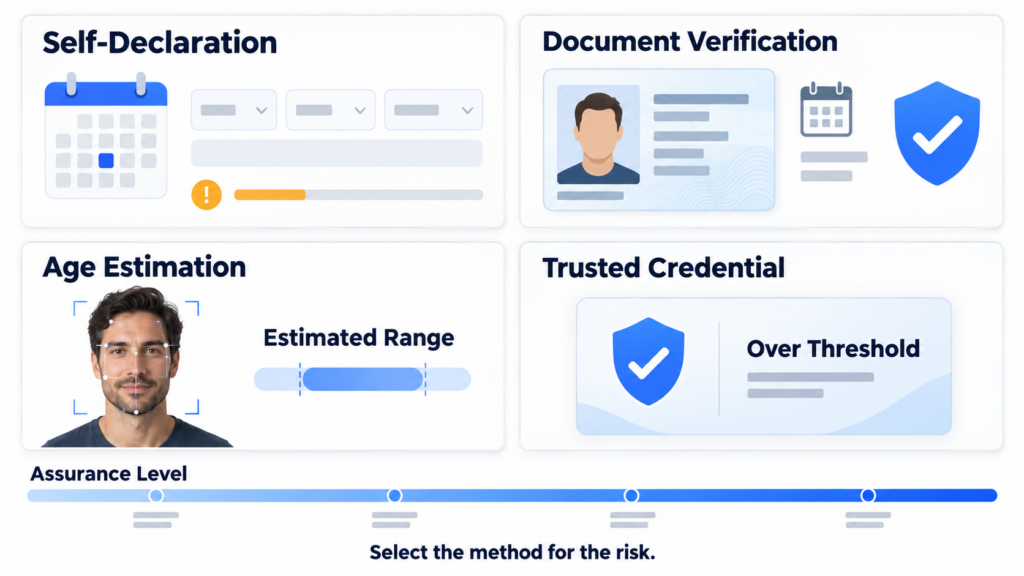
- Age assurance is the broad category covering methods used to determine whether someone meets an age requirement.
- Age verification confirms age using reliable evidence, such as an identity document or trusted digital credential.
- Age estimation predicts an age or age range from signals such as facial appearance without necessarily confirming identity or date of birth.
- Self-declaration asks the user to enter an age or date of birth without independent evidence.
The UK Information Commissioner’s Office also treats age assurance as an umbrella term covering methods that estimate or verify age. ICO Age-Assurance Opinion
2. Why Online Platforms Verify Age
Age checks can support:
- Restricting access to adult or harmful content
- Protecting minors within social and community platforms
- Applying age-appropriate privacy settings
- Controlling purchases of regulated goods or services
- Managing gaming, gambling, or financial-product eligibility
- Obtaining parental consent where required
- Delivering experiences appropriate to different age groups
Requirements vary significantly across countries, industries, and types of service. Businesses should identify the applicable threshold and assurance level before selecting a technical method.
3. Common Age-Verification Methods
Self-Declared Date of Birth
This creates minimal friction but provides limited assurance because the user can enter any date.
Identity-Document Verification
The platform extracts the date of birth from an identity document and calculates whether the user meets the threshold. Document authenticity, expiry, and data consistency should also be evaluated; OCR alone only reads the visible information.
Trusted Data or Digital Credentials
Age may be confirmed through an authorized identity provider, payment relationship, mobile operator, government source, or privacy-preserving credential, where legally and technically available.
Facial Age Estimation
A facial-analysis model estimates the user’s apparent age or age range. This can reduce the need to collect full identity details, but it produces an estimate rather than a verified date of birth.
Combined Methods
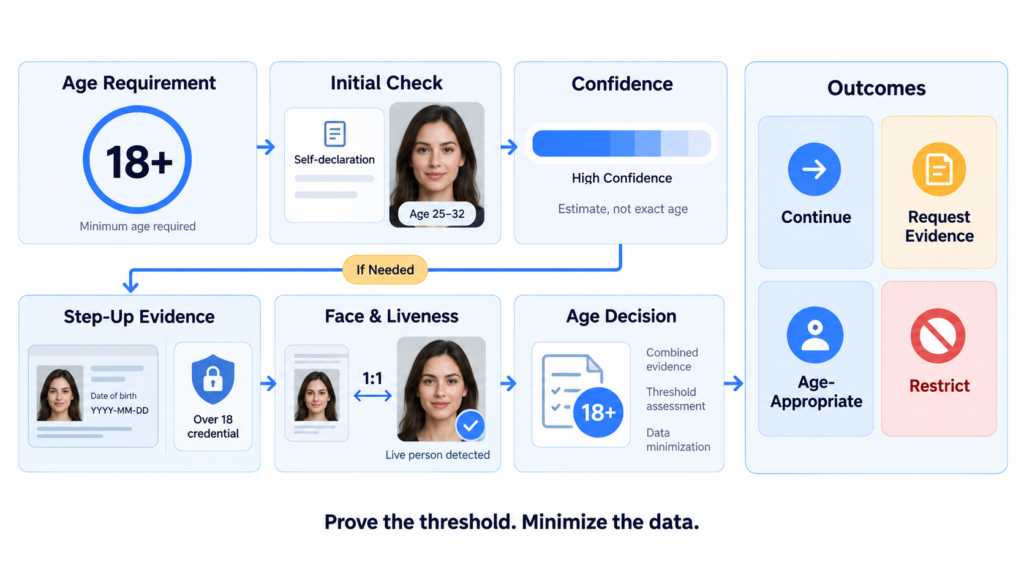
Platforms can use a lower-friction method first and request stronger evidence when the result is uncertain or close to the required threshold.
4. How Document-Based Age Verification Works
A document-based workflow may include:
- Capturing an accepted identity document
- Checking image quality and document type
- Extracting the date of birth with OCR
- Validating the date format and internal consistency
- Evaluating document authenticity
- Calculating age against the relevant threshold
- Confirming that the document belongs to the user
Face++ OCR capabilities can support data extraction, while 1:1 face comparison can compare the document portrait with a current face. Liveness detection can assess whether the facial sample represents a genuinely present person rather than a photo, replay, or mask. Face++ Identity Verification
These biometric checks strengthen identity binding. They do not independently establish that the document is authentic or that the platform’s age policy is legally sufficient.
5. How Facial Age Estimation Works
Facial age estimation analyzes visual facial characteristics and returns an approximate age or age range.
Face++ Face Attribute Analysis includes age analysis alongside other facial attributes. Face++ Face Attribute Analysis
Age estimation can support low-friction screening because the platform may only need to determine whether someone is likely above or below a threshold. However, results can be affected by:
- Image quality and lighting
- Facial pose and expression
- Makeup or obstruction
- Individual differences in aging
- Camera and image-processing conditions
- Model performance across demographic groups
The result should not be presented as an exact biological or legal age. Platforms should validate performance for their users and create an uncertainty band around the threshold.
6. Managing Users Near the Age Threshold
A binary decision based on one estimated value can create avoidable errors.
For example, if access requires the user to be 18, the platform can define three policy zones:
- Clearly above the threshold: Continue when the selected method provides sufficient confidence.
- Uncertain: Request stronger evidence, such as an identity document or trusted credential.
- Clearly below the threshold: Apply the required restriction or age-appropriate experience.
Thresholds and buffers should be based on measured performance, regulatory expectations, and the consequence of an incorrect decision.
Legitimate users should also have a clear retry or appeal path when poor image quality or model uncertainty causes an incorrect result.
7. Preventing Age-Check Evasion
An age check can be undermined if another person completes it, a borrowed document is submitted, or prerecorded media is presented.
A layered workflow can combine:
- Document-authenticity analysis
- OCR and date-of-birth validation
- Face++ face comparison
- Liveness detection
- Capture-integrity controls
- Device and session signals
- Duplicate-account indicators
- Behavioral and transaction context
A successful liveness check only indicates that a live person appears to be present. Face comparison is needed when the platform must establish that the person matches a particular identity document.
8. Privacy and Data Minimization
Age assurance can involve identity documents, facial images, and biometric data. Platforms should collect only the information necessary for the specific purpose.
Privacy-focused design may include:
- Returning only an “over threshold” result
- Avoiding retention of full identity documents
- Separating age proof from account identity
- Applying short retention periods
- Encrypting data and restricting access
- Preventing reuse for unrelated profiling
- Providing clear notices and user controls
The European Commission’s age-verification blueprint is designed around proving that a user meets an age threshold without disclosing other identity information. European Commission Age-Verification Blueprint
9. Frequently Asked Questions
Q1. Is entering a date of birth age verification?
It is more accurately described as self-declaration because the information has not been independently confirmed.
Q2. Is facial age estimation the same as age verification?
No. Age estimation predicts an approximate age, while verification confirms age using stronger evidence.
Q3. Can Face++ determine a user’s legal age from a selfie?
Face++ can analyze age as a facial attribute, but the result is an estimate. Legal-age decisions may require additional evidence depending on the use case and jurisdiction.
Q4. Why combine Face++ face comparison with document-based age verification?
It helps determine whether the person completing the check matches the portrait on the document containing the verified date of birth.
10. Choose Assurance Proportionate to the Risk
Age verification is not one universal check. A low-risk feature may use self-declaration or estimation, while access to regulated content or products may require documentary or trusted-source evidence.
By combining appropriate age evidence with Face++ OCR, face comparison, liveness detection, and risk-based escalation, platforms can protect younger users while limiting unnecessary data collection and friction.