Deepfake technology can generate or manipulate faces, voices, documents, and videos with increasing realism. Although it has legitimate applications in entertainment and content creation, fraudsters are using the same technology to impersonate real people, create synthetic identities, and bypass digital identity verification.
For digital platforms, the challenge is no longer limited to identifying a printed photo or recorded video. Modern attacks may combine generative AI, virtual cameras, stolen identity data, and device manipulation to create an apparently legitimate verification session.
Understanding how these attacks work is the first step toward building more resilient identity controls.
What Is Deepfake Fraud?
Deepfake fraud uses AI-generated or AI-manipulated media to misrepresent a person’s identity, presence, or actions. During identity verification, attackers may submit a fabricated face, alter an existing video, animate a stolen portrait, or replace the live camera stream with generated content.
The objective depends on the business scenario. Attackers may attempt to:
- Open accounts using stolen or synthetic identities
- Take over existing customer accounts
- Recover accounts without the legitimate owner
- Bypass transaction authorization
- Create multiple fraudulent accounts
- Impersonate executives, employees, or customers
Deepfake fraud is especially dangerous because the manipulated media may look convincing to human reviewers while also satisfying basic automated checks.
How a Deepfake Identity Attack Is Created
A typical attack begins with identity data. Fraudsters may collect photographs, videos, identity document images, and personal information from social media, data breaches, phishing campaigns, or underground marketplaces.
Generative AI tools can then transform these materials into attack assets. For example, an attacker may animate a still photograph, replace their own face with the victim’s face, generate a synthetic person, or synchronize facial movements with a prerecorded or generated voice.
The resulting content must then be delivered to the verification system. Common delivery methods include:
- Replaying media in front of a physical camera
- Presenting content on another screen
- Using a virtual camera
- Manipulating an application or SDK
- Injecting media directly into the capture pipeline
- Running the verification process through an emulator or compromised device
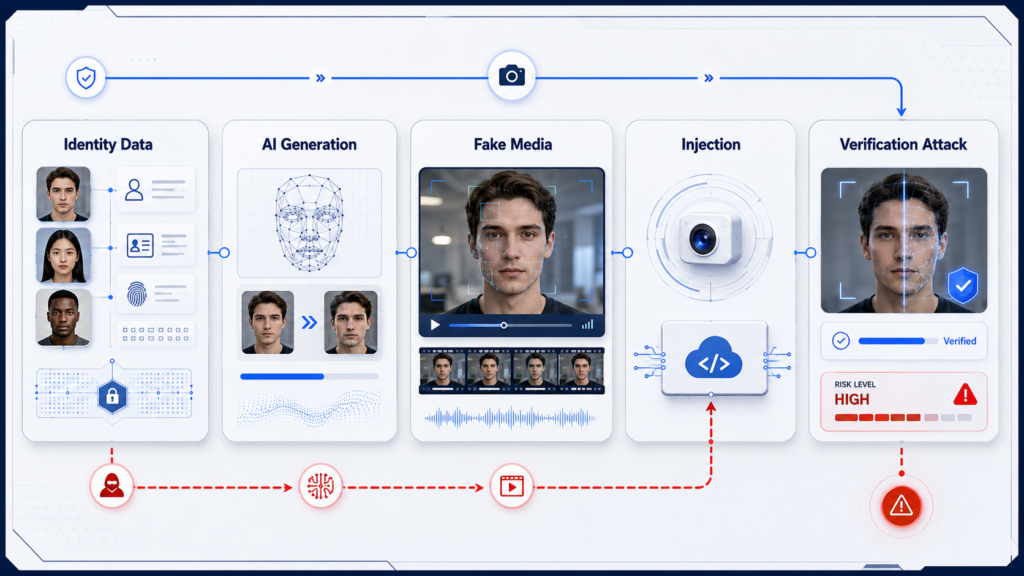
The most advanced attacks do not interact with the physical camera at all. Instead, they insert manipulated frames into the video stream after capture. This can make the media appear clean and high quality while bypassing controls designed only to detect screens or printed photographs.
Common Types of Deepfake Identity Attacks
1. Face Swapping
Face-swapping technology maps a target person’s facial appearance onto the attacker or another source video. The attacker may perform natural head movements while the system displays the victim’s identity.
Potential warning signals include unstable facial boundaries, inconsistent skin texture, unusual reflections, and mismatches between facial motion and the surrounding scene.
2. Face Reenactment
Face reenactment transfers expressions or movements from one person to another face. A static photograph may appear to blink, smile, turn, or follow instructions.
These attacks are particularly relevant to active liveness systems that rely on simple actions. If the requested action can be generated or reproduced, the challenge alone may not confirm genuine presence.
3. Fully Synthetic Identities
AI can generate faces belonging to people who do not exist. These faces may be combined with fabricated identity information or manipulated documents to create synthetic identities.
Because there is no direct victim photograph to detect, businesses must evaluate the consistency of the entire identity—not only the visual quality of the face.
4. Voice and Video Impersonation
Some attacks combine a deepfake face with cloned speech. This creates a more complete impersonation attempt for video onboarding, remote interviews, customer support, or transaction confirmation.
A realistic voice does not prove that the speaker is genuine. Voice, face, device, document, and behavioral signals should be assessed together.
Why Basic Face Matching Is Not Enough
Face matching answers a specific question: how similar is the captured face to the reference image?
A high similarity score does not confirm that the captured person is physically present. A high-quality deepfake built from the same reference identity may produce strong facial similarity while still representing fraudulent media.
This is why face verification should be combined with liveness detection. Liveness analysis evaluates whether the session contains evidence of a genuine live person rather than a photo, replay, mask, generated face, or injected stream.
However, liveness should not operate in isolation either. Deepfake attacks continue to evolve, and a single model or challenge may not detect every attack method.
A Layered Approach to Deepfake Detection
Effective protection combines capture security, biometric analysis, and risk intelligence.
1. Protect the Capture Pipeline
The system should verify that media originates from an authorized physical camera and has not been replaced through a virtual camera, API hook, emulator, or modified application.
SDK integrity checks, device attestation, encrypted transmission, and injection detection can help protect the path between capture and verification.
2. Analyze Liveness and Media Authenticity
Liveness models can examine facial texture, depth, lighting, motion, reflections, and temporal consistency. Deepfake detection can add analysis for blending artifacts, generated patterns, abnormal frame transitions, and other manipulation indicators.
Both individual frames and the video sequence should be assessed because some anomalies appear only over time.
3. Verify Identity Consistency
The live face should be compared with a trusted reference, such as the portrait extracted from a verified identity document or an existing customer profile.
Document data, facial identity, and submitted customer information should also be cross-checked for inconsistencies.
4. Evaluate Device and Session Risk
Signals such as emulator use, device tampering, abnormal IP location, repeated attempts, shared devices, and unusual session behavior may reveal fraud even when the media appears realistic.
5. Apply Risk-Based Decisions
Not every suspicious signal requires immediate rejection. A risk engine can combine verification results and route the session to approval, step-up verification, manual review, or blocking.
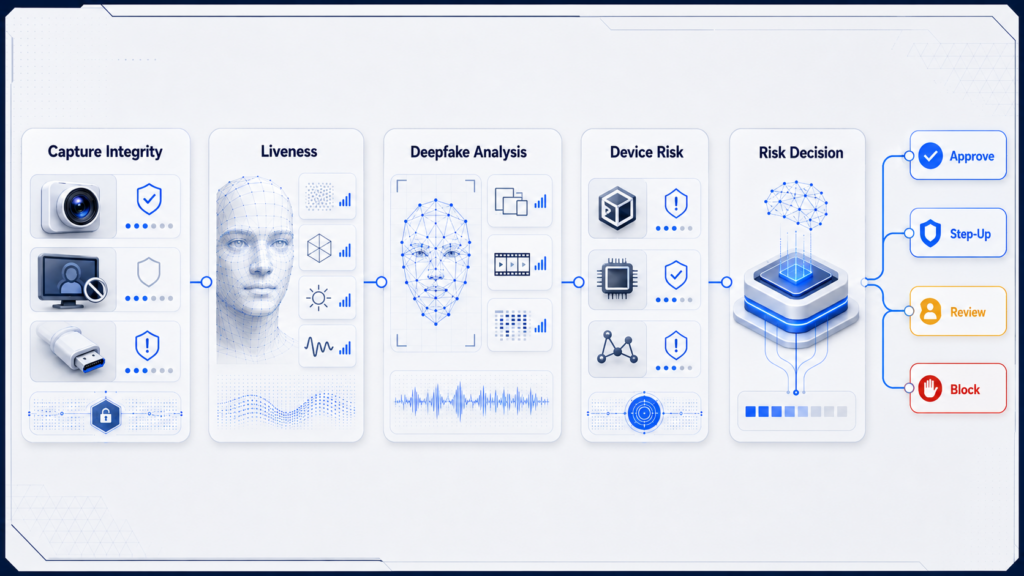
This layered model reduces dependence on any single detection technique and gives businesses greater flexibility as attack methods change.
Building Resilience Against Evolving Attacks
Deepfake fraud is not a fixed attack category. Generative models, delivery tools, and evasion methods will continue to improve. Identity security therefore requires ongoing model updates, attack testing, threshold monitoring, and analysis of newly observed fraud patterns.
Businesses should also preserve relevant evidence—including capture metadata, risk signals, model results, and decision records—to support investigations and compliance reviews.
Face++ combines face matching, liveness detection, and facial analysis capabilities that can support layered identity verification workflows. When these capabilities are integrated with secure capture, device intelligence, and risk-based decisioning, digital platforms can respond more effectively to AI-powered identity attacks while maintaining a practical customer experience.