A clear facial image does not prove that a real person is participating in a verification session. A photograph, replayed video, or manipulated facial sample may resemble the legitimate customer closely enough to challenge a system that checks only appearance.
Liveness detection helps address this gap by assessing evidence of genuine presence. Combined with Face++ face comparison, document verification, and capture-integrity controls, it supports stronger remote identity decisions.
1. What Is Liveness Detection?
Facial liveness detection evaluates whether a captured facial sample comes from a live person participating in the session rather than a spoofed representation.
Depending on the implementation, it may analyze image characteristics, temporal consistency, responses to challenges, depth, or other sensor information.
Liveness detection is closely related to presentation attack detection, or PAD. PAD evaluates attempts to deceive a biometric capture system using artifacts such as printed photographs, replayed videos, or masks. Liveness is one approach within this broader defensive area; the terms should not automatically be treated as identical.
A successful liveness result provides evidence of presence. It does not independently establish the person’s identity, authenticate a document, or make the entire session trustworthy.
2. Liveness Detection vs Face Matching
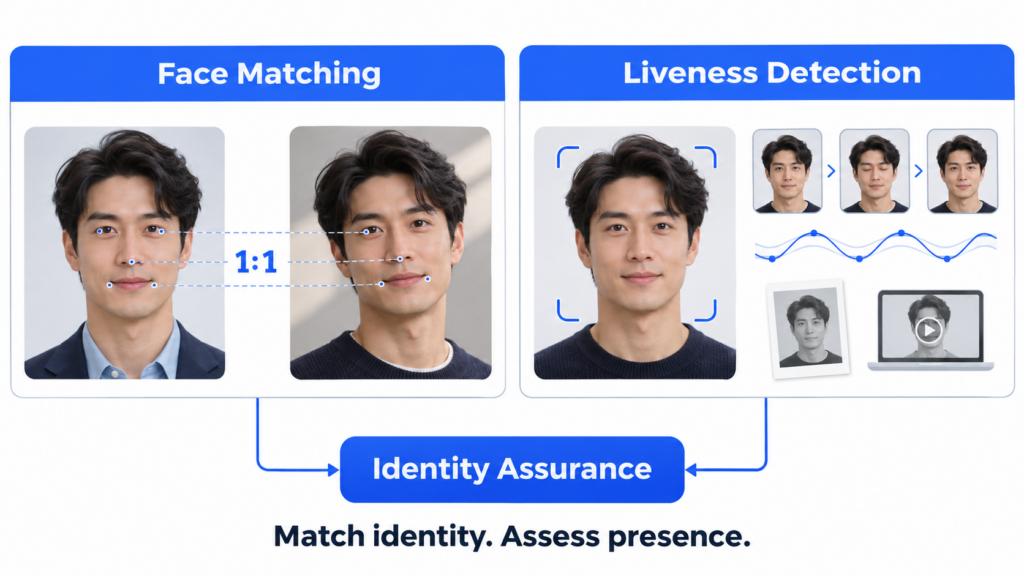
These controls answer different questions:
- Face matching: Does the captured face resemble the trusted reference?
- Liveness detection: Does the capture show evidence of a genuinely present person?
A live impostor may pass a liveness check but fail face matching. Conversely, a convincing representation of the legitimate customer may produce a strong facial similarity result without demonstrating genuine presence.
Face++ Face Comparing supports 1:1 comparison between facial images and returns a confidence score with reference thresholds. Liveness detection complements that comparison rather than replacing it.
The reference must also be trustworthy. Matching a live person to an unverified or manipulated enrollment portrait does not resolve the underlying identity risk.
3. Active and Passive Liveness Detection
Active Liveness
Active methods ask the user to complete an action or respond to a challenge. Examples include turning the head, following a visual cue, or performing a requested movement.
The system evaluates the response, not simply whether movement occurred. A basic blink or head turn is not sufficient protection by itself.
Passive Liveness
Passive methods assess the capture without requiring an explicit user action. They may analyze a still image or video sequence, depending on the system.
Passive verification can reduce user effort, but lower interaction does not automatically mean stronger or weaker security.
The appropriate method depends on tested attack coverage, capture conditions, accessibility, and the consequences of an incorrect decision. Active and passive techniques may also be combined.
4. Which Attacks Can It Help Detect?
Depending on its design and evaluation, a liveness or PAD system may help identify:
- Printed-photo presentations
- Facial images displayed on another screen
- Replayed facial videos
- Masks or three-dimensional facial artifacts
- Other suspicious presentation characteristics
Coverage varies across products and attack types. Performance against printed photographs should not be interpreted as proof of equivalent performance against masks, synthetic media, or unfamiliar attacks.
Deepfakes also require careful distinction. Manipulated media presented to a camera and manipulated media injected directly into a software pipeline follow different attack paths. A system must be evaluated against the threats relevant to its deployment.
5. Why Capture Integrity Matters
An injection attack can replace or introduce media between the camera and the component performing verification. This may bypass assumptions about where the facial sample originated.
Liveness analysis can make some attacks harder, but it does not independently secure the capture pipeline.
A layered workflow may also use:
- Trusted capture components
- Device and application integrity checks
- Virtual-camera and emulator indicators
- Session-bound challenges
- Protected communications
- Manipulated-media analysis
These controls address related but distinct risks. A passing face comparison or liveness result should not automatically override evidence of capture manipulation.
6. How Liveness Fits into Remote Verification
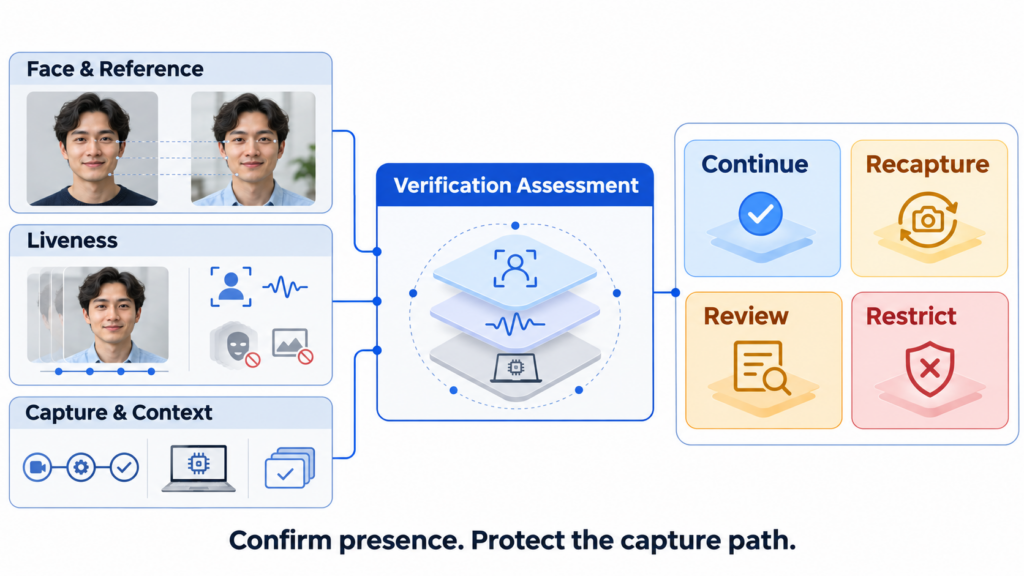
A practical verification workflow can:
- Establish a trusted identity reference.
- Guide the customer through a suitable facial capture.
- Check image quality and capture integrity.
- Evaluate liveness or presentation-attack evidence.
- Compare the current face with the trusted reference.
- Combine document, device, session, and account context.
- Continue, request another capture, escalate, or restrict the session.
Face++ face comparison and the liveness capabilities described in its identity-verification solution can support the biometric layer. Businesses should confirm the selected integration’s supported methods, attack coverage, and deployment requirements.
The final decision should reflect combined evidence rather than one biometric result.
7. Managing Failed or Uncertain Results
A failed check is not always confirmed fraud. Poor lighting, motion blur, camera limitations, connection problems, or difficulty following instructions can affect legitimate users.
Platforms should distinguish between:
- Insufficient quality: Provide targeted guidance and request recapture.
- Uncertain evidence: Request additional verification or review.
- Strong attack indicators: Apply appropriate restrictions and investigation.
Retries should be controlled and monitored. Repeated attempts can indicate either unresolved usability problems or deliberate probing.
Accessible alternatives and clear instructions help maintain security without excluding customers who cannot complete a particular capture method.
8. Evaluating Liveness Performance
Evaluate both attack detection and legitimate-user acceptance under realistic conditions.
Review supported attack categories, independent test scope, false acceptance and rejection results, device coverage, demographic performance, latency, and completion rates.
A test result applies to the evaluated product version, configuration, and attack set—not every possible threat.
Biometric processing also requires appropriate privacy controls, including data minimization, access restrictions, retention limits, and applicable consent or other lawful processing arrangements.
9. Frequently Asked Questions
Q1. Does passing liveness prove identity?
No. A live person may still be an impostor. Identity evidence and face comparison serve separate purposes.
Q2. Can liveness detection stop every deepfake?
No. Coverage depends on the system and attack path. Injection and manipulated-media defenses may also be necessary.
Q3. Is passive liveness always less secure?
No. Security depends on demonstrated performance, not simply whether the user performs an action.
Q4. Should every failed check be rejected?
No. Quality and usability problems may justify guided recapture, alternative evidence, or review.
10. Build Assurance Beyond Facial Similarity
Liveness detection helps platforms assess genuine presence, while face matching evaluates similarity with a trusted reference.
By combining Face++ biometric capabilities with document checks, capture protection, and contextual risk assessment, businesses can strengthen remote verification without treating one successful check as complete proof of identity.