Account recovery is designed for legitimate users who lose access to a password, email address, phone number, trusted device, or authentication method. Unfortunately, the same flexibility can give attackers an alternative route into a protected account.
Instead of defeating the normal login process, an attacker may convince the platform that they are the account owner and replace the customer’s trusted credentials. A secure recovery journey must therefore verify identity, evaluate session risk, and tightly control what happens after access is restored.
1. What Is Account Recovery Fraud?
Account recovery fraud occurs when an unauthorized person abuses password-reset, credential-replacement, or support-assisted recovery processes to take control of another user’s account.
The attacker’s objective may be to:
- Reset the account password
- Replace the registered email address or phone number
- Remove an existing authenticator
- Enroll a new device or biometric
- Redirect payments or withdrawals
- Access personal or financial information
- Lock the legitimate customer out
Recovery is especially sensitive because the user may no longer possess the normal authentication factors. The platform must make a high-impact decision using incomplete or alternative evidence.
NIST treats authenticator recovery and replacement as part of the authenticator lifecycle and requires providers to manage the authenticators bound to each subscriber account.
2. How Attackers Target Recovery Channels
Attackers may begin with personal information obtained through phishing, data breaches, social media, malware, or previous account compromises.
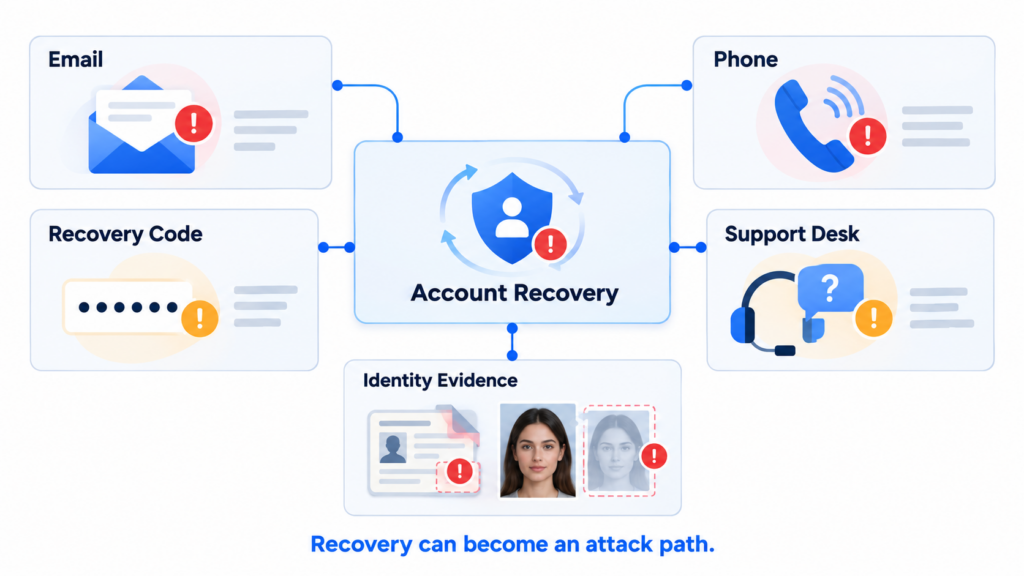
Common attack paths include:
- Taking control of the registered email account
- Hijacking or replacing a mobile number
- Stealing one-time passwords or recovery codes
- Answering knowledge-based questions with exposed personal data
- Impersonating the customer during a support interaction
- Uploading stolen or manipulated identity evidence
- Using a photograph, replay, mask, or deepfake during facial verification
- Exploiting weak processes for replacing MFA methods
Help desks can also become targets. CISA has documented threat actors using voice communications to persuade support personnel to reset passwords or MFA tokens.
3. Why Recovery Can Be Weaker Than Login
A platform may secure routine login with a password, trusted device, and MFA but allow recovery using only an email link, SMS code, or personal questions.
This creates a security imbalance: the recovery method becomes an easier substitute for the authentication controls it replaces.
Weak recovery workflows often rely too heavily on:
- Information that can be researched or purchased
- Communication channels that may already be compromised
- A single identity document
- A basic selfie without liveness detection
- Manual support judgment without structured evidence
- One successful verification signal
CISA recommends MFA because it increases the difficulty of account takeover, with phishing-resistant methods preferred where appropriate. Recovery should preserve comparable assurance instead of silently reducing it.
4. Common Account Recovery Warning Signs
No individual signal proves fraud, but several signals together may indicate elevated risk:
- Recovery initiated from a new device or location
- Recent changes to the registered phone number or email
- Multiple failed password, OTP, or biometric attempts
- Unusual IP, proxy, emulator, or device characteristics
- Recovery followed immediately by credential changes
- A new beneficiary or withdrawal destination
- Identity details inconsistent with the existing profile
- An altered, expired, or previously reused document
- Face mismatch or failed liveness detection
- Repeated recovery attempts across linked accounts
The platform should compare current activity with the customer’s historical device, behavior, identity, and transaction profile.
5. Verifying Identity During Recovery
Recovery should answer a stronger question than whether the applicant knows account information:
Is the person requesting recovery the legitimate account holder?
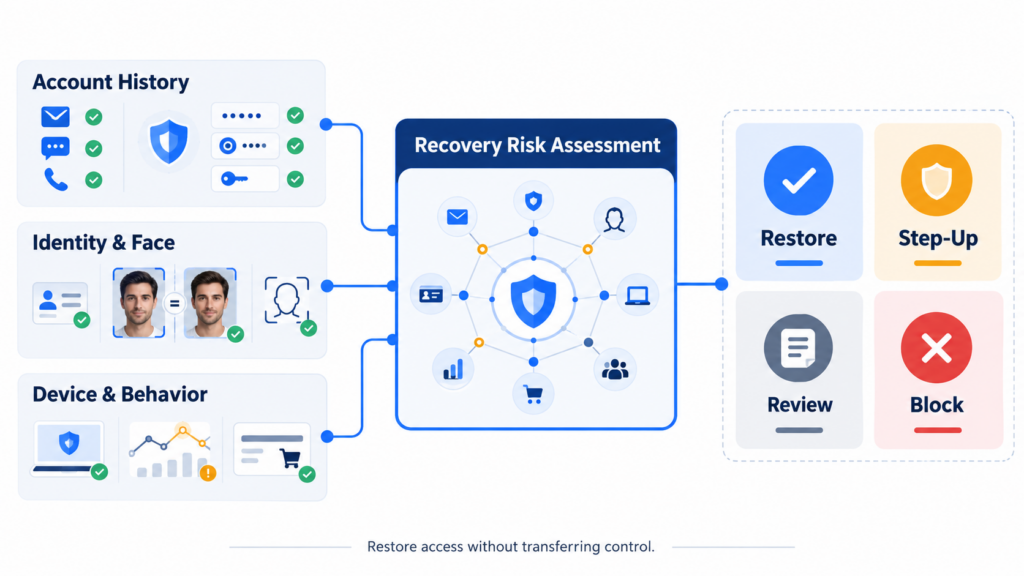
A risk-based process may combine:
- Existing account and authenticator history
- Trusted-device and session evidence
- Previously verified identity information
- Fresh identity-document evidence when necessary
- Face comparison with a trusted customer portrait
- Liveness and capture-integrity analysis
- Behavioral and transaction context
- Manual review for unresolved cases
Face++ 1:1 face comparison can compare the recovery applicant with an enrolled customer image or trusted document portrait. This helps bind the recovery event to the previously verified identity.
However, facial similarity alone is insufficient. A stolen photograph or synthetic video might still resemble the customer. Face++ liveness detection adds a separate assessment of whether the capture comes from a genuinely present person rather than a photo, replay, mask, or manipulated stream.
6. Risk-Based Recovery Decisions
Applying the same recovery process to every case can create either excessive fraud exposure or unnecessary customer friction.
A practical model may use four levels:
- Low risk: Allow recovery using established channels and trusted-device evidence.
- Medium risk: Request face verification, liveness, or additional account evidence.
- High risk: Require stronger identity evidence and manual review.
- Critical risk: Temporarily block recovery and protect sensitive account functions.
Face++ can support step-up identity verification for account recovery, new-device access, sensitive profile changes, and other high-risk events. The final decision should combine biometric results with device, account, behavioral, and session signals.
7. Protecting the Account After Recovery
A successful recovery should not immediately provide unrestricted control.
Post-recovery safeguards may include:
- Notifying the customer through previously trusted channels
- Revoking old sessions and compromised authenticators
- Requiring enrollment of a new MFA method
- Applying a cooling-off period to sensitive changes
- Restricting new beneficiaries or large withdrawals
- Monitoring device, profile, and transaction changes
- Preserving recovery evidence and decision logs
- Providing a rapid dispute or reversal channel
Recovery codes should also be treated as sensitive authenticators. NIST notes that saved recovery codes are not phishing-resistant and should be securely delivered, stored, rate-limited, and usable only once.
8. Frequently Asked Questions
Q1. Is account recovery fraud the same as account takeover?
Account recovery fraud is one route to account takeover. The attacker gains control by abusing the recovery process instead of completing the normal login journey.
Q2. Is an OTP sufficient for secure account recovery?
Not always. If the email account or phone number has been compromised, the attacker may receive the OTP. Higher-risk cases require independent evidence.
Q3. How does Face++ support account recovery security?
Face++ face comparison can compare the applicant with a trusted customer portrait, while liveness detection helps identify presentation and manipulated-media attacks.
Q4. Should a successful face match automatically restore access?
No. A biometric score should be combined with liveness, capture integrity, device history, account behavior, recovery-channel risk, and other identity evidence.
9. Build Recovery as a High-Assurance Identity Event
Account recovery should not be treated as a weaker version of login. It is a high-risk identity event capable of replacing the credentials that normally protect the account.
By combining secure recovery channels, Face++ face comparison, liveness detection, device intelligence, behavioral signals, and controlled post-recovery actions, platforms can restore legitimate access while making recovery-based account takeover significantly harder.