For many digital businesses, KYC is still treated as a one-time onboarding checkpoint. A customer signs up, submits an ID document, completes face verification, passes liveness detection, and then enters the platform. From that point on, identity is often assumed to remain stable unless a compliance rule requires periodic review.
That approach is no longer enough.
Customer identity risk changes over time. A legitimate user may lose access to an account. A fraudster may take over an existing profile. A document may expire. A user may suddenly change device, location, phone number, withdrawal method, or transaction behavior. In high-risk sectors such as fintech, lending, digital wallets, gaming, marketplace platforms, mobility, and social apps, identity verification needs to become part of a continuous risk control framework.
Regulatory expectations also point in this direction. FATF’s recommendations set a global AML/CFT framework for customer due diligence, and ongoing CDD is a key part of that risk-based approach. AUSTRAC’s ongoing CDD guidance explicitly refers to reviewing, updating, and, where appropriate, reverifying KYC information when risks or customer information change. The EBA’s remote onboarding guidance also emphasizes safe, effective, and risk-sensitive customer due diligence in digital channels.
This is where event-driven KYC reverification becomes important.
What Is Event-Driven KYC Reverification?
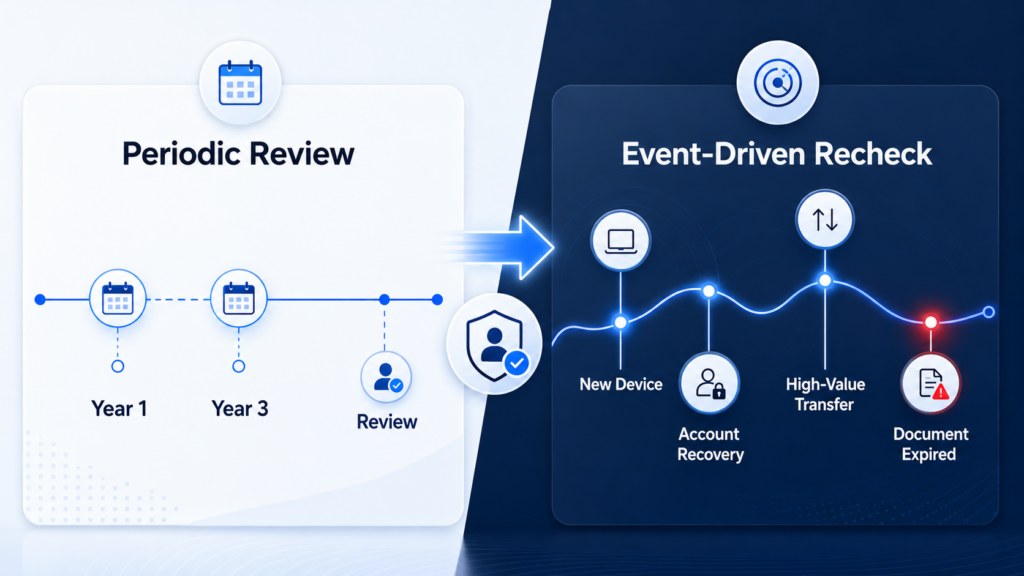
Event-driven KYC reverification means rechecking a customer’s identity when a meaningful risk event occurs, instead of relying only on fixed review cycles.
A traditional KYC refresh might happen every one, three, or five years depending on customer risk level and regulatory requirements. Event-driven reverification is different. It is triggered by behavioral, transactional, account, document, device, or compliance signals that suggest the original identity assurance level may no longer be sufficient.
The goal is not to force every customer through full KYC again. That would damage conversion, increase operational cost, and create unnecessary friction. The goal is to apply the right identity check at the right moment.
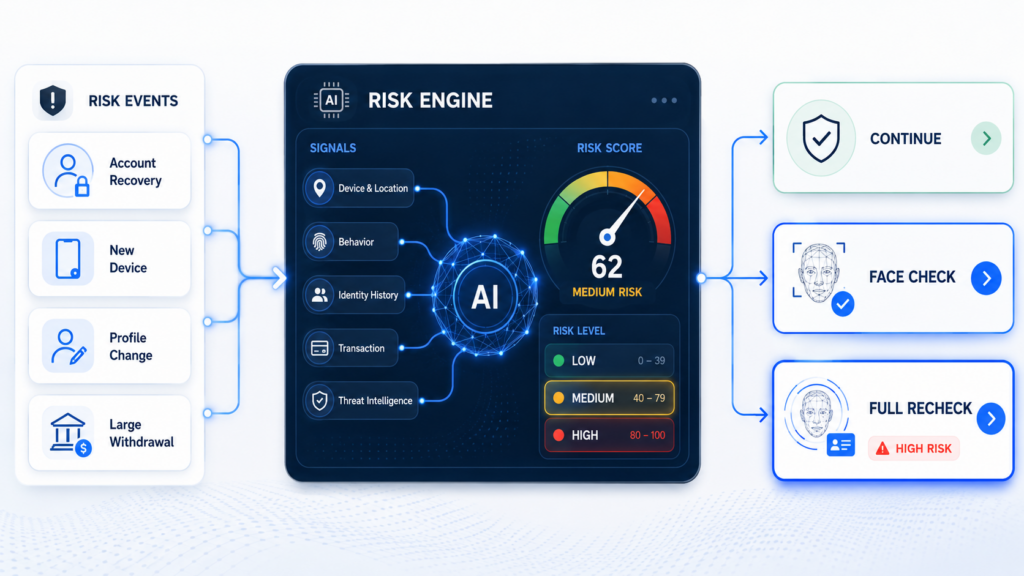
For low-risk events, the platform may only need a silent risk review. For medium-risk events, a face match or liveness check may be enough. For high-risk events, full document reverification and manual review may be required.
Why Periodic KYC Reviews Are Not Enough
Periodic reviews are useful for maintaining compliance records, but they are not designed to respond to fast-moving fraud.
Account takeover, synthetic identity abuse, mule account activity, deepfake attacks, and document reuse can happen long before the next scheduled KYC refresh. If a platform only rechecks identity on a fixed calendar, it may miss the most important risk moments.
In digital environments, fraud patterns are event-based. A user suddenly logs in from a new region. A dormant account becomes active and immediately changes its payout method. A customer requests a password reset, changes the linked phone number, and initiates a high-value withdrawal. Each event may look manageable on its own, but together they create a clear risk pattern.
Event-driven reverification allows businesses to respond before fraud turns into financial loss, compliance exposure, or user trust damage.
Key Events That Should Trigger KYC Reverification
1. Account Recovery or Credential Reset
Account recovery is one of the highest-risk moments in the customer lifecycle. If a fraudster controls the email, SIM card, or recovery channel, they may be able to reset credentials and take over the account.
When users request password resets, phone number changes, email changes, or recovery from a new device, digital businesses should consider step-up identity checks. A face match against the original onboarding identity, combined with liveness detection, can confirm whether the person recovering the account is the legitimate user.
2. New Device, Location, or Session Risk
A new device does not automatically mean fraud. Customers change phones, travel, and use different networks. However, device and session changes become more meaningful when combined with other signals.
Examples include a login from a high-risk IP, inconsistent geolocation, VPN or proxy use, device emulator signals, impossible travel patterns, or rapid switching between accounts. If these signals appear during sensitive actions, reverification can provide additional assurance without blocking legitimate users too early.
3. Sensitive Account Information Changes
Changes to personal data should not be treated as simple profile updates when they affect identity, ownership, or risk exposure.
Triggers may include changes to legal name, date of birth, address, phone number, email address, linked bank account, beneficiary, payout wallet, or business representative. In financial services, lending, and wallet platforms, these updates may directly impact compliance obligations and fraud exposure.
A practical workflow is to apply lightweight checks for normal updates and stronger reverification for high-impact changes. For example, changing a marketing preference should not require KYC, but changing a withdrawal account may require face verification or document confirmation.
4. High-Risk Transactions or Withdrawal Behavior
Reverification is especially useful before irreversible or high-value actions. These may include large withdrawals, first-time payouts, new recipient transfers, crypto withdrawals, high-value loan disbursements, or unusual transaction velocity.
The key is to avoid applying the same friction to every transaction. A returning customer making a normal payment from a trusted device should not face unnecessary checks. But a customer initiating a high-value withdrawal right after changing device, password, and payout method should be routed into step-up verification.
5. Dormant Account Reactivation
Dormant accounts are attractive to fraudsters because they often carry existing trust, transaction history, and verified status. When a long-inactive user suddenly returns, especially from a new device or region, the original KYC status may no longer be enough.
Businesses can design reactivation rules based on account age, last login, previous transaction behavior, and current risk signals. A low-risk dormant account may only need a basic login challenge. A high-risk reactivation may require face verification, liveness detection, and document reverification.
6. Expired, Inconsistent, or Suspicious Documents
Identity documents expire, get replaced, or become inconsistent with user profile information. In some markets, documents may also be frequently photographed, reused, manipulated, or submitted across multiple accounts.
If a document is expired, appears edited, shows inconsistent fields, or is linked to suspicious account patterns, the business should request updated document verification. Modern document checks can analyze data fields, document layout, security features, image quality, and signs of tampering.
7. Regulatory or Risk Policy Changes
Sometimes reverification is triggered not by customer behavior, but by internal policy changes, regulatory updates, new market entry, or revised risk classification. AUSTRAC guidance, for example, highlights that ongoing CDD should include monitoring unusual transactions and behaviors, reviewing customer ML/TF risk, updating KYC information where appropriate, and keeping records of decisions.
When risk policies change, businesses should avoid blanket reverification where possible. A risk-based migration plan is more efficient: prioritize high-risk customers, active customers, customers with outdated information, and accounts with recent suspicious behavior.
How to Build a Risk-Based Reverification Workflow
A strong event-driven reverification framework should combine risk signals, identity checks, and decision rules.
First, define trigger events. These should cover account recovery, profile changes, transaction risk, device risk, document status, dormant account reactivation, and compliance review.
Second, assign risk levels. Not every trigger needs the same response. Businesses can classify events as low, medium, high, or critical based on signal combinations.
Third, map each risk level to a verification action. Low-risk cases may continue with no interruption. Medium-risk cases may require face verification or liveness detection. High-risk cases may require document reverification, face match, liveness, and manual review. Critical cases may be blocked or escalated immediately.
Fourth, maintain audit logs. Every trigger, risk score, verification result, user action, and manual decision should be recorded. This supports compliance, investigation, dispute resolution, and model improvement.
Finally, optimize user experience. Reverification should feel proportional. The customer should understand why a check is required, complete it quickly, and return to the original journey with minimal disruption.
Where Face Verification and Liveness Fit
Face verification is especially valuable when the platform needs to confirm continuity between the original verified identity and the current user. It can help answer a simple but critical question: is the person performing this sensitive action the same person who passed onboarding?
Liveness detection adds another layer by checking whether the face is being presented by a real person, rather than a printed photo, screen replay, mask, deepfake, or injection attempt. For event-driven KYC reverification, this matters because fraudsters often target moments where speed and convenience are prioritized, such as account recovery or urgent withdrawals.
For digital businesses, the strongest approach is not to use face verification everywhere. It is to use it selectively when risk justifies additional assurance.
Conclusion
KYC should not end after onboarding. In modern digital platforms, customer identity risk is dynamic, and identity assurance needs to respond to real events.
Event-driven KYC reverification helps businesses reduce fraud, protect trusted users, support compliance, and avoid unnecessary friction. The best strategy is not to reverify every customer all the time. It is to identify the moments when identity risk changes and apply the right level of verification.
By combining document verification, face match, liveness detection, device signals, behavioral risk, and audit-ready decisioning, digital businesses can move from static KYC to continuous identity trust.