Digital onboarding has become the default entry point for banking, fintech, e-wallet, mobility, gaming, and online service platforms. A user can open an account, verify an identity document, complete a selfie check, and access financial or platform services within minutes.
That convenience is now a competitive requirement. But it also changes the threat model.
In 2026, identity fraud is no longer limited to simple photo spoofing. Attackers can use high-resolution face images, replayed videos, printed masks, manipulated camera feeds, synthetic identities, and increasingly realistic deepfake content to bypass weak onboarding flows. As a result, face recognition security can no longer depend only on whether a submitted selfie looks similar to an ID photo.
This is where liveness detection becomes critical.
Liveness detection adds a security layer that helps determine whether the face being verified comes from a real, present person rather than a spoofed, replayed, or digitally manipulated source. For digital onboarding teams, it turns face recognition from a simple matching step into a more reliable identity trust decision.
Why Face Recognition Alone Is Not Enough
Face recognition answers an important question:
Does this face match the reference identity?
In digital onboarding, the reference identity is often an ID document portrait, a passport image, or an existing user profile photo. The system compares the user’s captured face with the trusted reference and calculates whether both belong to the same person.
This is essential, but it is not sufficient.
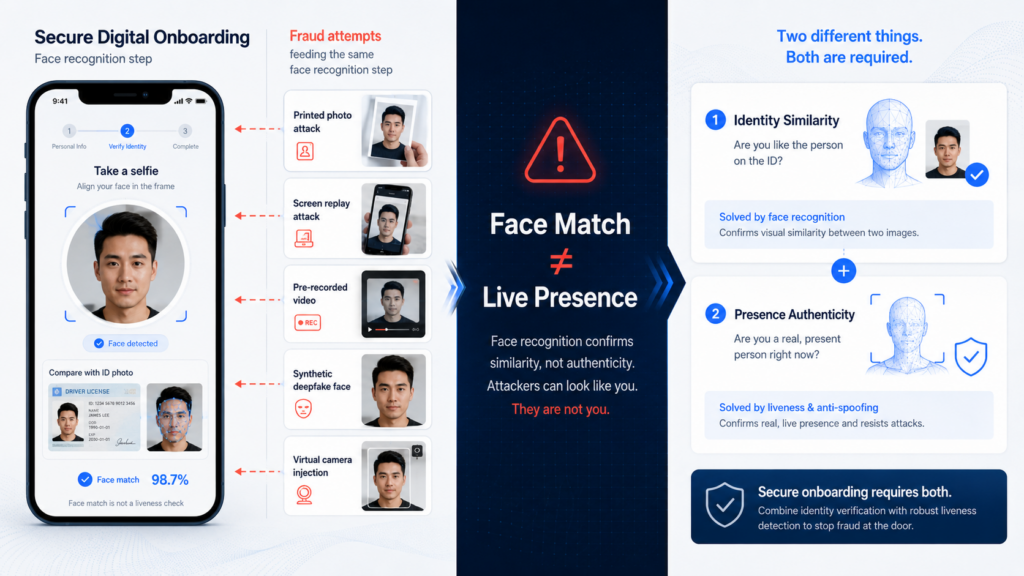
A face match can confirm similarity, but it does not automatically prove that the user is physically present during the session. If an attacker has access to a victim’s face image or video, a weak onboarding system may still receive an input that visually resembles the genuine user.
Common attack methods include:
- Printed photo attacks
- Screen replay attacks using another phone or monitor
- Pre-recorded video replay
- 2D or 3D mask attacks
- Face-swapping or deepfake video
- Camera injection using virtual camera tools or manipulated video streams
The core problem is simple: a face recognition model may see a face that matches the identity, but the onboarding platform still needs to know whether that face is live, current, and captured from a legitimate session.
Liveness detection helps close that gap.
What Liveness Detection Adds to Digital Onboarding
Liveness detection is designed to verify whether the biometric sample comes from a real human being present at the time of capture. Instead of only analyzing identity similarity, it evaluates signs of physical presence, natural facial behavior, capture integrity, and spoofing risk.
In a practical onboarding flow, liveness detection can help answer questions such as:
Is this a real face instead of a printed image?
Is the face being captured from a live camera rather than a replayed screen?
Does the face show natural motion, depth, texture, and lighting consistency?
Is the session showing signs of manipulation or synthetic generation?
Is additional verification required before the user can proceed?
This changes the security model.
Without liveness detection, face recognition may operate as a one-dimensional comparison. With liveness detection, the platform can evaluate both identity match and presence authenticity.
For high-risk industries such as financial services, this distinction matters. A platform does not only need to know who the user appears to be. It needs to know whether the user is genuinely participating in the onboarding process.
Active vs. Passive Liveness Detection
Liveness detection is usually implemented through active, passive, or hybrid approaches.
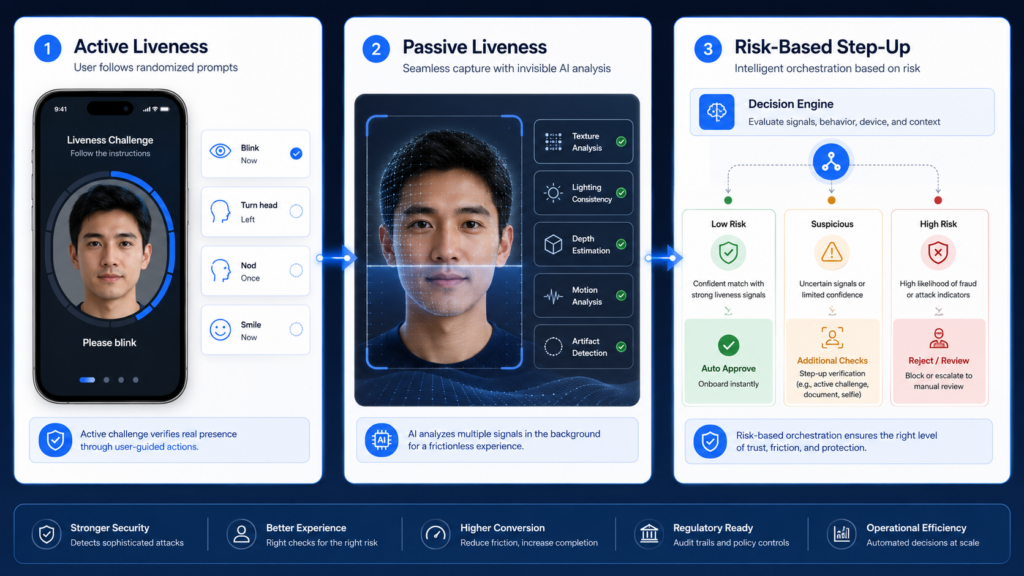
Active liveness detection asks users to complete a specific action, such as blinking, turning their head, opening their mouth, nodding, or following on-screen instructions. The benefit is that randomized user actions can make replay attacks harder. If an attacker only has a static image or pre-recorded video, it becomes more difficult to satisfy real-time prompts.
However, active checks may introduce friction. Users may be in low-light environments, using low-end devices, or completing onboarding in public places where speaking or exaggerated movement feels inconvenient.
Passive liveness detection works in the background. It analyzes the captured image or video for signs of real human presence without asking the user to perform obvious actions. This can create a smoother user experience and reduce onboarding drop-off, especially for mobile-first platforms.
Passive methods may analyze signals such as face texture, lighting reflection, depth cues, motion consistency, image artifacts, and abnormal patterns associated with spoofing media. In higher-risk scenarios, passive checks can also be combined with active prompts or additional risk controls.
For 2026 onboarding strategies, the best approach is usually not “active or passive.” It is risk-based orchestration.
Low-risk users can pass through a low-friction passive flow. Suspicious sessions can trigger step-up verification. High-risk cases can require stronger interaction, additional document checks, manual review, or device-level risk assessment.
How Liveness Detection Improves Face Recognition Security
1. It reduces presentation attack risk
Presentation attacks occur when fraudsters present a fake biometric sample to the capture device. This may include printed photos, screen replays, masks, or manipulated media.
Liveness detection helps identify whether the submitted face sample is likely to come from a real person rather than an artificial presentation. This reduces the chance that an attacker can use stolen images or videos to pass a selfie verification step.
For digital onboarding, this is one of the most direct security benefits. Many fraud attempts start with simple attack materials because they are cheap and scalable. Strong liveness detection raises the cost of attack.
2. It strengthens selfie-to-ID verification
A typical digital onboarding flow compares the selfie captured during onboarding with the portrait extracted from an ID document. This is useful for confirming that the applicant looks like the document holder.
But without liveness detection, the selfie itself may be untrusted.
A stronger workflow first checks whether the submitted selfie or selfie video is live, then performs face comparison against the ID portrait. This makes the face match result more meaningful because the system is comparing the ID holder’s document portrait against a live capture rather than an unknown or potentially spoofed source.
In other words, liveness detection improves the quality of the biometric evidence used by face recognition.
3. It helps defend against replay and screen attacks
Replay attacks are common in remote onboarding. A fraudster may display a victim’s face video on another device and present it to the camera. In weaker systems, this can appear like a normal user session.
Liveness detection can analyze visual cues that indicate the face is being shown on a screen rather than captured from a live person. These may include moiré patterns, abnormal reflections, edge artifacts, flat depth, inconsistent motion, or unnatural lighting behavior.
As attackers improve replay quality, onboarding systems need to evaluate more than surface-level image clarity. The goal is not only to determine whether the face is visible, but whether the capture conditions are credible.
4. It adds friction only when risk requires it
Security teams often face a trade-off between fraud prevention and conversion rate. Too much friction can increase user abandonment. Too little friction can expose the platform to fraud loss, compliance risk, and account abuse.
Liveness detection helps balance this trade-off by supporting adaptive verification.
A platform can allow most legitimate users to complete onboarding with a smooth passive liveness flow. At the same time, it can apply stronger controls when risk signals appear, such as:
- Poor capture quality
- Suspicious device environment
- Repeated onboarding attempts
- Abnormal face movement
- Potential replay indicators
- Mismatch between document, face, and session signals
- High-risk geography, transaction pattern, or account behavior
This gives onboarding teams a more flexible security architecture. Instead of applying the same friction to every user, they can reserve stronger checks for sessions that need them.
5. It supports compliance and audit readiness
Digital identity verification is increasingly tied to regulatory expectations around fraud prevention, customer due diligence, and remote identity proofing. While requirements vary by market, many regulated businesses need to demonstrate that their onboarding process includes reasonable controls against impersonation and synthetic identity risk.
Liveness detection can support this requirement by creating stronger evidence that the applicant was present during verification. When combined with document verification, face comparison, session logs, risk scoring, and audit records, it contributes to a more defensible identity verification process.
For banks, fintech platforms, payment providers, and other regulated businesses, this is not just a technical upgrade. It is part of a broader risk governance framework.
Building a Secure Digital Onboarding Flow in 2026
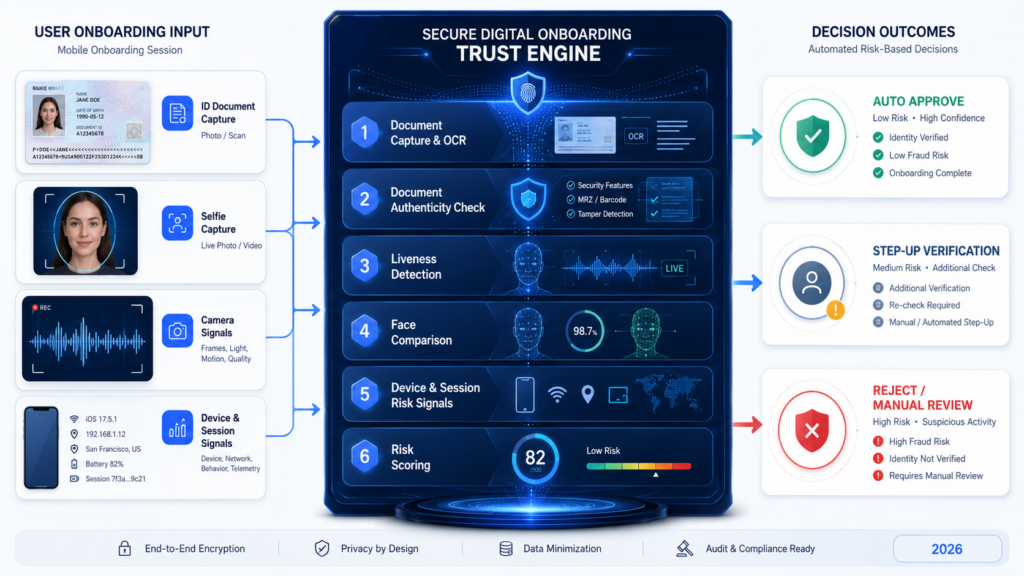
A modern face verification workflow should not treat liveness detection as an isolated feature. It should be embedded into the full onboarding decision engine.
A practical architecture may include:
Document capture and OCR
The system extracts user information from an ID document and checks document quality.
Document authenticity checks
The platform analyzes whether the document appears genuine, complete, and consistent.
Face capture
The user takes a selfie or selfie video during onboarding.
Liveness detection
The system evaluates whether the captured face comes from a real, present person.
Face comparison
The live face is compared with the portrait extracted from the ID document.
Risk scoring
The platform combines biometric, document, device, behavior, and session signals.
Decision orchestration
Low-risk users are approved automatically, suspicious cases are stepped up, and high-risk attempts are rejected or sent to manual review.
This layered approach is stronger than relying on a single pass/fail check. Fraudsters rarely attack only one layer. They look for the weakest point in the onboarding chain. A multi-signal system makes that chain harder to break.
Key Considerations When Choosing Liveness Detection
When evaluating liveness detection for face recognition security, businesses should consider both security and operational factors.
Detection coverage
The solution should address common spoofing methods, including photo attacks, screen replays, masks, and increasingly synthetic media risks.
User experience
The process should minimize unnecessary friction while preserving strong fraud controls.
Mobile performance
Digital onboarding often happens on mobile devices with different camera quality, lighting conditions, and network environments.
Integration flexibility
APIs and SDKs should fit into existing onboarding flows without requiring a full system rebuild.
Risk-based configuration
The platform should support different thresholds, step-up flows, and business rules based on the risk level of each session.
Scalability
The system should support high-volume onboarding without creating latency bottlenecks.
Auditability
Verification results, timestamps, and risk signals should be available for review, compliance, and fraud investigation.
For enterprise teams, the right question is not only whether liveness detection exists. The real question is whether it can operate reliably across real-world users, devices, fraud patterns, and regulatory expectations.
The Role of Face++ in Secure Digital Onboarding
Face++ provides face recognition and liveness detection capabilities designed for identity verification, KYC, platform security, and trusted digital interactions. In digital onboarding scenarios, Face++ can help businesses verify whether a user’s face matches the submitted identity document while also reducing spoofing risks through liveness detection.
For platforms facing rising identity fraud, this combination is important. Face recognition helps confirm identity similarity. Liveness detection helps confirm real-time human presence. Together, they create a stronger foundation for secure, scalable onboarding.
As deepfakes, replay attacks, and injection-based fraud become more accessible, businesses need identity verification systems that can evolve beyond basic matching. Liveness detection is one of the most important layers in that evolution.
Conclusion
In 2026, digital onboarding security depends on more than recognizing a face.
A secure onboarding system must determine whether the face is real, live, and captured in a trustworthy session. Liveness detection improves face recognition security by reducing spoofing risk, strengthening selfie-to-ID verification, supporting adaptive risk controls, and improving audit readiness.
For fintech, banking, e-wallet, mobility, gaming, and other digital platforms, liveness detection is no longer an optional add-on. It is a core layer of modern identity verification.
Face recognition tells you whether the face matches.
Liveness detection helps prove that the person is actually there.
FAQ
What is liveness detection in face recognition?
Liveness detection is a security technique used to determine whether a face presented during verification belongs to a real, live person rather than a photo, video, mask, or manipulated source.
Why is liveness detection important for digital onboarding?
It helps prevent attackers from using stolen face images, replayed videos, or synthetic media to bypass selfie verification and open fraudulent accounts.
What is the difference between face recognition and liveness detection?
Face recognition checks whether two faces match. Liveness detection checks whether the captured face is from a real, present person. Both are needed for stronger identity verification.
Should businesses use active or passive liveness detection?
The best choice depends on risk level, user experience requirements, and fraud exposure. Many platforms use passive liveness for low-friction onboarding and trigger active or step-up verification for suspicious sessions.
Can liveness detection stop deepfake attacks?
Liveness detection can reduce deepfake and spoofing risks, especially when combined with face comparison, document verification, device risk analysis, and session integrity checks. It should be part of a layered identity verification strategy rather than the only defense.