Multi-account fraud has become one of the most persistent risks across digital platforms. In fintech, gaming, e-commerce, mobility, social media, and online marketplaces, fraud actors rarely rely on a single account anymore. Instead, they create and operate networks of accounts to abuse incentives, bypass risk controls, manipulate platform activity, and hide suspicious behavior behind seemingly legitimate user profiles.
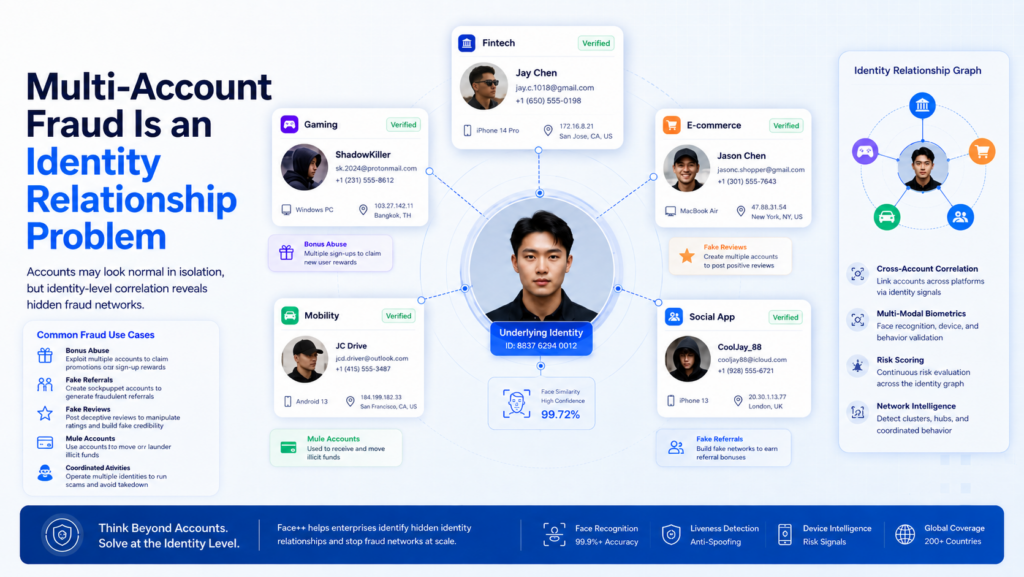
The challenge is that each account may look normal when reviewed in isolation. The registration data may be valid. The device fingerprint may appear clean. The transaction amount may stay below the risk threshold. The profile photo may look unique. However, when these accounts are connected at the identity level, a very different pattern begins to appear.
This is where Face Search (1:N) becomes valuable. Instead of only verifying whether one face matches one submitted identity document, Face Search allows platforms to compare one facial image against a large-scale face database and identify whether the same person, or a highly similar identity, already exists in the system. For fraud prevention teams, this shifts identity verification from a single-session decision into a broader identity intelligence capability.
Multi-Account Fraud Is an Identity Relationship Problem
Traditional fraud detection systems are often built around account-level signals. They evaluate whether a login, transaction, registration, or device session looks suspicious based on predefined rules and risk thresholds. This approach works well for many basic fraud scenarios, but it becomes less effective when attackers deliberately distribute their behavior across many accounts.
A fraud group may use multiple phone numbers, different email addresses, rotating IP addresses, emulators, proxy networks, and synthetic profile information. Each account is designed to appear independent. If the platform only evaluates these accounts one by one, the underlying fraud network remains hidden.
The real risk does not always exist inside one account. It often exists between accounts.
For example, a platform may see hundreds of new user registrations over several weeks. Each account passes basic checks and shows low-risk behavior at the beginning. Later, these accounts may be used for referral abuse, fake transactions, promotional arbitrage, chargeback schemes, account resale, or coordinated scams. By the time rule-based systems detect abnormal activity, the fraud network may already have scaled.
Face Search addresses this problem by introducing identity-level correlation. It helps platforms answer a more strategic question: has this person appeared before, and how many accounts may be connected to the same underlying identity?
Why Device and Behavior Signals Are Not Enough
Device fingerprints, IP addresses, location patterns, and behavioral analytics are still important parts of a modern fraud stack. However, they are increasingly easy to manipulate.
Fraud operators can change devices, reset environments, use virtual machines, rotate proxies, and simulate human-like behavior. In mobile-first markets, shared devices and unstable networks can also create noise, making device-level rules harder to interpret with confidence. A strict rule may block legitimate users, while a loose rule may allow fraud clusters to pass.
Behavioral signals also have limitations. Many multi-account fraud networks are designed to stay below detection thresholds. Instead of triggering obvious abnormal behavior, accounts may operate slowly, remain dormant, or perform only small actions until they are activated together.
This makes identity correlation especially important. While infrastructure signals can be rotated, the human identity behind multiple accounts is much harder to replace at scale. Face Search does not replace device or behavior analysis, but it provides a stronger anchor for detecting hidden relationships across accounts.
How Face Search (1:N) Works in Fraud Detection
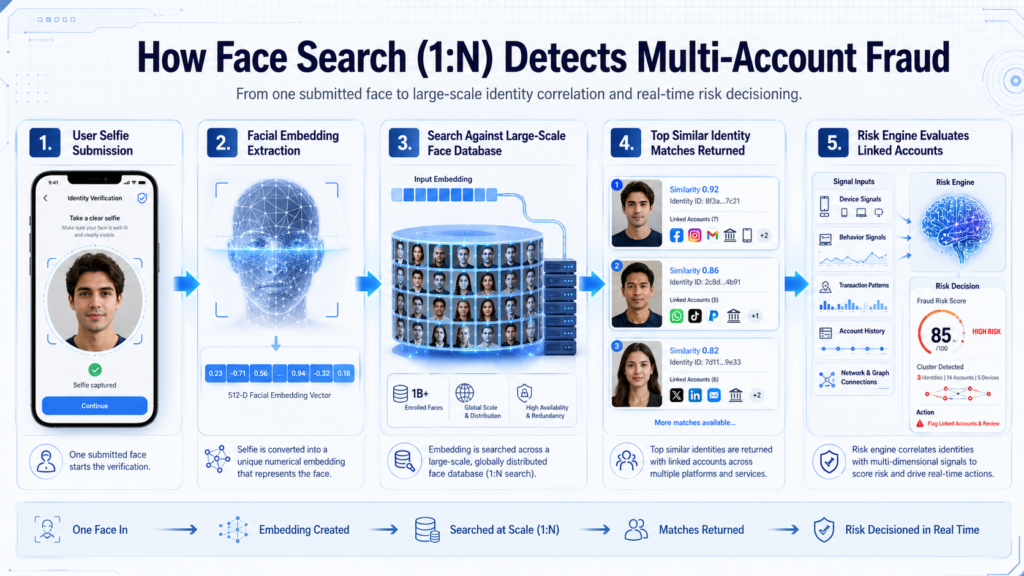
Face Search (1:N) compares one face against many enrolled faces in a database. The process usually begins when a user submits a selfie during onboarding, login, re-verification, or a high-risk transaction. The system extracts facial features from the image and converts them into a mathematical representation, often referred to as a facial embedding.
This embedding is then searched against an existing face database to identify possible matches. Instead of returning a simple yes-or-no result, a Face Search system can return the most similar identities, along with confidence scores and related account information. This allows the platform to evaluate whether the same person may have registered before under different credentials.
In practical fraud scenarios, this capability can help identify repeated onboarding attempts, account farming networks, mule accounts, duplicate user identities, and coordinated abuse rings. It also helps risk teams distinguish between isolated duplicate cases and systematic fraud operations.
The technical challenge is scale. A platform may need to search across millions of enrolled faces while keeping latency low enough for real-time onboarding or risk decisions. Therefore, Face Search is not just a facial recognition model. At production level, it becomes a high-performance retrieval system that requires optimized indexing, fast similarity search, stable feature extraction, and scalable infrastructure.
From Face Matching to Identity Graphs
The most important value of Face Search is not only finding a similar face. Its larger value is helping platforms build an identity graph.
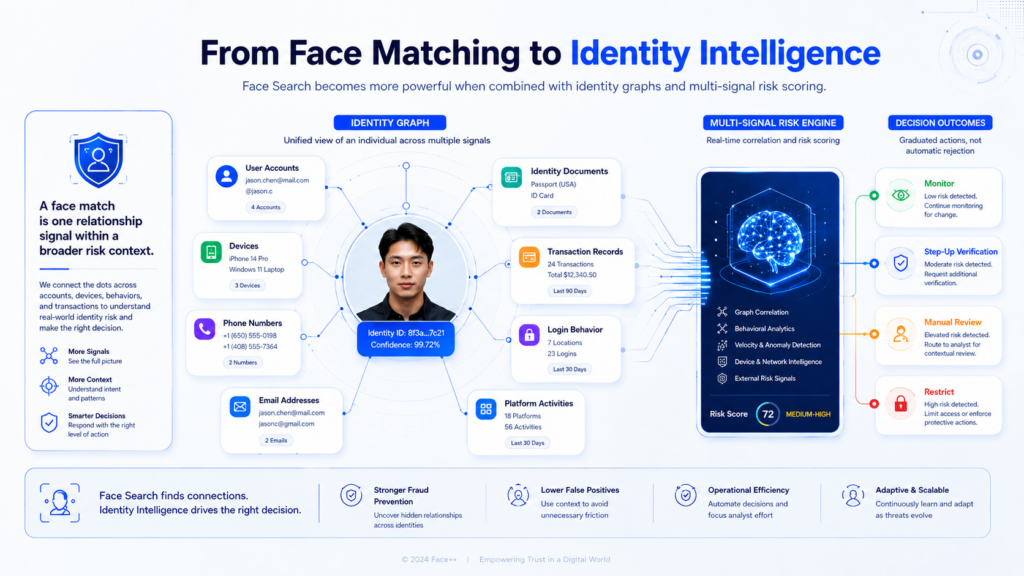
An identity graph connects accounts, faces, devices, documents, phone numbers, transactions, and behavioral patterns into a broader relationship network. When Face Search finds that one face is connected to multiple accounts, the platform can combine this information with other signals to understand whether the pattern is normal, suspicious, or clearly fraudulent.
For example, two accounts linked to the same face may not always indicate fraud. A user may have created a duplicate account by mistake. A family member may use a shared device. A previous registration may have failed and been retried. Context matters.
However, if the same facial identity appears across dozens of accounts, all created within a short time period, using different phone numbers and similar transaction patterns, the risk profile changes significantly. The issue is no longer a single duplicate account. It becomes a coordinated identity abuse pattern.
This is why Face Search works best when integrated into a multi-signal risk engine. The face match result should not operate as an isolated decision. It should become one input into a broader risk model that considers account history, device data, document consistency, behavior, transaction velocity, and platform-specific business rules.
Key Fraud Scenarios Across Digital Platforms
In fintech and digital banking, Face Search can help detect users who attempt to open multiple accounts to bypass onboarding limits, obtain repeated promotional rewards, or support money laundering networks. When connected with KYC workflows, it allows financial institutions to identify whether one person is repeatedly appearing under different identity profiles.
In gaming and entertainment platforms, multi-account abuse often appears in the form of bonus exploitation, ranking manipulation, virtual asset farming, or account resale. Face Search can help identify whether multiple accounts are controlled by the same individual, especially when fraud actors attempt to separate accounts through different emails, devices, or login environments.
In marketplaces and e-commerce ecosystems, multi-account fraud may involve fake sellers, fake buyers, review manipulation, refund abuse, or promotional arbitrage. Face Search gives platforms another layer of identity correlation beyond payment, address, or device-level signals.
In mobility and gig economy platforms, duplicate driver or worker accounts can create safety, compliance, and operational risks. A person previously removed for policy violations may attempt to re-enter the platform using new credentials. Face Search can help detect these re-registration attempts more effectively than document checks alone.
Reducing False Positives with Contextual Decisioning
A common concern in biometric search systems is false positives. This is why Face Search should not be designed as a standalone blocking mechanism. A similarity result should trigger contextual evaluation rather than automatic rejection in every case.
The platform should define different response strategies based on risk severity. A low-confidence match may only require additional monitoring. A medium-risk match may trigger step-up verification. A high-confidence match connected to multiple suspicious accounts may require manual review or automated restriction.
This layered decisioning approach helps balance fraud prevention and user experience. It allows platforms to act aggressively against organized abuse while avoiding unnecessary friction for legitimate users.
The best implementation is not “match equals reject.” A more mature approach is “match equals relationship signal,” and the final decision depends on the broader risk context.
Infrastructure Requirements for Large-Scale Face Search
For Face Search to support real-time fraud detection, infrastructure design is critical. The system must handle large databases, high concurrency, and fast response requirements without compromising accuracy.
As the face database grows, search performance becomes increasingly important. Platforms need efficient vector indexing and approximate nearest neighbor search to retrieve similar faces quickly. They also need strong data governance to manage biometric storage, access permissions, audit logs, encryption, and retention policies.
Latency is another core consideration. In onboarding or transaction scenarios, fraud detection cannot introduce excessive delays. A Face Search system must be fast enough to support real-time decisions while remaining accurate enough to detect subtle identity relationships.
Scalability also matters. Fraud patterns often spike during campaigns, holidays, promotional events, or regional expansion. The system must be able to handle sudden traffic increases without degrading the quality of risk decisions.
How Face++ Supports Face Search (1:N)
Face++ Face Searching (1:N) is designed for large-scale facial identity search scenarios where platforms need to compare one face against an existing face set. For digital platforms facing multi-account fraud, this capability can support duplicate identity detection, account relationship discovery, and fraud network analysis.
The value of Face Search is not limited to onboarding. It can also be applied during account recovery, high-risk login, withdrawal review, merchant verification, driver onboarding, content platform moderation, and other scenarios where identity consistency matters.
By integrating Face Search with broader platform risk controls, companies can move from reactive fraud response to proactive identity risk detection. Instead of waiting for suspicious behavior to accumulate, the platform can identify hidden identity links earlier in the user lifecycle.
Official product page: https://www.faceplusplus.com/face-searching/
The Strategic Shift: From Account Security to Identity Intelligence
Multi-account fraud will continue to evolve as attackers gain access to better automation tools, synthetic media, and infrastructure rotation capabilities. As these techniques become more accessible, platforms need stronger ways to identify relationships that are not visible through account-level data alone.
Face Search (1:N) provides a foundation for this shift. It helps platforms move beyond isolated verification events and build a more connected view of identity risk. When combined with device intelligence, behavioral analysis, document verification, and transaction monitoring, it becomes a powerful layer in modern fraud prevention architecture.
The goal is not only to know whether a user can pass verification. The goal is to understand whether that user is part of a larger pattern.
For digital platforms operating at scale, this distinction is critical. Account-level checks can detect suspicious events. Identity-level intelligence can reveal fraud networks.
FAQ
What is Face Search (1:N)?
Face Search (1:N) compares one submitted face against a database of many enrolled faces. It is commonly used to identify whether the same person already exists in a system under another account or identity profile.
How does Face Search help detect multi-account fraud?
It helps platforms identify hidden identity relationships across accounts. Even when users register with different phone numbers, emails, devices, or documents, Face Search can detect whether the same facial identity has appeared before.
Is Face Search the same as face verification?
No. Face verification usually refers to 1:1 matching, where one face is compared with one reference image. Face Search is 1:N matching, where one face is searched against many existing faces in a database.
Should platforms automatically block users when a match is found?
Not always. A match should usually be treated as a risk signal rather than an automatic rejection. The final decision should consider confidence score, account history, device data, behavior, transaction patterns, and business rules.
Which platforms can benefit from Face Search?
Face Search is useful for fintech platforms, digital banks, e-wallets, gaming platforms, marketplaces, mobility platforms, social platforms, and any business where duplicate accounts or coordinated identity abuse can create financial, compliance, or trust risks.
Meta Description
Learn how Face Search (1:N) helps digital platforms detect multi-account fraud by identifying hidden identity relationships across users. This article explains how Face Search supports fraud prevention, duplicate account detection, identity graph analysis, and large-scale risk control across fintech, gaming, marketplaces, mobility, and other digital ecosystems.